
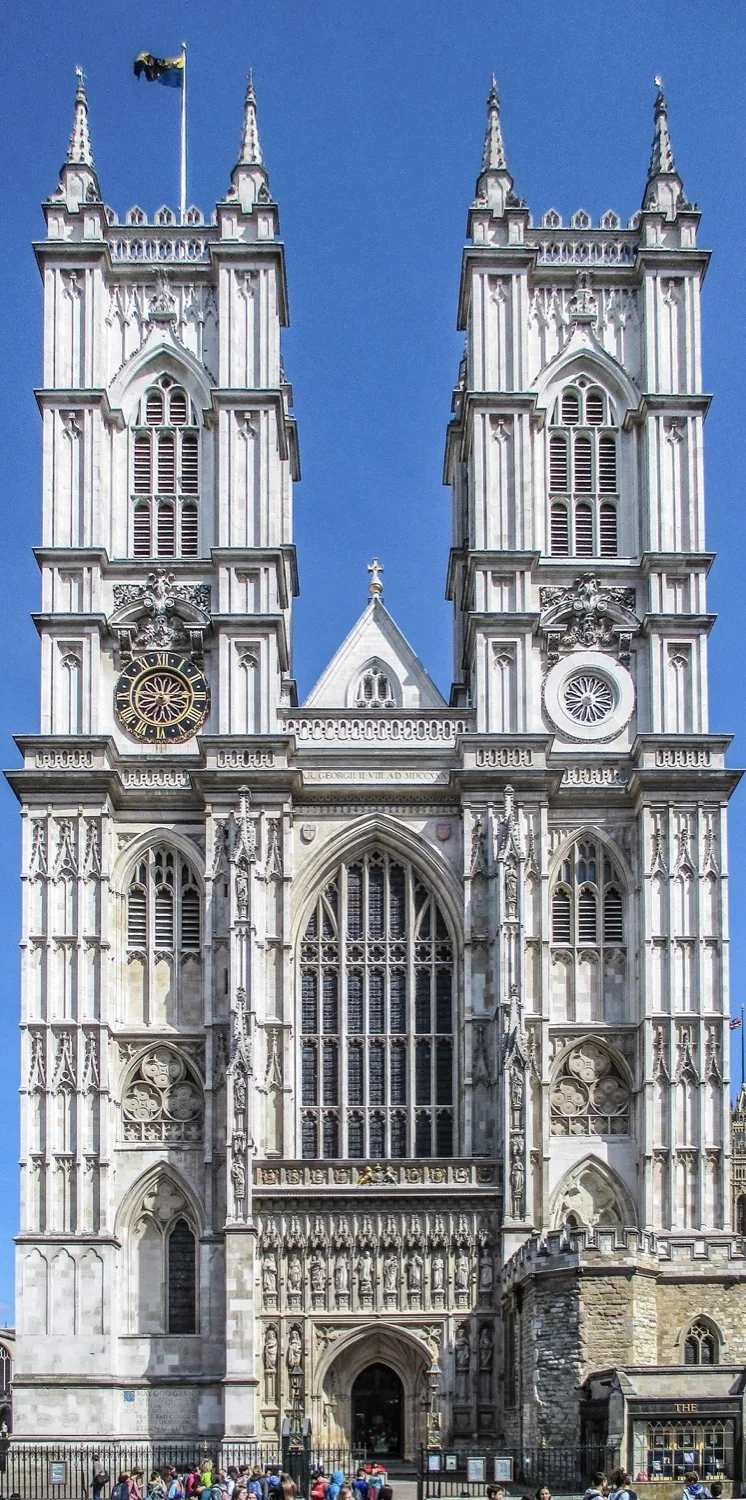
In the heart of London, facing Parliament, Westminster Abbey has for nearly a thousand years been the church of England's kings: the place where they are crowned, married and buried. In the Renaissance it receives its ultimate jewel, the Henry VII Chapel — the last great masterpiece of English Gothic, and yet the birthplace of Renaissance sculpture on the island.
The church of kings
Founded by Benedictine monks and rebuilt in the Gothic style in the thirteenth century by Henry III, Westminster is, from the Middle Ages, the sanctuary of the English monarchy. Every sovereign has been crowned here since 1066, seated on the ancient King Edward's Chair. Around the choir gather the tombs of kings and queens, making the abbey the great necropolis of the nation. When the Tudor age opens, Westminster is already charged with this sacred prestige: to build here is to write one's name into the very stone of the kingdom.
This is what Henry VII, the first Tudor king, does. To house his tomb and assert the legitimacy of his new dynasty, he has raised, from 1503, a prodigious chapel at the eastern end of the abbey. The Henry VII Chapel — also called the Lady Chapel — unfurls a pendant fan vault of unheard-of virtuosity, a lace of stone hung in the air, ringed with statues of saints and banners of chivalry. It is the last dazzling flourish of Perpendicular Gothic, on the eve of the Renaissance.
Torrigiano, and the Renaissance that enters by way of a tomb
The paradox of Westminster is that the Renaissance enters here not through the architecture, which stays Gothic, but through the sculpture. For the tomb of Henry VII and his queen Elizabeth of York, a Florentine artist was brought over, Pietro Torrigiano — the same who, as a young man, is said to have broken Michelangelo's nose with a punch. Around 1512-1518 Torrigiano carved the gilt-bronze effigies of the king and queen, and the tomb of Lady Margaret Beaufort, the king's mother: these are the first fully Renaissance works ever made in England, of a wholly Italian naturalism and grace, set at the heart of a Gothic chapel. Later, Elizabeth I and her rival Mary Queen of Scots would also lie in the chapel, reconciled in death by the will of James I.
What to see
- The fan vault of the Henry VII Chapel, the summit of Perpendicular Gothic.
- The gilt-bronze effigies of Henry VII and Elizabeth of York, by Torrigiano.
- The tomb of Lady Margaret Beaufort, also by Torrigiano.
- The tombs of Elizabeth I and Mary Queen of Scots, rival queens reunited.
- Poets' Corner and the King Edward's Chair of the coronation.
Did you know?
The sculptor of the royal tomb, Pietro Torrigiano, had an iron reputation: in his Florentine youth, jealous of a fellow pupil's talent, he is said to have struck Michelangelo in the face and broken his nose — a disfigurement the great master carried all his life. So it was the man who had disfigured Michelangelo who brought Renaissance sculpture to England, at Westminster.
Practical information
Westminster Abbey stands in the heart of London, facing the Palace of Westminster (Parliament), in the City of Westminster. It is a working church (a Royal Peculiar) and a UNESCO World Heritage Site, open to visitors outside services. Opening hours, prices and access to certain chapels are liable to change, especially during royal ceremonies; it is best to check them against the official sources before visiting.
Quiz
- Which Florentine artist carved the royal tombs of the Henry VII Chapel?
- Pietro Torrigiano
- Benvenuto Cellini
- Donatello
- What kind of vault covers the Henry VII Chapel?
- A fan vault
- A dome
- A barrel vault
- What has traditionally taken place at Westminster Abbey since 1066?
- The coronation of sovereigns
- The sitting of Parliament
- The minting of coins