
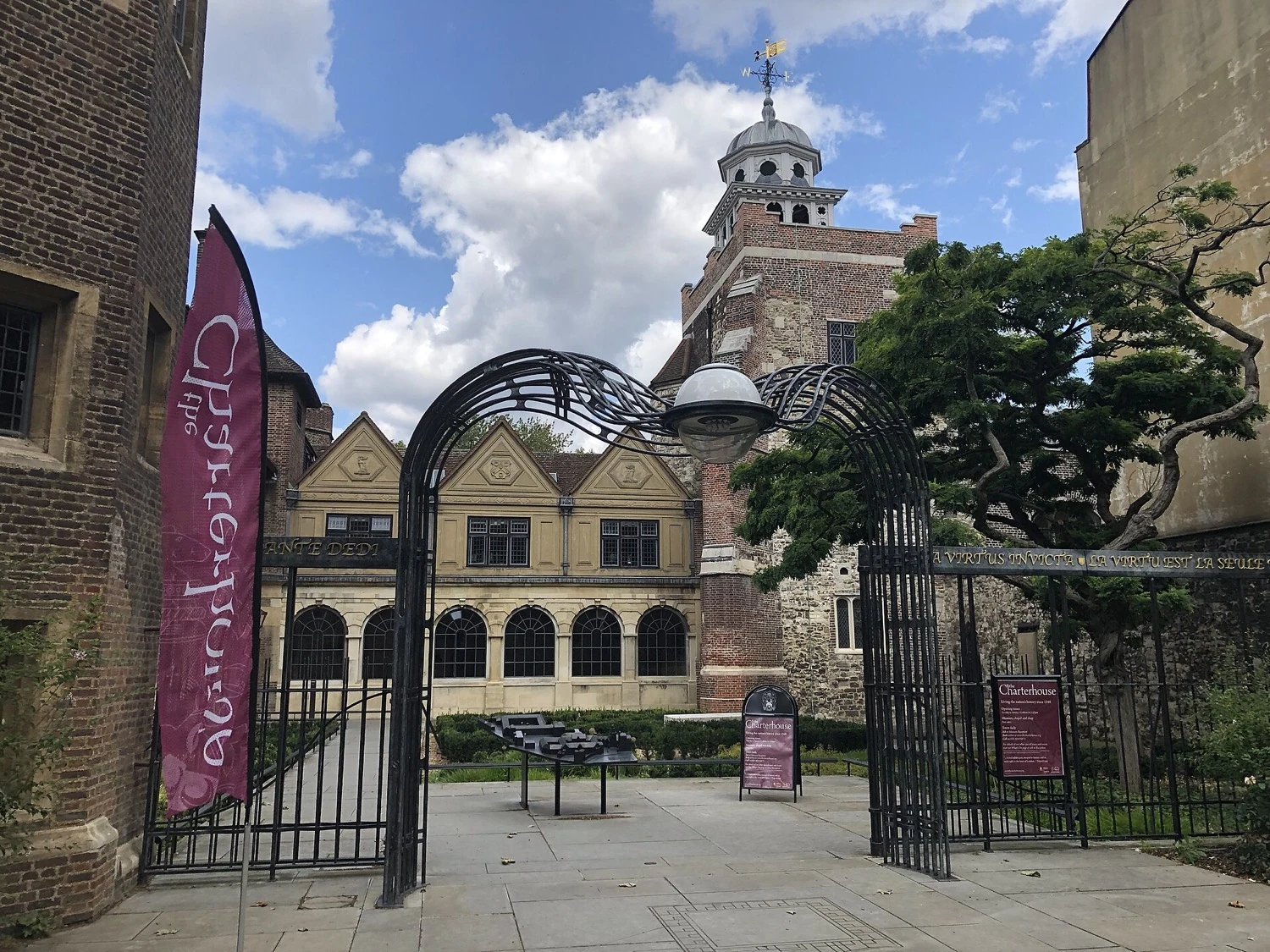
North of the City, the Charterhouse — the Carthusian house of London — offers in a single place the whole English Reformation in miniature: a convent of silent monks, it became the scene of a martyrdom, then a sumptuous courtier's house, before ending as an almshouse and a school.
A martyred convent
Founded in the fourteenth century, the London Charterhouse sheltered Carthusian monks, vowed to silence, solitude and prayer. In 1535, when Henry VIII demanded of all the oath acknowledging his supremacy over the Church, Prior John Houghton and his brothers refused. The repression was atrocious: the prior was hanged, disembowelled and quartered at Tyburn, and several monks died in prison, chained and starved. These Carthusians are among the first and most famous martyrs of the English Reformation. The convent was dissolved, its goods seized.
From ruin to courtier's house
Like so many religious houses, the Charterhouse then passed into the hands of courtiers. It was transformed, in the mid-sixteenth century, into a great Tudor house: galleries, a great hall, state apartments. The Duke of Norfolk lodged here, and Queen Elizabeth I stayed here before her coronation. The place thus embodies the great transfer of the English Renaissance: the wealth of the Church tipping towards the new aristocracy. In the early seventeenth century the rich Thomas Sutton made it a charitable foundation — an almshouse for old men and a school — that carried the name of Charterhouse on for centuries.
What to see
- The Great Hall and the Tudor galleries of the house.
- The remains of the cloister of the old Charterhouse.
- The memory of the Carthusian martyrs of 1535.
- The setting of Charterhouse Square, a preserved enclave north of the City.
Did you know?
The very severity of the Carthusian rule made the martyrdom the more striking: these monks already lived as dead to the world, in silence and privation. Their obstinate refusal to swear, even under torture, struck contemporaries — so much so that their story inspired, much later, tales and paintings. A convent vowed to silence became, by its death, one of the strongest voices against the Reformation.
Practical information
The Charterhouse lies at Charterhouse Square, north of the City of London (borough of Islington). It is today a foundation housing a small museum and homes for elders; certain parts may be visited, often on a guided tour. Hours and arrangements are liable to change; it is best to check them against the official sources before visiting.
Quiz
- What kind of monks occupied the Charterhouse?
- Carthusians
- Franciscans
- Jesuits
- What did the convent become after the dissolution of 1535?
- A Tudor courtier's house
- A fortress
- A theatre
- Why were the monks executed in 1535?
- They refused to acknowledge the king's supremacy
- They had stolen the royal treasure
- They had plotted with Spain