
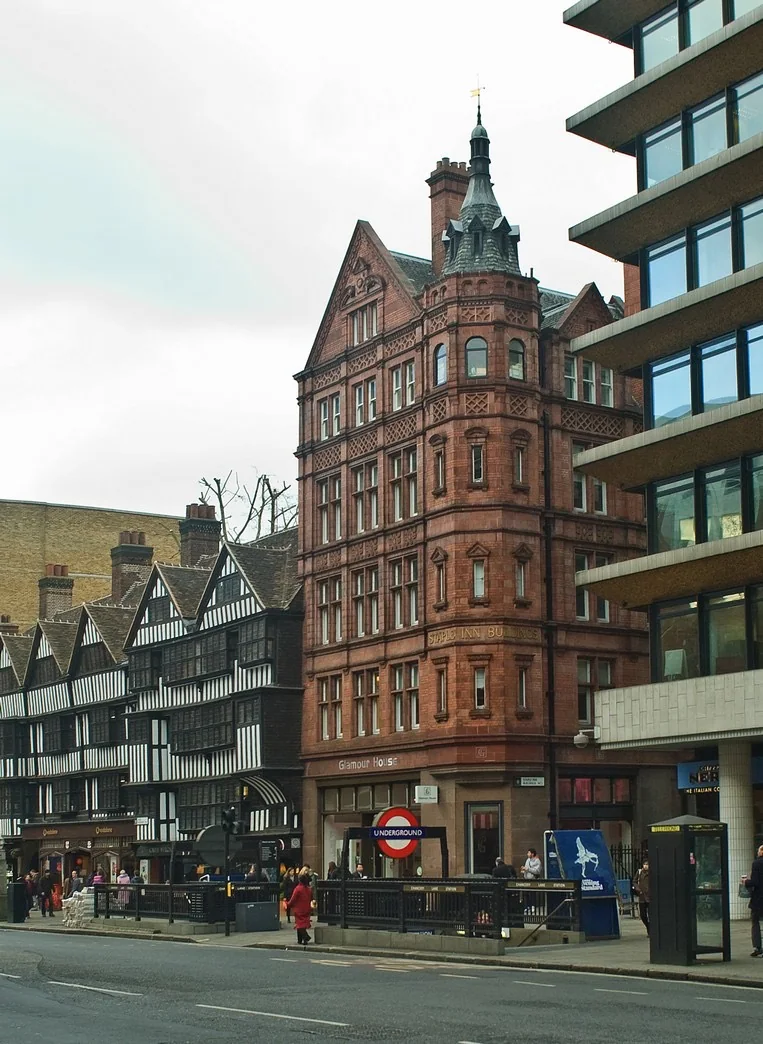
At Holborn, at the gates of the City, a long frontage of timber and plaster with pointed gables seems to have escaped from another age. Staple Inn, built in 1585, is the last great witness of the timber-framed architecture of Elizabethan London — the city that the Great Fire of 1666 would all but wipe away.
A surviving frontage
Before the Great Fire, medieval and Tudor London was a city of wood: timber-framed houses, jettied storeys leaning out over the street, crowded gables. Staple Inn, built in 1585, belongs to that world. Its frontage, several bays long, ranges its mullioned windows and its gables along Holborn High Street. Miraculously spared by the flames of 1666 (the fire stopped a little to the east), much restored since, it gives today the truest image of what the city's streets looked like in the time of Elizabeth I.
From the wool trade to the study of law
The name of Staple Inn recalls its first function: the staple was the official market where wool, the chief wealth of medieval England, was weighed and taxed. The place was later attached to the Inns of Chancery, annexes of the great schools of law, where clerks and students lodged. Behind the frontage lie a quiet courtyard and a small timber-roofed hall. Staple Inn thus joins the two great affairs of Renaissance London: trade and the law.
What to see
- The timber-framed frontage of 1585, the largest surviving in London.
- The pointed gables and mullioned windows on Holborn.
- The quiet inner courtyard, away from the street.
- The small timber-roofed hall.
Did you know?
Staple Inn owed its survival to an invisible boundary: the Great Fire of 1666, which devoured four-fifths of the City, stopped just short of Holborn. The timber frontage that should have blazed like the rest slipped through the disaster — and that is why Londoners today can still see, in the middle of the city, a street such as Elizabeth I would have known.
Practical information
Staple Inn lies on Holborn, at the western edge of the City of London. The frontage is visible from the street at all times; the inner courtyard and the built parts, in private use, may be visited only in a limited way. It is best to check any access arrangements against the official sources.
Quiz
- From when does the timber-framed frontage of Staple Inn date?
- 1585
- 1666
- 1485
- To which trade does the name 'Staple' refer?
- The wool trade
- The wine trade
- The spice trade
- Why is this frontage exceptional in London?
- It survived the Great Fire of 1666
- It is the tallest in the city
- It is made of marble