
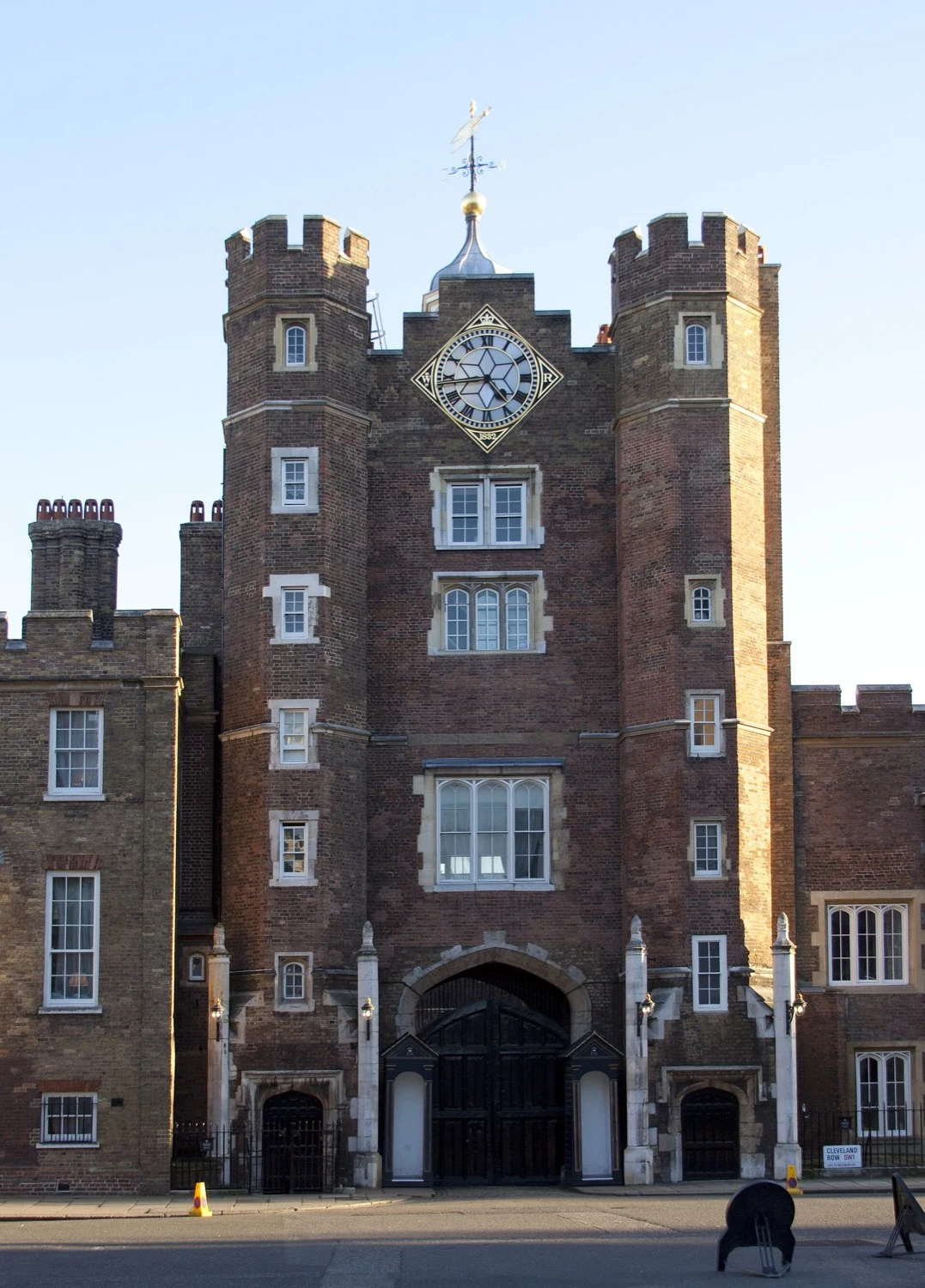
A stone's throw from the future Buckingham, St James's Palace still raises its crenellated red-brick gatehouse, the unmistakable mark of the Tudor style. Built by Henry VIII, it is the oldest royal palace in London still in use, and it passed, discreet but faithful, through the whole Tudor century.
From leper hospital to royal palace
The place bore the name of St James because a hospital for leprous women had stood there since the Middle Ages. After the dissolution of the religious houses, Henry VIII seized the ground and had a new brick palace built there between 1531 and 1536, around several courts. It was not a residence of great state like Whitehall or Hampton Court, but a more intimate house, set within a hunting park (today's St James's Park). Its red-brick gatehouse, with octagonal turrets, bearing the cipher of Henry VIII and Anne Boleyn, remains its most famous feature.
A quiet witness of the Tudor century
St James's did not know the noisy splendour of the great palaces, but it was present at all the dynasty's intimate moments. Queen Mary I died here in 1558, leaving the throne to her half-sister Elizabeth. The latter is said to have stayed here on the eve of facing the threat of the Spanish Armada in 1588. More modest and better preserved than its vanished neighbours, the palace became, after the burning of Whitehall at the end of the seventeenth century, the official residence of the sovereigns — so much so that ambassadors are still accredited today to the 'Court of St James's'. Of all the Tudor palaces of London, it is the most faithful survivor.
What to see
- The red-brick gatehouse with octagonal turrets, an emblem of the Tudor style.
- The cipher of Henry VIII and Anne Boleyn carved on the palace.
- The Chapel Royal, with a painted ceiling attributed to Holbein's circle.
- The setting of St James's Park, the old royal hunting ground.
Did you know?
It is because St James's became the official residence of the Crown that foreign diplomats are, to this day, formally accredited to the 'Court of St James's' — even though the sovereigns have long ceased to live there. A Tudor palace thus gave its name to British diplomacy as a whole.
Practical information
St James's Palace lies in the St James's district of Westminster, between the park of the same name and Pall Mall. It is a working royal palace: it is not freely open to visitors, but its façade and gatehouse are visible from the street, and the Chapel Royal opens for certain services. It is best to check the rare occasions of access against the official sources.
Quiz
- Which king had St James's Palace built?
- Henry VIII
- Charles I
- Henry VII
- On what was the palace built?
- A former leper hospital
- A former castle
- A theatre
- To which 'court' are ambassadors accredited?
- The Court of St James's
- The Court of Windsor
- The Court of Hampton