
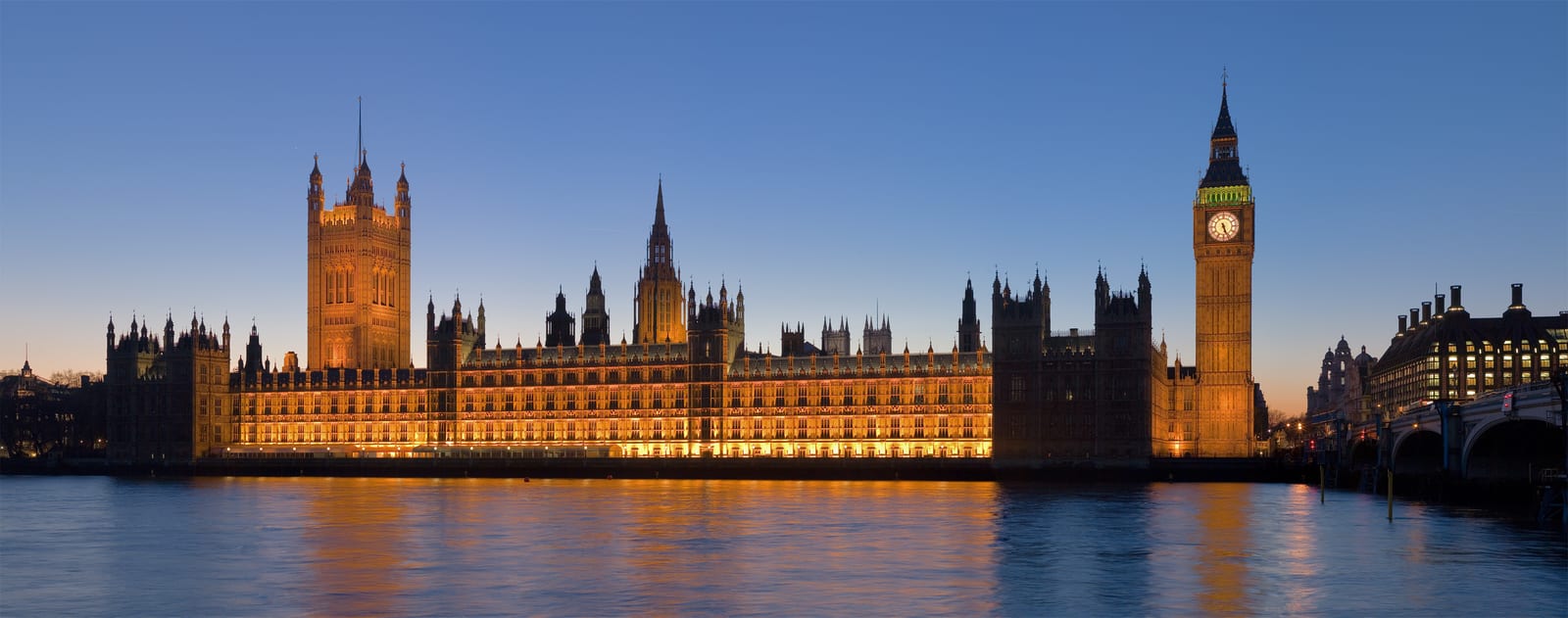
On the bank of the Thames, beside the abbey, the Palace of Westminster was for centuries the chief residence of England's kings. In the Renaissance a fire and a king's will turn it from its first purpose: from a lived-in palace it becomes forever the house of Parliament and the courts.
From the palace of kings to the house of the law
A royal residence since Edward the Confessor, Westminster is in the Middle Ages the administrative heart of the kingdom: here are the great halls of state, the Treasury, the courts of justice. Its jewel is Westminster Hall, a vast hall built under William II and then, at the end of the fourteenth century, crowned with an extraordinary hanging oak roof (hammer-beam), the largest of its kind in northern Europe. Here are held coronations, great feasts and resounding trials.
In 1512 a fire ravages the royal apartments. Henry VIII, who has just seized the nearby palace of Whitehall, chooses not to rebuild: he abandons Westminster as a residence and lets the institutions settle there for good. Parliament, which already sat there from time to time, makes it its permanent home; St Stephen's Chapel becomes the chamber of the Commons. And so, as the king moves out, Westminster turns into the seat of legislative and judicial power — a decisive shift of the English Renaissance, which sees the law take root where the prince had lodged.
The theatre of the great trials
Westminster Hall, spared by the flames, remains the great theatre of the kingdom's justice. It is beneath its oak roof that, across the sixteenth century, the most illustrious accused are tried: Thomas More, condemned in 1535 for refusing to acknowledge the royal supremacy, heard his sentence here. The place thus joins the majesty of medieval architecture to the gravity of the darkest hours of the Reformation: the same hall that crowned kings condemned their opponents.
What to see
- Westminster Hall, with its late-fourteenth-century hanging oak roof.
- The site of St Stephen's Chapel, which became the chamber of the Commons.
- The nearness of Westminster Abbey, inseparable from the palace.
- The setting of the Thames, the old royal approach to the palace.
Did you know?
Of the whole old medieval palace, only Westminster Hall has come down the centuries almost intact: it survived the fire of 1512, and then the great fire of 1834 that destroyed the rest of the palace (and gave birth to today's neo-Gothic Parliament). Its oak roof, more than six centuries old, is thus the oldest standing witness of English power.
Practical information
The Palace of Westminster stands in the heart of London, on the bank of the Thames, in the City of Westminster; it houses today the Parliament of the United Kingdom and is a UNESCO World Heritage Site. Westminster Hall and certain parts may be visited under varying arrangements (guided tours, public opening days); it is best to check these against the official sources before visiting.
Quiz
- Which medieval hall, with its oak roof, survives from the old palace?
- Westminster Hall
- The Hall of Mirrors
- The Throne Room
- What did the Palace of Westminster become after the fire of 1512?
- The seat of Parliament
- An abbey
- A fortress
- Which illustrious accused was condemned here in 1535?
- Thomas More
- Francis Bacon
- Walter Raleigh