
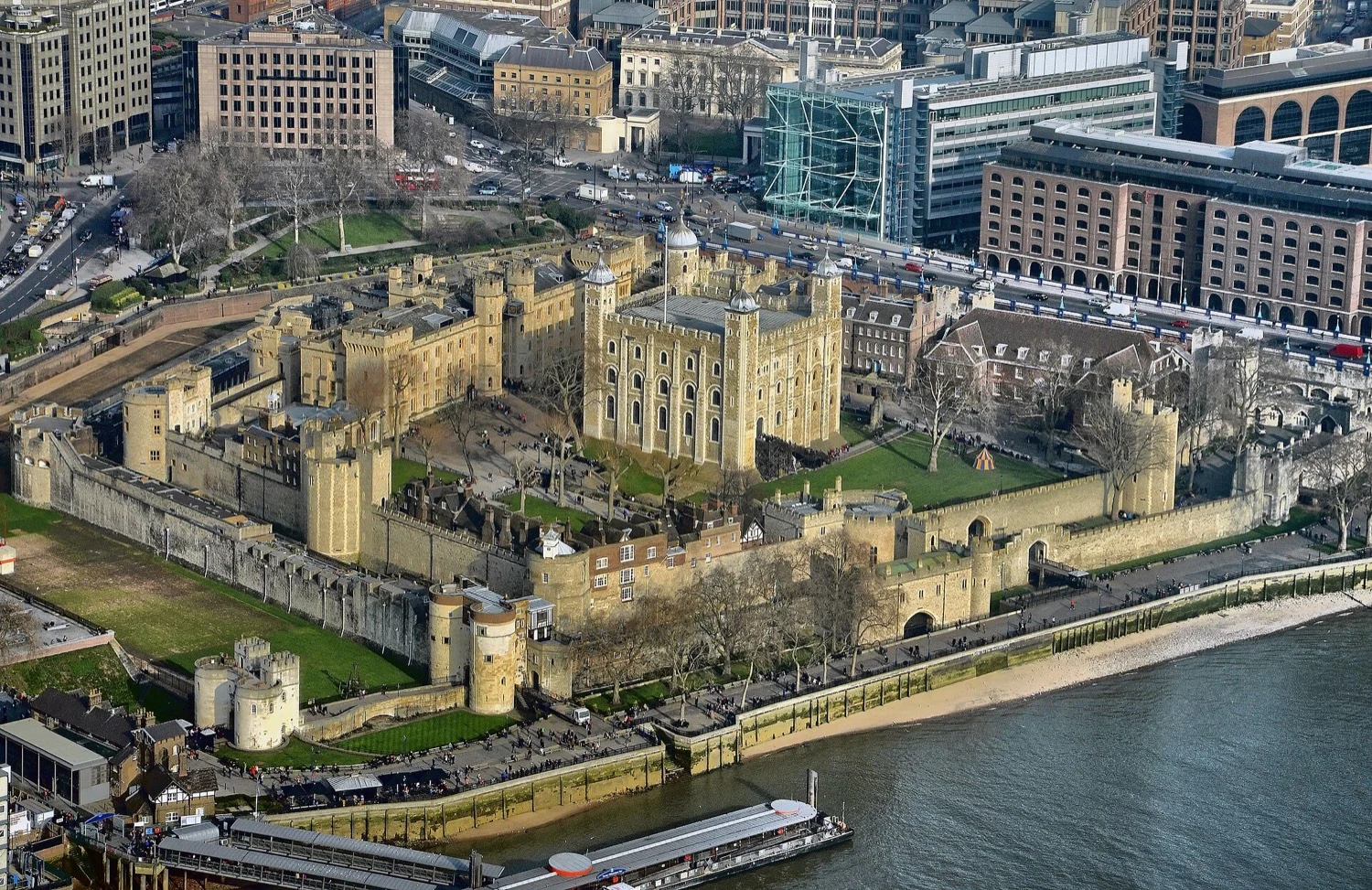
On the north bank of the Thames, the Tower of London has raised its walls and its great white keep for nine centuries. Fortress, royal palace, arsenal, menagerie and prison all at once, it is the oldest heart of English power — and, in the Renaissance, the place where the most tragic fates of the House of Tudor are played out.
From Norman fortress to the stage of Tudor power
Raised by William the Conqueror after 1066 to subdue and watch over London, the Tower is first a machine of war: the White Tower, a massive keep of Caen stone, dominates the city and the river. Throughout the Middle Ages kings lodge here before their coronations, and keep here their jewels, their records, their mint and their beasts. It is a city within the city, ringed by walls and moat, at once refuge and symbol of the Crown.
Under the Tudors the fortress changes its role without changing its walls. The kings gradually cease to live here, but the Tower becomes the great theatre of royal justice and of fear. It is here that Henry VIII imprisons, and then beheads, those who cross his will or fall from his favour: the Reformation and the dynastic struggles fill its cells and raise its scaffolds. The Renaissance Tower is no longer only a defence against the enemy without — it is the instrument of power against its own subjects.
The great downfalls of the House of Tudor
Two of Henry VIII's queens were beheaded here: Anne Boleyn, in 1536, mother of the future Elizabeth I, and Catherine Howard, in 1542. On the small lawn of Tower Green fell also Lady Jane Grey, the nine days' queen, and many more. The humanist chancellor Thomas More and Bishop John Fisher were imprisoned here before dying for their loyalty to Rome. The princess Elizabeth herself, suspected by her half-sister Mary I, was held here in 1554, entering, it is said, by Traitors' Gate, before one day reigning over England. The Crown Jewels, for their part, have been kept here for centuries: the Tower is at once the treasury and the tomb of the monarchy.
What to see
- The White Tower, the eleventh-century Norman keep at the heart of the fortress, and its Chapel of St John.
- Tower Green and the execution memorial, where Anne Boleyn and Catherine Howard died.
- The royal chapel of St Peter ad Vincula, where the executed lie buried.
- Traitors' Gate, through which prisoners arrived by the river.
- The Crown Jewels and the guard of the Yeomen Warders ('Beefeaters').
Did you know?
Legend holds that the fall of the crown is foretold by the ravens: it is said that if the ravens leave the Tower, the fortress — and the kingdom — will crumble. To this day at least six ravens are kept there by the Crown, a 'Ravenmaster' watching over them. The superstition arose long after the Renaissance, but it speaks of the funereal aura that clings to this place where so many heads fell.
Practical information
The Tower of London stands on the north bank of the Thames, beside Tower Bridge (borough of Tower Hamlets). It is today a monument in the care of Historic Royal Palaces and a UNESCO World Heritage Site. Opening hours, prices and closing days, as well as access to the Crown Jewels, are liable to change; it is best to check them against the official sources before visiting.
Quiz
- Which of Henry VIII's queens was beheaded at the Tower in 1536?
- Anne Boleyn
- Catherine of Aragon
- Jane Seymour
- Who built the White Tower at the heart of the fortress?
- William the Conqueror
- Henry VIII
- Elizabeth I
- What is still kept at the Tower of London today?
- The Crown Jewels
- The records of Parliament
- The Royal Library