
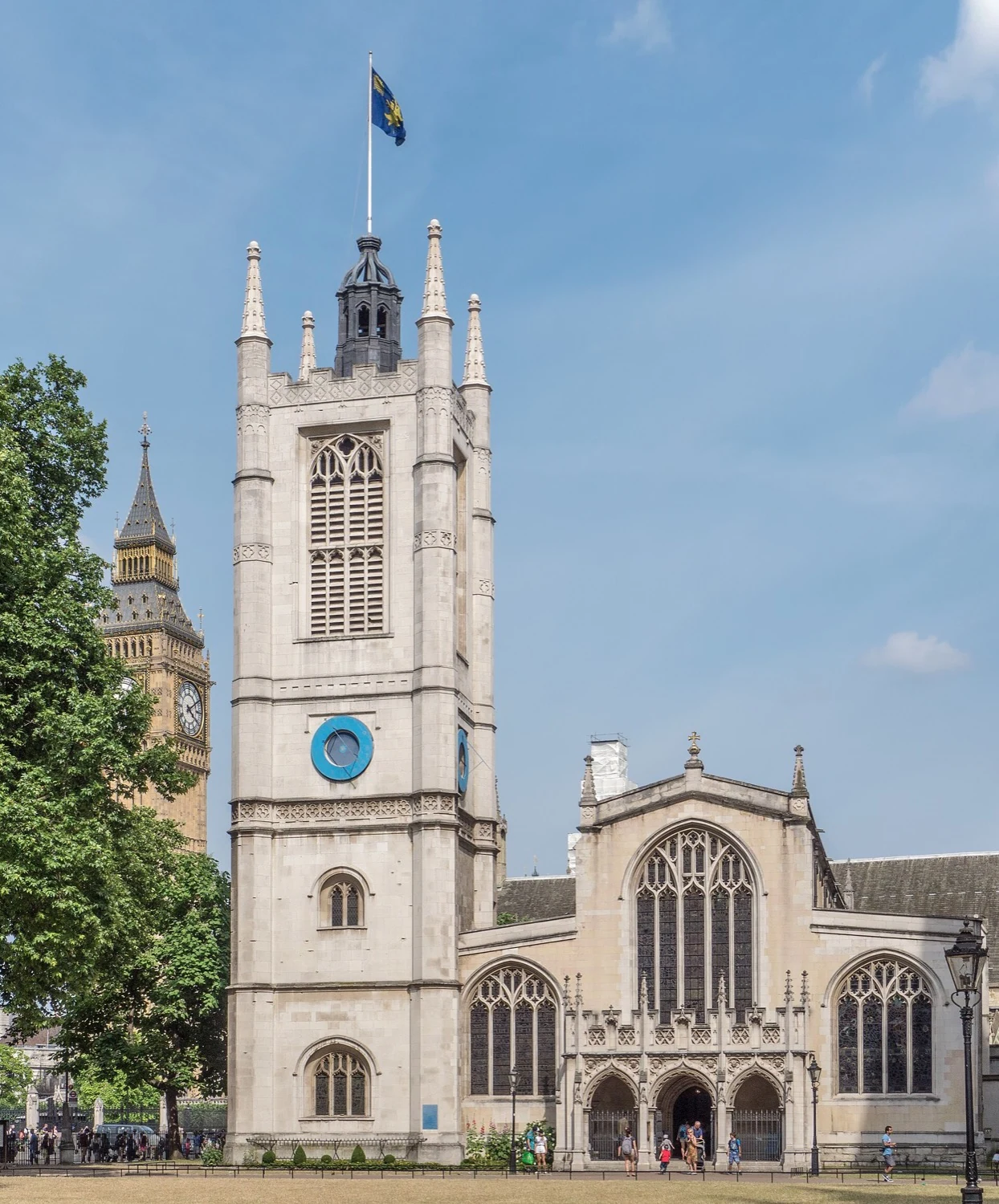
In the shadow of Westminster Abbey, on Parliament Square, St Margaret's has for centuries been the parish church of the House of Commons. Rebuilt under the first of the Tudors, it gathers within its walls some of the names that made the English Renaissance, from the printer Caxton to the navigator Raleigh.
Henry VII's church
The present building was rebuilt under Henry VII, from 1486 to 1523, in the late Perpendicular style: it is thus an early Tudor church, contemporary with the coming of the dynasty. Its treasure is the east window, in Flemish glass of 1509: a sumptuous work commemorating the betrothal of Catherine of Aragon and Henry VIII — a union that, a quarter-century later, torn apart by divorce, would bring about the break with Rome. The window is thus a coloured witness of the dynastic hope before the storm.
Caxton, Raleigh and the neighbourhood of power
Its nearness to Westminster made St Margaret's the last resting place of several great figures. The printer William Caxton — the first to print books in English — was buried here in 1491, close to the workshop he had set up at Westminster. Later, Sir Walter Raleigh, courtier, poet and explorer, beheaded in 1618 at nearby Old Palace Yard, was buried here: his head, it is said, was kept by his widow, but his body rests here. To see: the Flemish east window of 1509, the Tudor Perpendicular nave, the burial of Walter Raleigh and the memorial to Caxton.
Did you know?
The great window of St Margaret's was given to celebrate a happy marriage — that of Catherine of Aragon and the young Henry VIII, in 1509. The irony of history is that it celebrates precisely the union whose divorce, twenty-four years later, would separate England from Rome and launch the English Reformation.
Notes
St Margaret's Westminster lies on Parliament Square, beside Westminster Abbey; a working church, usually free to enter — enquire according to official ceremonies.
Quiz
- What does the Flemish window of 1509 commemorate?
- The betrothal of Catherine of Aragon and Henry VIII
- The defeat of the Armada
- Elizabeth's coronation
- Which printer was buried here in 1491?
- William Caxton
- Wynkyn de Worde
- John Stow
- Which explorer beheaded in 1618 rests here?
- Sir Walter Raleigh
- Francis Drake
- Martin Frobisher