
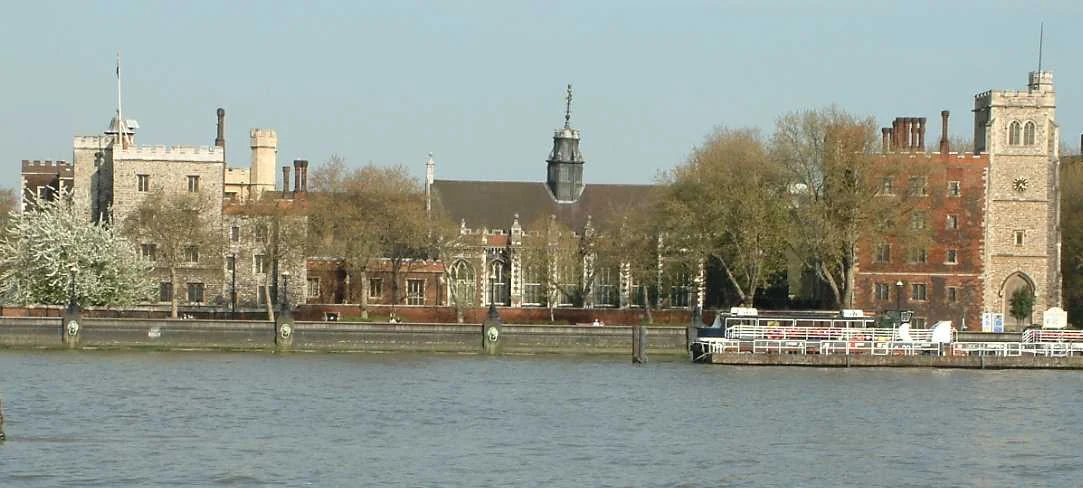
On the south bank of the Thames, just opposite the Palace of Westminster, Lambeth has for eight centuries been the London residence of the Archbishops of Canterbury, primates of the Church of England. In the Renaissance this palace of brick and stone was one of the places where the religious fate of the kingdom was decided.
The palace of the primates
The residence of the Archbishops of Canterbury since the thirteenth century, Lambeth faced, across the river, the royal power of Westminster: Church and Crown looked at each other from bank to bank. At the end of the fifteenth century Archbishop John Morton raised the fine red-brick gatehouse (Morton's Tower, c. 1490) that still guards the entrance — one of the first great brick works of London, announcing the Tudor style. Behind it stretched the great hall, the chapel, the library and the gardens.
A cradle of the Reformation
Under Henry VIII, Lambeth became a key place of the Reformation, for Archbishop Thomas Cranmer, who lived here, was one of its chief architects. It was largely from Lambeth that he led the break with Rome, pronounced the annulment of the king's marriage to Catherine of Aragon, and shaped the new English Church — for which he later wrote the Book of Common Prayer, a monument of the English language. The palace housed theological debates, trials and councils. Its library, founded in the early seventeenth century, holds priceless manuscripts. Lambeth thus remains the living witness of the moment when England gave itself its own Church.
What to see
- The late-fifteenth-century red-brick gatehouse (Morton's Tower).
- The chapel and the great hall of the palace.
- The Lambeth Palace Library and its manuscripts.
- The setting of the Thames, facing Westminster.
Did you know?
Archbishop Cranmer, who made Lambeth the laboratory of the Reformation under Henry VIII, paid the price under the following reign: the Catholic Mary I had him tried and burned alive at Oxford, in 1556. At the stake, it is said, he first held out to the flames the hand that had signed his recantation, that it might burn first. The palace that had seen the birth of the Church of England had been the home of its most famous martyr.
Practical information
Lambeth Palace lies on the south bank of the Thames, at Lambeth, facing the Palace of Westminster. It is the working residence of the Archbishop of Canterbury; the palace and its library may be visited only by booking or on organised guided tours. It is best to check the access arrangements against the official sources.
Quiz
- Which prelates reside at Lambeth Palace?
- The Archbishops of Canterbury
- The Bishops of London
- The Abbots of Westminster
- Which archbishop shaped the Reformation here under Henry VIII?
- Thomas Cranmer
- Thomas Wolsey
- Reginald Pole
- From when does the brick gatehouse (Morton's Tower) date?
- The late fifteenth century
- The eighteenth century
- The Norman period