
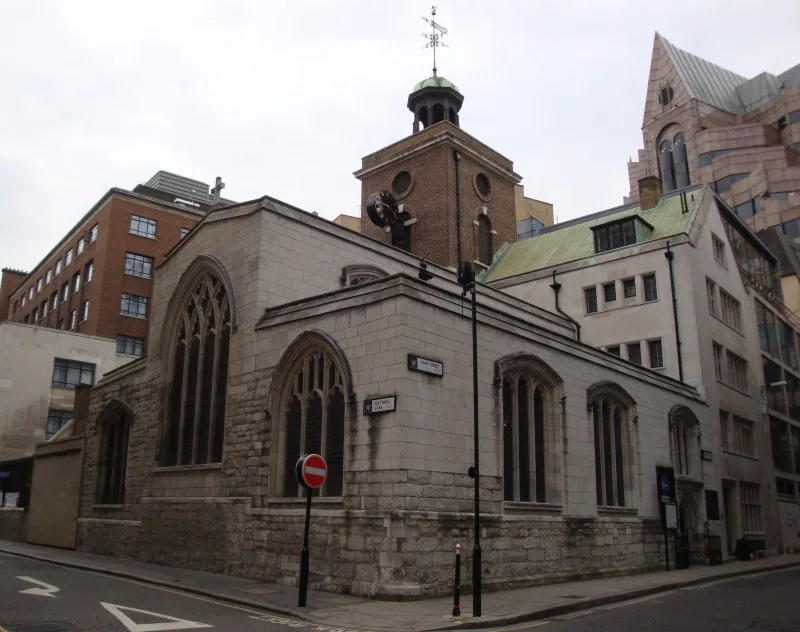
At the corner of Hart Street and Seething Lane, St Olave is one of those discreet medieval parish churches that made up the religious fabric of the City. Its luck was to survive: it escaped the Great Fire of 1666, which makes it today one of the few preserved witnesses of London architecture before the Reformation.
A survivor of old London
The surviving building dates essentially from the mid-fifteenth century. Its nave, its arcades and its porch offer the face of a late-medieval parish church, such as the Londoners of Tudor times knew it. In a City ravaged in 1666 then rebuilt by Wren, St Olave stands as a precious exception: to enter it is to recover the intimate scale and the stone setting of the Elizabethan parishes, before the fire effaced most of their sisters.
The register of 'Mother Goose'
Like all parishes, St Olave kept its registers of baptisms, marriages and burials — precious sources for social history. Its own bears, at the date of 14 September 1586, the burial of a person named 'Mother Goose' — the Mother Goose of the tales —, a curious Elizabethan entry commemorated by a plaque. (The church's famous association with the diarist Samuel Pepys is, for its part, later: it belongs to the seventeenth century, outside our window.) To see: the medieval/Tudor nave and arcades, the porch, the crypt and the Elizabethan parish registers.
Did you know?
The Mother Goose of children's tales may have a grave: the register of St Olave notes, on 14 September 1586, the burial of a 'Mother Goose'. Nothing proves the link with the figure of the nursery rhymes — but a plaque, in the church, nicely keeps the mystery alive.
Notes
St Olave Hart Street lies at the corner of Hart Street / Seething Lane, City of London; a working church, one of the City's rare medieval survivors. Access to check.
Quiz
- What is exceptional about St Olave in the City?
- It escaped the Great Fire of 1666
- It was built by Wren
- It houses a royal throne
- Which famous burial does its 1586 register note?
- That of 'Mother Goose'
- That of Shakespeare
- That of Raleigh
- Is the association with Samuel Pepys within our period?
- No, it is later (seventeenth century)
- Yes, in 1500
- Yes, under Henry VII