
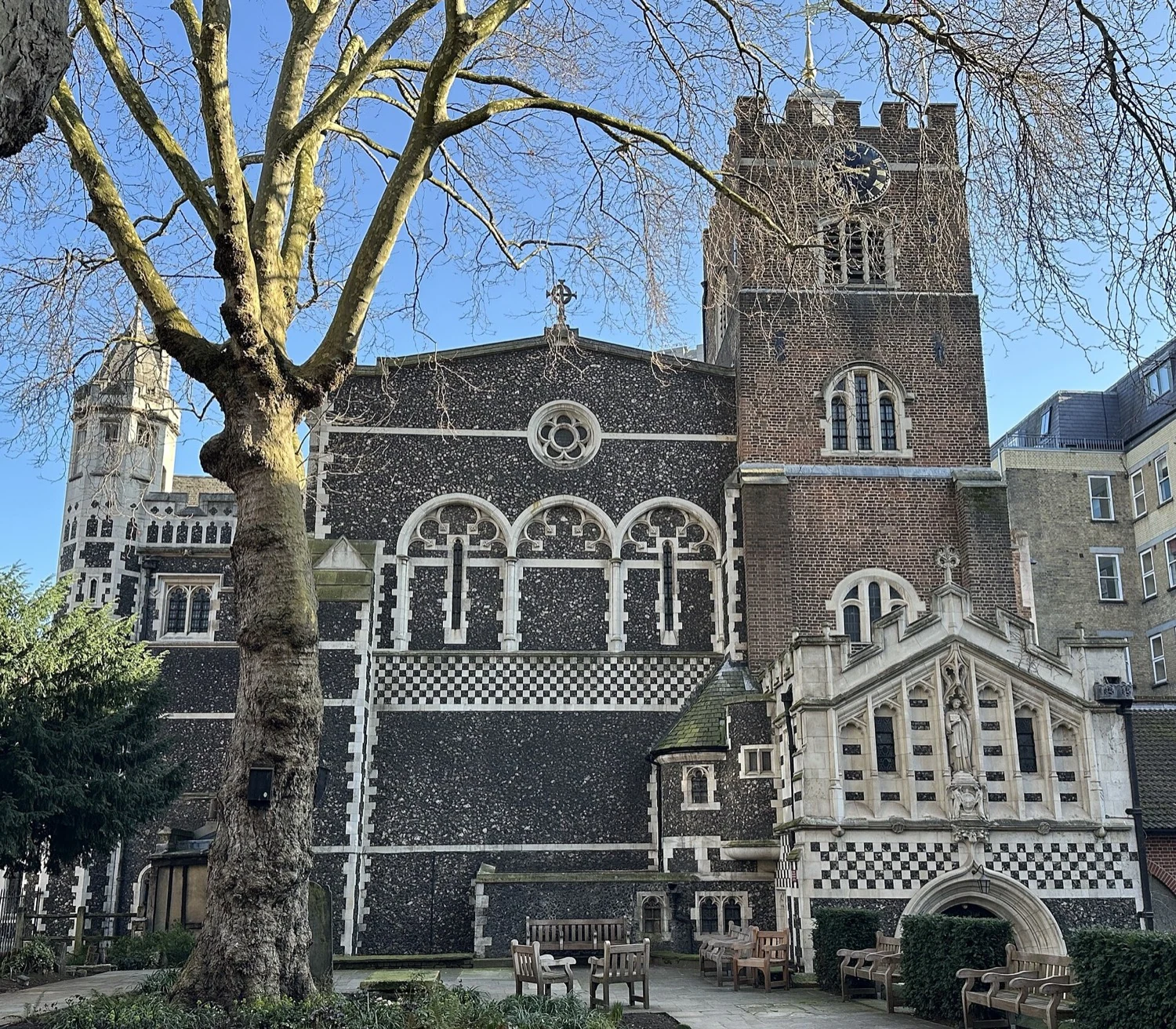
At Smithfield, in the City, St Bartholomew the Great is one of the oldest churches in London. Formerly the priory church of the Augustinian canons, it bears in its stone both the mark of the Tudor Renaissance and the scars of the Reformation: its history is that of a great medieval monastery broken, of which only the Norman core survives.
Prior Bolton's window
Under the last priors, the church knew the refinements of the nascent Renaissance. Prior William Bolton (1505-1532), a trusted man employed by Henry VII and Henry VIII on royal building works, had inserted into the choir an elegant oriel window — a box from which he could follow the services. He had his rebus carved there: a bolt (a crossbow bolt) driven through a tun (a barrel), that is 'Bolt-tun', Bolton. This witty signature, typical of the visual spirit of the age, still adorns the window overlooking the Norman choir.
The break of the Reformation
In 1539, the Dissolution of the Monasteries struck the priory: dissolved under the last prior Robert Fuller, it saw its nave demolished, leaving only the Norman choir founded by Rahere in the twelfth century. Under Mary I, the church was briefly re-established as a Dominican priory (1556), before being finally returned to the Crown under Elizabeth I, on 13 July 1559. Close by, at Smithfield, Protestant martyrs burned under Mary: the church was the silent witness of those fires. To see: Bolton's oriel window and its rebus, the Norman choir, the tomb of the founder Rahere and the Tudor porch.
Did you know?
Prior William Bolton signed his window by a play of images rather than by his name: a crossbow bolt through a tun (a barrel) reads 'Bolt-tun' — Bolton. This carved riddle, five centuries old, can still be deciphered today above the choir.
Notes
St Bartholomew the Great lies at West Smithfield, City of London; a working parish church, open to visit (admission charge possible). Near the site of the Smithfield burnings.
Quiz
- What does Prior Bolton's rebus represent?
- A bolt (crossbow bolt) through a tun (barrel)
- A crowned lion
- A Tudor rose
- What did the priory undergo in 1539?
- Its dissolution (nave demolished)
- Its enlargement
- A coronation
- What survives of the medieval church?
- The Norman choir (founded by Rahere)
- The Gothic spire
- The intact cloister