
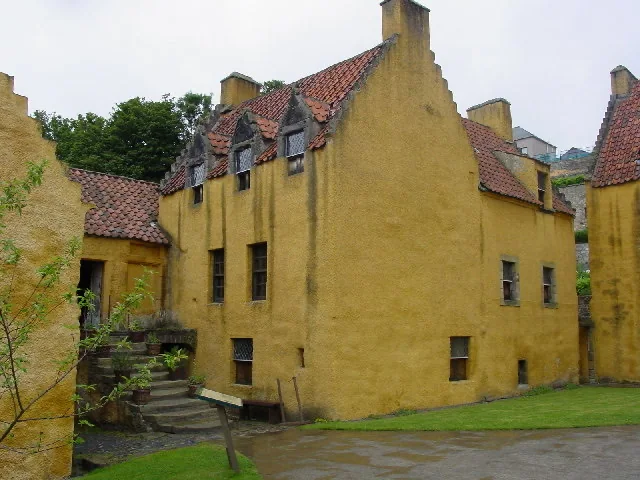
On the north shore of the Forth, in Fife, the little burgh of Culross seems stopped in the seventeenth century: cobbled lanes, gabled houses, ochre walls. At its heart, the 'palace' of Culross — in reality the home of a rich merchant — tells another side of the Scottish Renaissance: that of trade, industry and the rise of the burghers.
A merchant's 'palace'
Despite its name, Culross Palace is not a royal residence but the house of a merchant-entrepreneur, Sir George Bruce, built between 1597 and 1611. Enriched by trade and the working of coal and salt, Bruce had a vast, comfortable house built for himself, with walls coated in ochre yellow (the famous 'Culross yellow'), with interiors adorned with panelling and painted ceilings of moralising scenes and emblems — a decoration typical of the Scottish Renaissance, colourful and instructive. The word 'palace' comes to it from its scale and its luxury, exceptional for a mere burgh.
The industry of a Renaissance man
Sir George Bruce was not only a merchant: he was a daring engineer. He worked a coal mine whose galleries plunged beneath the bed of the Forth, with an air shaft rising in the middle of the estuary — a technical feat that amazed King James VI himself, come to visit it. Culross prospered thanks to coal, salt and trade with the Netherlands, as the Dutch tiles and bricks of its houses attest. The burgh, admirably preserved by the National Trust for Scotland, thus offers the most complete image of a small merchant town of the Scottish Renaissance — a reminder that the great century was not only that of kings and abbeys, but also that of the enterprising merchants who made the country's fortune.
What to see
- The palace of Culross with its ochre-yellow walls and painted ceilings.
- The panelled interiors and the reconstructed terraced garden.
- The preserved burgh of Culross (lanes, Dutch-gabled houses).
- The memory of Sir George Bruce and his mine beneath the Forth.
Did you know?
Sir George Bruce had dug, beneath the estuary of the Forth, a coal mine one of whose shafts opened onto an artificial islet in the middle of the water: at high tide, one could reach it by boat, bring the coal up by sea, then go back down through the gallery to the shore. King James VI, come to visit this wonder around 1617, is said to have thought himself trapped for a moment on finding himself, at the end of the gallery, surrounded by water — before understanding the ingenuity of the device. The anecdote tells the enterprising spirit of a Scottish Renaissance which, far from the courts, also knew how to dig the earth and defy the sea.
Practical information
Culross lies on the north shore of the Firth of Forth, in Fife, in Scotland. The palace and part of the burgh are in the care of the National Trust for Scotland, open to the public. Opening hours and days are liable to change with the seasons; it is best to check them against the official sources before visiting.
Quiz
- Who had the 'palace' of Culross built?
- The merchant Sir George Bruce
- King James VI
- The Archbishop of St Andrews
- Which side of the Scottish Renaissance does Culross illustrate?
- The trade and industry of the burghers
- The wars of religion
- Monastic life
- Which technical feat of Sir George Bruce amazed James VI?
- A coal mine plunging beneath the Forth
- An astronomical clock
- A suspension bridge