
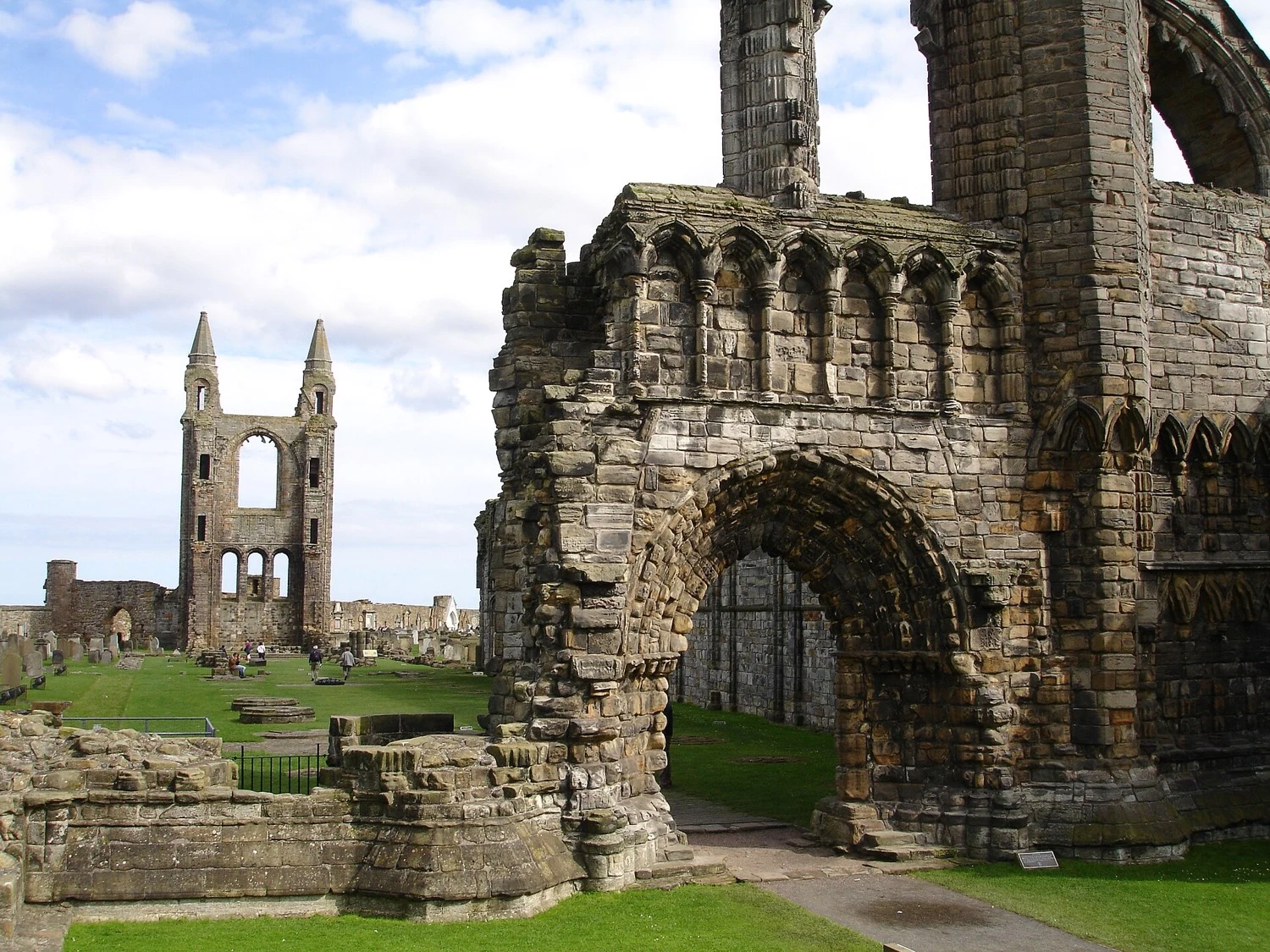
On the east coast of Fife, St Andrews was the religious and intellectual heart of Scotland: its cathedral, the largest in the country, its episcopal castle and its venerable university made it the spiritual capital of the kingdom. It was here, more than anywhere, that the drama of the Scottish Reformation was played out.
The religious capital of Scotland
St Andrews owed its prestige to the relics of the apostle St Andrew, patron of Scotland, which made it a great place of pilgrimage. Its cathedral, consecrated in 1318, was the largest church ever built in Scotland; the seat of the archbishop, primate of the kingdom, resided here in a powerful castle overlooking the sea. The town also held the oldest university in Scotland, founded in 1413 — a home of learning where the religious debates were soon sharpened. St Andrews was, on the eve of the Reformation, the summit of the Scottish Church.
The fire of the Reformation
It was here that the Scottish Reformation found its martyrs and its heroes. In the 1520s-1540s several reformers were burned alive here for heresy, among them the preacher Patrick Hamilton (1528) and then George Wishart (1546), under the eye of the powerful Cardinal David Beaton, a fierce defender of the Roman Church. A few months after Wishart's ordeal, rebel reformers murdered Cardinal Beaton in his own castle and entrenched themselves there: among them, a still-unknown preacher, John Knox, who preached there for the first time. Taken prisoner, condemned to the French galleys, Knox would later return to lead the Reformation to victory. St Andrews was thus the furnace from which Protestant Scotland burst forth. After 1560 the great cathedral, deprived of worship, fell into ruin and served as a quarry; its remains still dominate the sea.
What to see
- The ruins of the cathedral, once the largest church in Scotland.
- St Andrews Castle, residence of the archbishops (and its famous siege tunnel).
- The University of St Andrews, the oldest in Scotland (1413).
- The memory of the Reformation martyrs and the beginnings of John Knox.
Did you know?
St Andrews Castle keeps one of the most extraordinary relics of the wars of religion: during the siege of 1546-1547, besiegers and besieged dug, each on their side, underground galleries in the rock — the one to undermine the walls, the other to intercept them. This 'mine and countermine', cut into the stone, can still be visited today: one goes down, in the dark, in the tracks of the war that accompanied the birth of reformed Scotland.
Practical information
St Andrews lies on the east coast of Fife, in Scotland. The cathedral ruins and the castle are in the care of Historic Environment Scotland; the university is active. Opening hours and days are liable to change; it is best to check them against the official sources before visiting.
Quiz
- What was St Andrews on the eve of the Reformation?
- The religious capital of Scotland
- A mere fishing village
- A Roman colony
- Which reformer, later leader of the Reformation, first preached here?
- John Knox
- Thomas Cranmer
- John Calvin
- What can be visited at St Andrews Castle?
- The mine and countermine tunnels of the 1546-1547 siege
- A gilded dome
- A topiary garden