
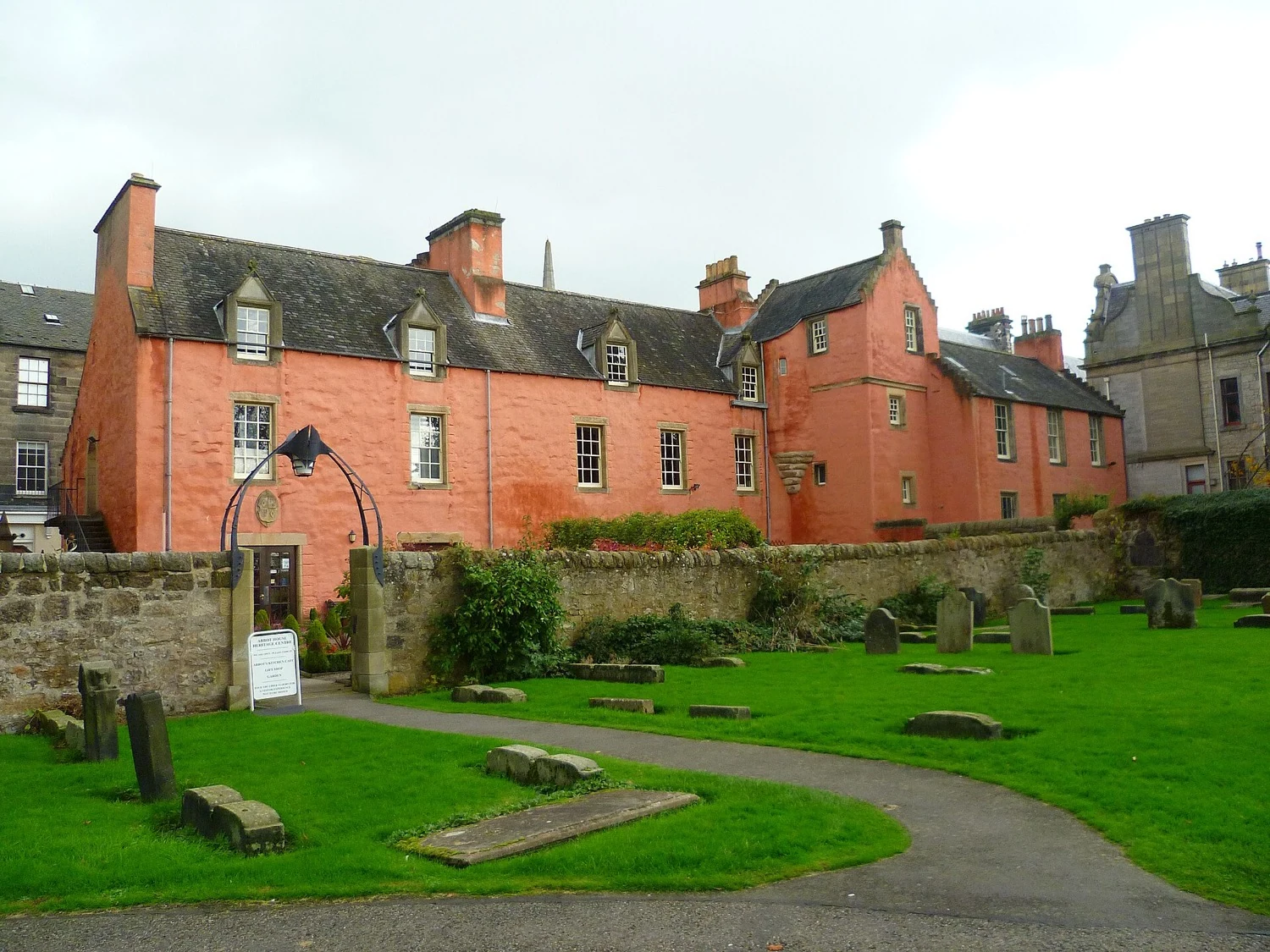
In the old town of Dunfermline, once a royal capital of Scotland, a stone house with ochre walls — Abbot House — is the oldest civic building in the city. It has crossed the Reformation, a great fire and four centuries, keeping a rare treasure: a Renaissance wall painting of the sixteenth century.
The house of the commendators
The core of the house goes back to the mid-sixteenth century, to the time when the revenues of the great Abbey of Dunfermline passed, on the eve of the Reformation, to lay "commendators" who administered its estates. It is a well-to-do town house, on the scale of a notable, enlarged and reworked over time. It bears, painted on its front, a motto in old Scots recalling the vanity of worldly goods — a direct trace of the moral culture of the Reformation.
A fresco of 1571
The true treasure is inside: a wall painting dated 1571, remnant of a painted scheme that adorned the principal upstairs chamber, which may illustrate a Scots translation of Virgil. Painted interiors of sixteenth-century Scotland are extremely rare — most have vanished; the one at Abbot House is among the few survivors of the Scottish Renaissance. The house even withstood the great fire of 1624 that ravaged Dunfermline. It has served as a heritage centre. Don't miss: the ochre front and its painted motto, the 1571 painting, the old interiors, the abbey close by.
Did you know?
To paint directly on walls — scenes, mottoes, mock hangings — was, in sixteenth-century Scotland, the equivalent of tapestry for those who could not afford hangings: Renaissance decoration within reach of the good bourgeoisie. Almost all of it perished under plaster, fire and fashion. That the chamber of Abbot House kept its painting of 1571 makes it a precious witness to an art almost entirely lost.
Info
Abbot House is at 21 Maygate, in old Dunfermline (Fife), near the abbey and palace; a Category A listed building. Opening according to the building's current use, to be checked.