
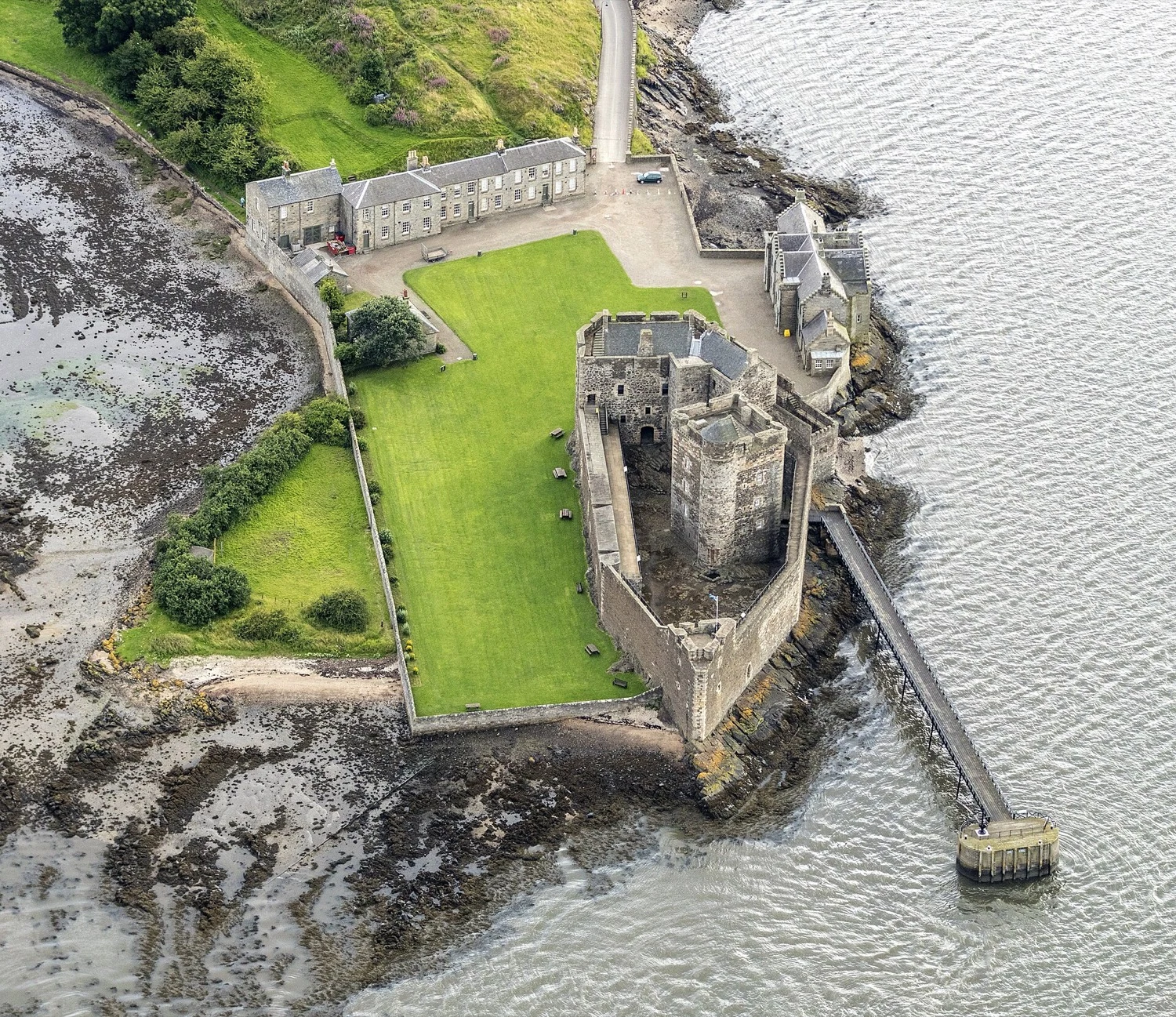
On the shore of the Firth of Forth, Blackness Castle raises an unusual silhouette: that of a stone ship run aground at the water's edge, with its 'prow', its 'stern' and its great central mast. This artillery fortress, a masterpiece of Stewart military engineering, served the neighbouring royal court and as a fearsome state prison.
A modern artillery fortress
Built in the 1440s by Sir George Crichton, Blackness became Crown property in 1453. But its great transformation dates from 1534-1540, when Sir James Hamilton of Finnart — a fortification expert trained in Europe — gave it a modern defensive system: a complex entrance, a fortified spur, a caponier, gun embrasures. Blackness thus became one of the most advanced artillery fortresses in Scotland, able to resist the cannon and to use it. Its position on the Forth made it the port and arsenal of the neighbouring royal court of Linlithgow, and a diplomatic base of the Auld Alliance with France: in 1512, James IV boarded here the Great Michael, his huge warship, to receive the French ambassador.
The state prison of the Reformation
Blackness had another, darker function: that of state prison. Its thick walls and its isolated position made it a secure place of detention for prisoners of note. In the time of the Reformation, leading figures were imprisoned there, including Cardinal Beaton — the great Catholic prelate — and the 6th Earl of Angus. Blackness thus illustrates the double function of the great Stewart fortresses: an instrument of the realm's defence and diplomacy, but also of political and religious repression. To see: the three towers (north, central 'the mast', south), the fortified entrance spur with caponier, the gun embrasures.
Did you know?
Blackness is nicknamed 'the ship that never sailed'. Seen from the sky or the shore, the castle indeed takes the form of a vessel: the north tower is the 'prow' pointed towards the open sea, the south tower the 'stern', and the tall central tower the 'main mast'. This resemblance, born of the constraint of the rock on which it is built, makes it one of the most unusual castles in Scotland — a stone galleon for ever moored on the Forth.
Notes
Blackness Castle lies at Blackness, Falkirk, on the shore of the Firth of Forth; a fortress run by Historic Environment Scotland, open to visits. A film set (Outlander, Hamlet). Seasonal hours to check.
Quiz
- What nickname is given to Blackness?
- 'The ship that never sailed'
- 'The glass castle'
- 'The golden tower'
- Which royal court did Blackness serve?
- Linlithgow
- London
- Paris
- Which Catholic prelate was imprisoned there?
- Cardinal Beaton
- John Knox
- Thomas More