
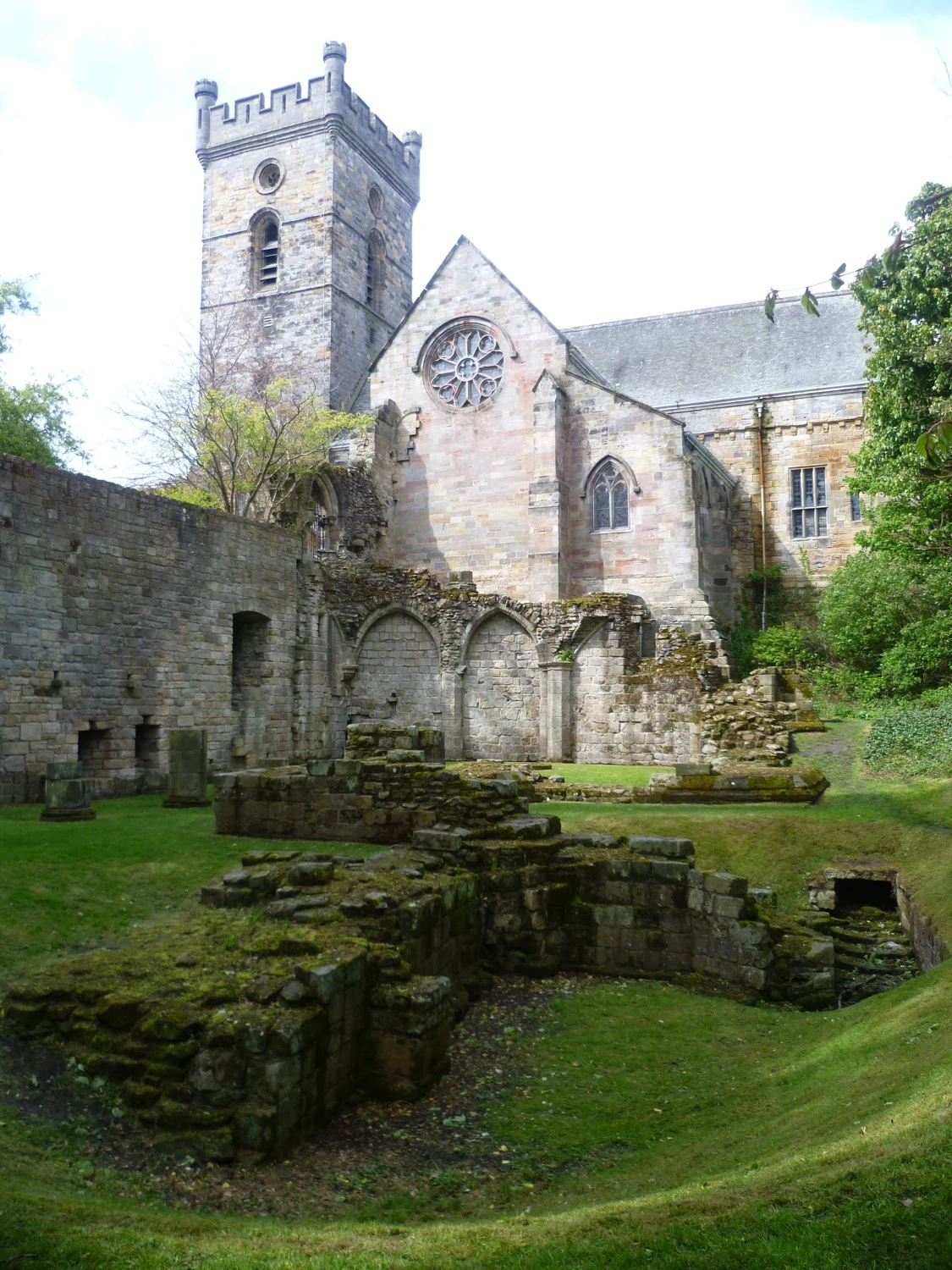
Dominating the pretty burgh of Culross, in Fife, the Cistercian abbey offers a singular example of the Scottish Reformation: here, no brutal closure nor spectacular demolition, but a gentle extinction, a community left to die out while its church passed, smoothly, to reformed worship.
An abbey left to die out
Founded in the thirteenth century, Culross Abbey had already seen its nave demolished around 1500. At the Reformation, in 1560, the Scottish Parliament forbade monastic life — but at Culross, the transition was singularly gentle: rather than a violent expulsion, the community was 'left to die out' with its last monk. Gradually, in the 1580s, the parish began to celebrate reformed worship in the former choir of the abbey. Culross thus illustrates a lesser-known facet of the Scottish Reformation: not always brutality and iconoclasm, but sometimes a slow evolution, a shift from the monastic to the parochial.
The Bruce monument
The restored choir of Culross, still an active parish church, shelters a jewel: the Bruce monument (north transept), with the alabaster effigies of Sir George Bruce of Carnock, his wife and their eight children — a fine example of the funerary art of the late Scottish Renaissance. The Bruce family was linked to this prosperous burgh (Sir George had developed a famous undersea coal mine). In 1613, the heart of Edward Bruce, 1st Lord Kinloss — who died in a duel against Edward Sackville — was brought back and buried in the abbey churchyard. To see: the restored choir (an active parish church), the Bruce monument with its alabaster effigies, the carved medieval stones.
Did you know?
In 1613, the heart of a man who died far from home came to rest at Culross: Edward Bruce, Lord Kinloss, had been killed in the Netherlands in a fierce duel against the Englishman Edward Sackville — a fight of extreme violence, fought to the death. According to the custom of the time, his heart was removed and brought back to Scotland to be buried in the churchyard of Culross Abbey. A travelling heart, the last witness of a fatal point of honour of the waning Renaissance.
Notes
Culross Abbey lies at Culross, Fife; the choir is still an active parish church; ruins and Bruce monument open to visit. Distinct from Culross Palace (George Bruce's house). Hours to check.
Quiz
- How did the Reformation happen at Culross?
- Gently: the community was 'left to die out'
- By a fire
- By a massacre
- What did the abbey choir become?
- An active parish church
- A castle
- A prison
- Which monument does the abbey shelter?
- The Bruce monument (alabaster effigies)
- A royal throne
- A mummy