
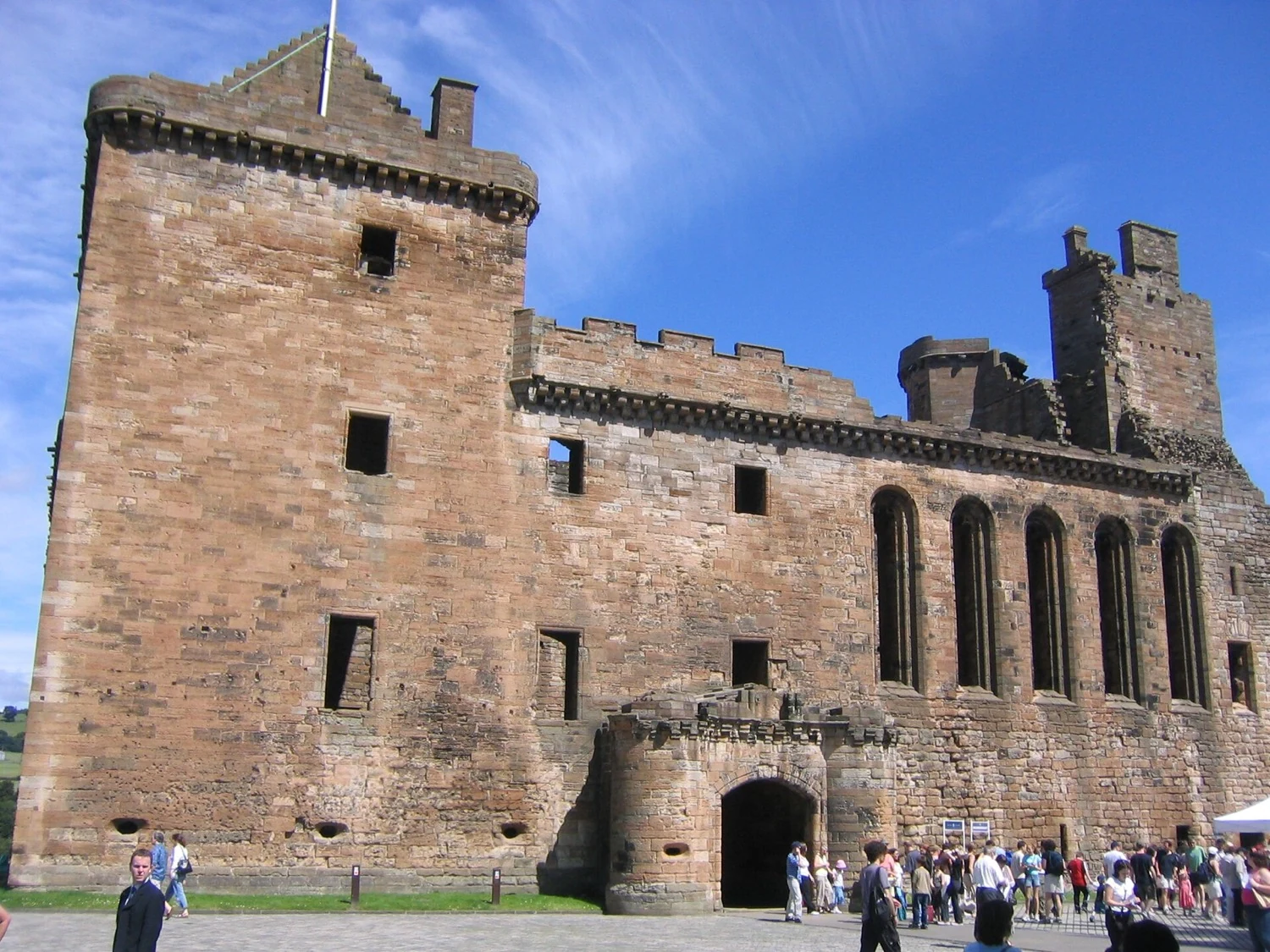
By a peaceful loch, between Edinburgh and Stirling, the golden ruins of Linlithgow Palace keep the memory of a lost splendour. A pleasure residence of the kings of Scotland, it was one of the most elegant royal houses in the country — and the birthplace of Mary Stuart.
The pleasure palace of the kings
Built and rebuilt by the Stuart kings in the fifteenth and early sixteenth centuries, Linlithgow was not a fortress but a pleasure palace, designed for comfort and display: a vast quadrangle around an inner court adorned with a fine carved fountain, great halls, galleries and light-filled lodgings opening onto the loch. James V, a lover of continental architecture, embellished it further. It was a favoured stop on the royal road between the two great places of Edinburgh and Stirling, a place where the court came to breathe, by the water.
The cradle of a tragic queen
Linlithgow entered history on 8 December 1542: it was here that Mary Stuart was born, daughter of James V and Mary of Guise. Six days later her father died at Falkland, broken: the infant became Queen of Scotland. So the sovereign whose fate would shake Scotland and England gave her first cry in this palace by the loch. The place declined after the Stuarts left for London in 1603; it burned accidentally in 1746 and was never restored. But its golden ruin, admirably preserved, remains one of the most moving witnesses of the Scottish Renaissance — and the cradle of a queen.
What to see
- The inner court and its carved Renaissance fountain.
- The Great Hall and the Chapel Royal.
- The chamber associated with the birth of Mary Stuart (1542).
- The setting of the palace by its loch.
Did you know?
The carved fountain that adorns the inner court of Linlithgow, commissioned by James V around 1538, is reckoned one of the oldest Renaissance fountains in Britain. Legend has it that, on great occasions, it was made to run with wine instead of water, for the joy of the court and the people. Wine or water, this fountain raised in the heart of the palace spoke of the refinement of the Stuarts — and the ambition of a small court of Scotland to rival, in taste, the splendours of the Continent.
Practical information
Linlithgow Palace lies at Linlithgow, in West Lothian, between Edinburgh and Stirling. It is today a ruin in the care of Historic Environment Scotland, open to the public. Opening hours and days are liable to change (conservation works may limit access); it is best to check them against the official sources before visiting.
Quiz
- Which queen was born at Linlithgow Palace in 1542?
- Mary Stuart
- Elizabeth I
- Mary of Guise
- What kind of residence was Linlithgow?
- A pleasure palace, not a fortress
- A state prison
- An abbey
- What adorns the inner court of Linlithgow?
- A carved Renaissance fountain
- An Egyptian obelisk
- A medieval well