
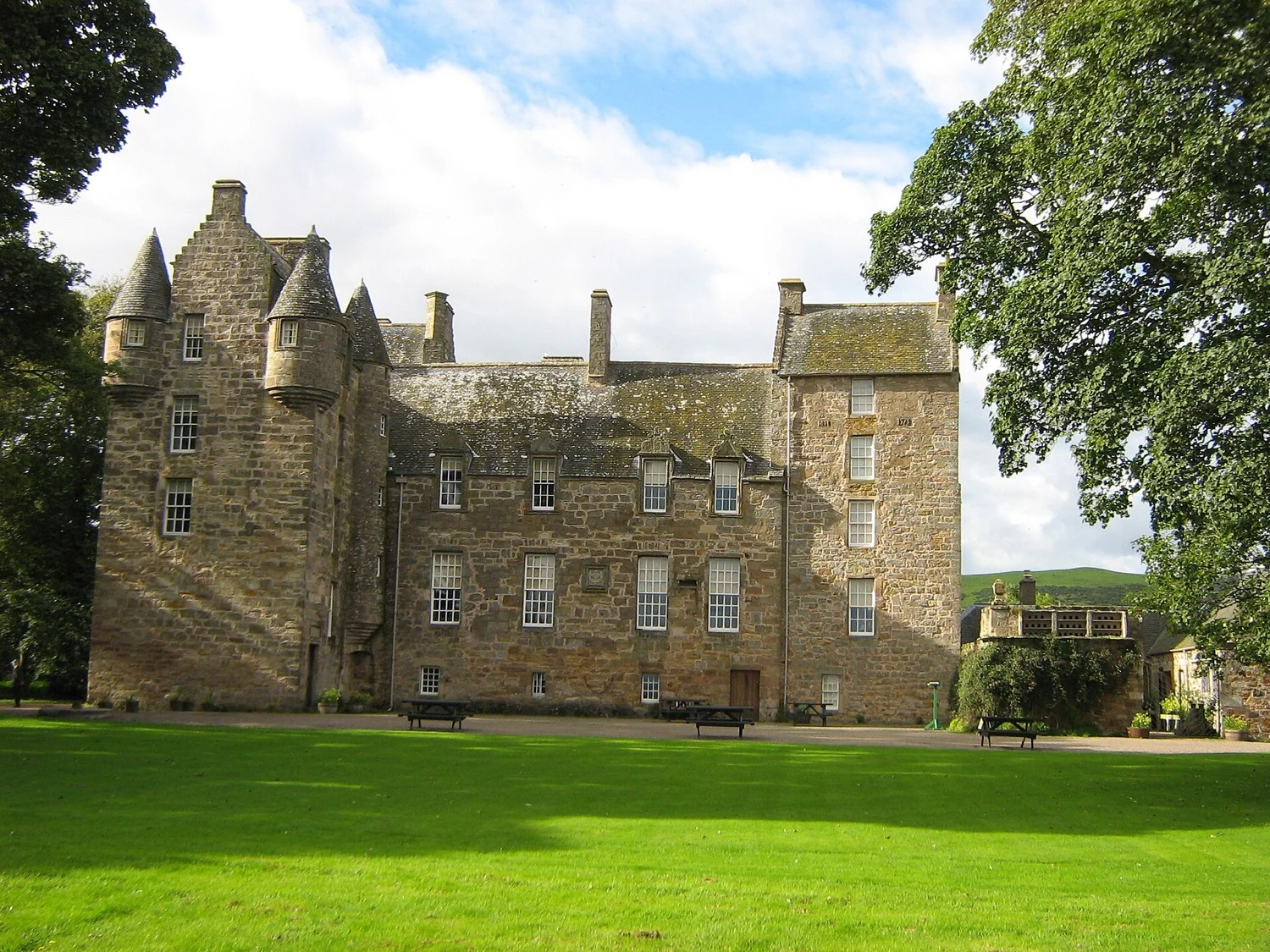
In the Fife countryside, near Pittenweem, Kellie Castle is one of the most appealing examples of the Scottish tower house come to maturity. Neither austere ruin nor royal palace, it is the residence of a landed noble family, enlarged in stages until, at the hinge of our period, it found its accomplished silhouette.
A growth by successive towers
Kellie was not built at a stroke, but assembled. To a first tower of the fourteenth-fifteenth century, the Oliphant family, owners in the sixteenth century, added other towers and ranges, so that the castle gradually took on its T-plan — two linked towers, essentially completed around 1606. It is the very portrait of the domestic Scottish Renaissance: not new Italian-style palaces, but old houses that are enlarged, linked, made lighter and more comfortable, without ever quite giving up defensive verticality. Widened windows, crow-stepped gables, turnpike stairs: everything speaks of the slow passage from refuge to residence.
The Erskines, Earls of Kellie
In debt, the Oliphants ceded Kellie in the early seventeenth century to Thomas Erskine, one of James VI's trusted men. Erskine had distinguished himself in 1600 by saving the king's life during the shadowy Gowrie conspiracy — that ambush in which the Ruthven brothers are said to have tried to attack the sovereign. Rewarded, he was created Earl of Kellie in 1619, giving the castle its title. Under the Erskines, Kellie received its famous painted ceilings and decoration — the refined culmination of a long history of stone. To see: the T-plan and linked towers, the decorated ceilings, the crow-stepped gables and the turnpike stair, the walled garden.
Did you know?
The master of Kellie, Thomas Erskine, owed his title to a few seconds: in 1600, at Perth, in the Ruthvens' house, he was one of the men who rushed to the aid of James VI under attack. From that rescue an earl was born — and a castle took the name of Kellie. A short way off, another great family, the Ruthvens of Dirleton, lost theirs for ever.
Notes
Kellie Castle lies about 5 km north-west of Pittenweem, Fife; a restored castle, today in the care of the National Trust for Scotland. Hours to check.
Quiz
- Which plan did Kellie eventually adopt (around 1606)?
- The T-plan (linked towers)
- The circular plan
- The cross plan
- Which family enlarged Kellie in the sixteenth century?
- The Oliphants
- The Douglases
- The Campbells
- Why was Thomas Erskine made Earl of Kellie?
- For having saved James VI (Gowrie conspiracy, 1600)
- For having won a naval battle
- For having written a play