
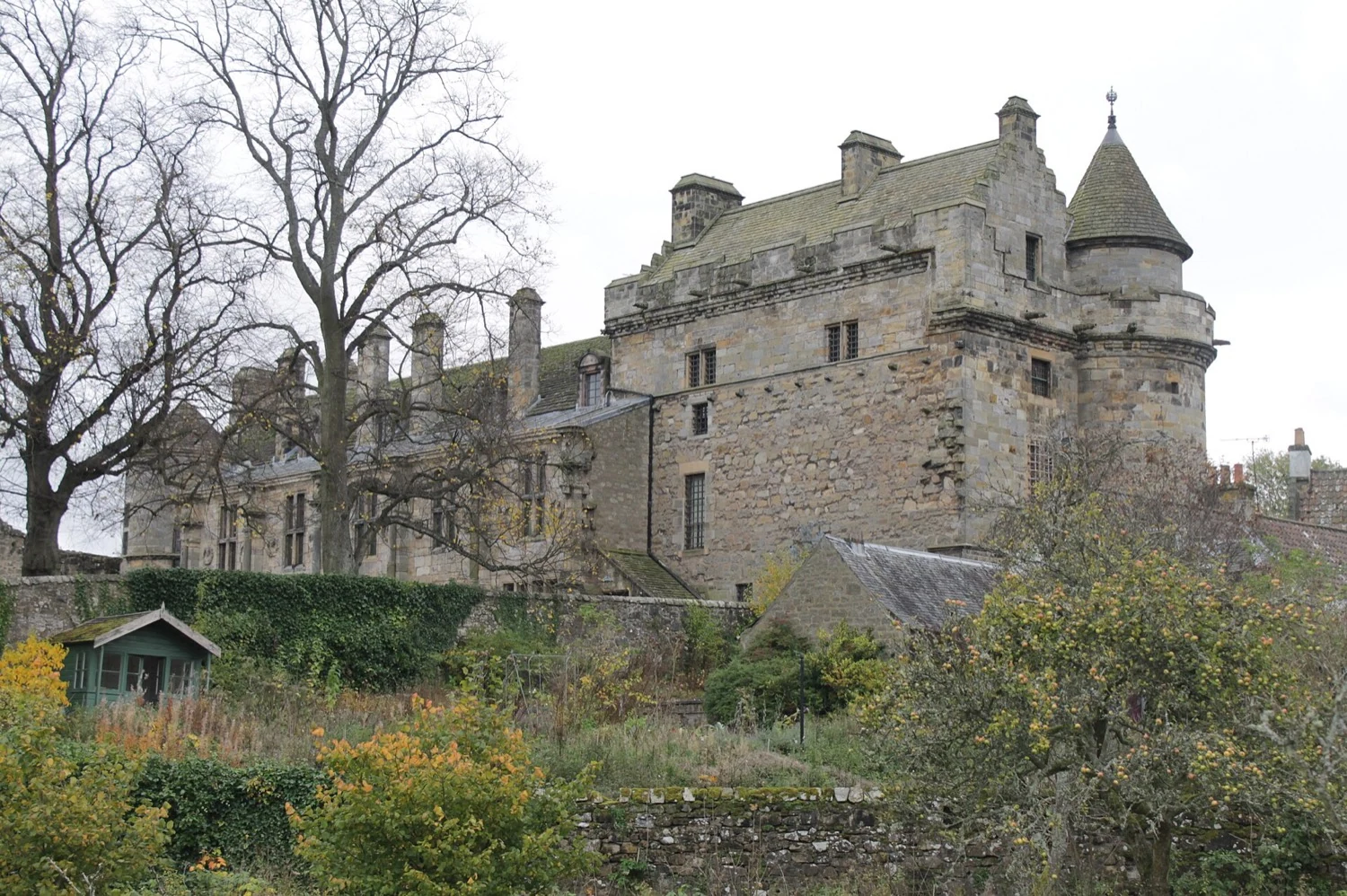
In the heart of a quiet Fife town, Falkland Palace unfolds a façade of wholly continental elegance: columns, roundels, antique statues. A hunting and pleasure lodge of the Stuart kings, it is the most purely 'French' of the Renaissance buildings in Britain — and the place where James V died.
The pleasure of the Stuarts
The kings of Scotland loved Falkland for its game-rich forests: here they came to hunt deer and boar, far from the affairs of Edinburgh. James IV and then above all James V transformed the old castle into a refined pleasure palace. James V, married to two French princesses and nourished on continental culture, had the façades of the inner courts adorned around 1537-1541 with columns, niches and Renaissance roundels, executed by French masons brought over on purpose. The result is unique in Britain: an architecture that seems to have come straight from the banks of the Loire, planted in the heart of Scotland.
The death of a king, the games of a court
It was at Falkland that James V died, in December 1542, broken by military defeat, only days after the birth of his daughter Mary Stuart — whose coming was announced to him on his deathbed. The palace stayed dear to the Stuarts: the young Mary Stuart came here to hunt and relax, as later did her son James VI. Falkland also holds the oldest real-tennis court in Britain, laid out in 1539 for James V — and on which play still goes on. Between hunting, sport and French refinement, Falkland embodies the happy side of the Scottish Renaissance, before the dramas of Mary's reign.
What to see
- The Renaissance façades of the courts, with antique columns and roundels.
- The Chapel Royal and the restored apartments.
- The real-tennis court of 1539, the oldest in Britain.
- The gardens, on the site of the old royal orchards.
Did you know?
On learning, dying at Falkland in 1542, that his only heir was a daughter (Mary Stuart), James V is said to have murmured a disillusioned prophecy about his dynasty: 'It came with a lass, it will go with a lass' — alluding to the crown of Scotland, which had come into the Stuart house through a woman (Marjorie Bruce). History proved him wrong: his daughter Mary, despite her tragic fate, passed the crown to her son James VI, who united the two kingdoms. But the phrase, spoken at Falkland, remains one of the most famous sayings in the history of Scotland.
Practical information
Falkland Palace lies in the town of Falkland, in Fife, in the east of Scotland. It is today a site in the care of the National Trust for Scotland, open to the public with its gardens and its tennis court. Opening hours and days are liable to change with the seasons; it is best to check them against the official sources before visiting.
Quiz
- In which style were the façades of Falkland adorned by James V?
- The French Renaissance style
- Flamboyant Gothic
- Romanesque
- What does Falkland hold, dating from 1539?
- The oldest real-tennis court in Britain
- The largest library in Scotland
- A cathedral
- Which king died at Falkland in 1542?
- James V
- James VI
- James IV