
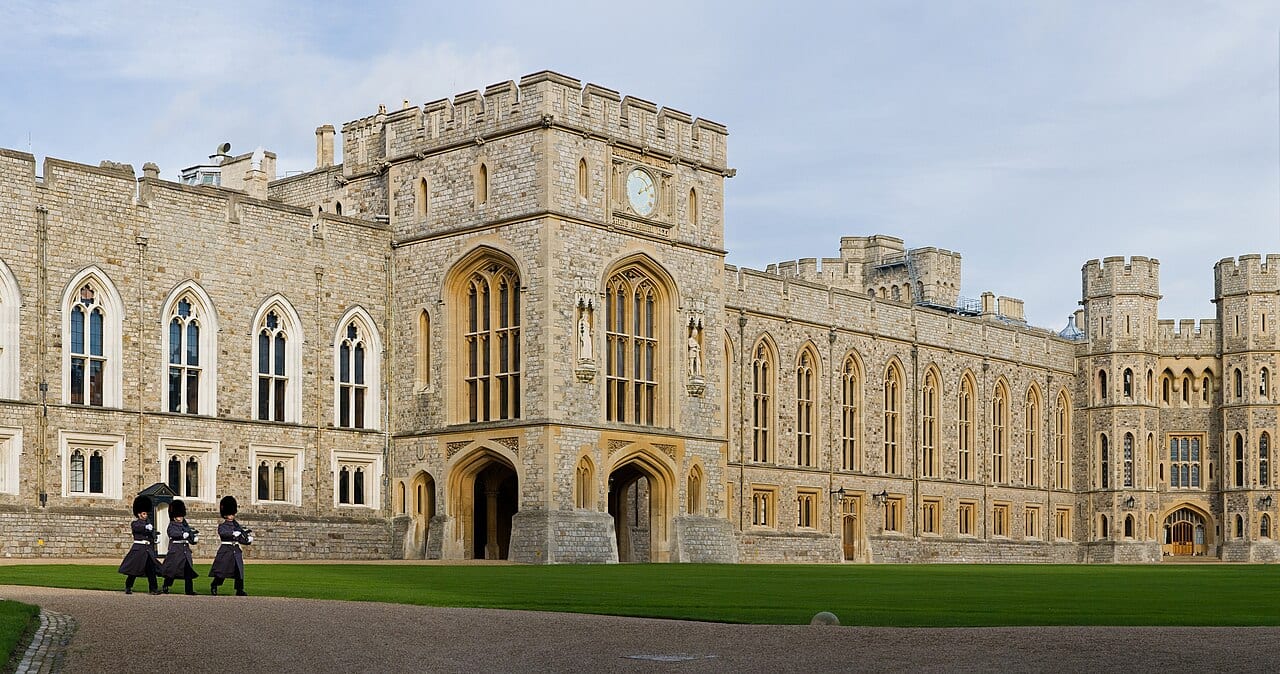
Rising above the Thames valley from its Norman motte, Windsor Castle is the oldest inhabited royal residence in Europe. Its outline — a fortress begun under William the Conqueror and taken up by almost every English sovereign since — belongs first of all to the Middle Ages. Yet it is under the Tudors, in the age of the English Renaissance, that Windsor claims a decisive place in the story we tell here, and the castle hides none of its layers: century by century, the stone itself can be read.
The most immediate Tudor trace greets the visitor at the lower entrance. The gateway known as Henry VIII's Gate, raised in 1511, carries on its carved panel the king's arms set beside the pomegranate of Catherine of Aragon, his first wife. That heraldic fruit, emblem of the queen from Spain, fixes in stone a marriage history would noisily undo — standing before it, one cannot help weighing all that the coming decades would overturn. Nearby, the Horseshoe Cloister, built by Edward IV between 1478 and 1481 for the priest-vicars serving the chapel, forms one of the most affecting timber-framed ranges within the walls — a curve of mellow brick and oak that already belonged to the castle when the Tudors came.
The heart of Windsor's Renaissance memory, however, is St George's Chapel. Begun by Edward IV in 1475 and completed under Henry VIII around 1528, its Perpendicular Gothic, fan vaulting and forest of stalls make it one of the masterworks of English religious architecture. Here Henry VIII lies buried. Interred on 16 February 1547, the king was laid beside Jane Seymour, his third wife, who died on 24 October 1537 of complications after giving birth to the long-awaited heir, the future Edward VI. Jane was the only one of Henry's wives to receive a queen's funeral; her body had been borne in procession from Hampton Court to Windsor on 12 November 1537. The monumental bronze-and-marble tomb Henry had planned was never finished: a plain marble slab, laid in 1837 under William IV, now marks, before the high altar, the shared grave of king and queen. Few places speak so soberly of the gulf between intended splendour and the reality bequeathed.
Windsor is also the spiritual home of the Most Noble Order of the Garter, founded by Edward III in 1348, Britain's highest order of chivalry. St George's Chapel remains its seat: its stalls bear the enamelled plates, banners and crests of the knights, and it was in this setting that the Tudors, consummate masters of ceremony, staged the prestige of the crown. Beneath these vaults one can easily picture the pomp of the investitures, the processions in mantles of blue velvet, the whole liturgy of power the dynasty knew so well how to orchestrate to secure a legitimacy that was still young. The sovereigns of the house of Tudor loved this castle deeply. Henry VIII hunted in the Great Park, whose woodland then stretched far; his daughter Elizabeth I relished Windsor in summer and is said to have spent more on works there than on any of her other residences — proof of the singular attachment the queen felt for these walls above the Thames.
What one sees today is therefore a palimpsest: medieval keep, state apartments remodelled down to the nineteenth century, and a Gothic chapel where Tudor memory still beats. For the lover of the Renaissance, Windsor is not a Renaissance set in the Italian sense — no classical orders, no villa — but the theatre in which sixteenth-century English monarchy fashioned its image, honoured its dead and asserted its continuity. To stand before Henry VIII's slab is to stand at the point where the glory of a turbulent reign resolves itself into a few words cut in marble, beneath the vaults of a chapel his own reign brought to completion.