
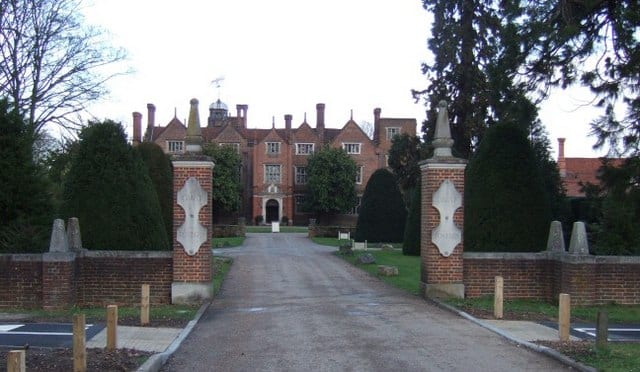
At Egham, on the edge of Windsor Great Park, Great Fosters raises its red-brick turrets and gables over a domain of gardens and moats. The house, of the mid-sixteenth century, ranks among the fine examples of Tudor domestic architecture in Surrey: warm brick dressed with stone, tiled roofs, and above all tall square towers rising to the level of the gables and containing the staircases, which give the house its solid, assertive three-storey shape. The whole originally formed a U-shaped range, a layout characteristic of the great Elizabethan house.
Building is placed around 1550. A persistent tradition holds that Great Fosters first served as a royal hunting lodge, linked to Henry VIII and to the nearness of Windsor Great Park, of which the estate once formed part; the memory of the place is also attached to Anne Boleyn and the young Elizabeth. These accounts must be received with due caution: appealing as they are, they rest largely on tradition rather than on firm documentary proof, and we report them as such. What is, by contrast, soundly attested and still visible today is the evidence carved above the entrance porch: the royal arms of Elizabeth I, dated 1598. This royal coat of arms, which likely marks a visit or a direct link to the crown, is the surest signature of the house's Elizabethan standing. To it is joined the name of Sir John Dodderidge (1555–1628), a King's Bench judge and former Solicitor General to James I, who owned Great Fosters and whose epitaph in Exeter Cathedral records that he "departed this lyfe at Forsters nere Egha(m) in Surrey".
The house was remodelled in the early seventeenth century — slightly larger brick in the porch keeps the trace of it, as do the tall chimneys, destroyed by bombing during the Second World War and later replaced with replicas. But the Elizabethan spirit remains, in the U-plan, the brick, the stair towers and the sober elegance of the fronts. Around the house stretch gardens that have become celebrated: listed parterres, an ancient moat that tradition calls Saxon, a Japanese-inspired bridge, a long vista of water. This landscaped setting, partly of later date, carries on today the spirit of retreat that always marked the place.
The nearness of Windsor is no accident of geography: this whole corner of Surrey lived in the shadow of the great royal park, hunting ground of sovereigns and resting place of the court on its progresses. A brick house like Great Fosters, built within reach of the royal woods, drew part of its prestige from that neighbourhood; to own a house on the margins of the king's domain was to share, if only at a distance, in the life of the monarchy. The stair towers, the gables and the carefully coursed brick express this ambition to be seen, within the limits of a prosperous gentry fortune rather than of high aristocracy — which makes the place all the more representative of its time.
Great Fosters holds in our atlas a place both modest and illuminating. Modest, because it is neither a royal palace nor the seat of a great magnate, but a fine, well-appointed country house. Illuminating, because it perfectly illustrates an essential type of Elizabethan England: the brick residence on the margins of the royal hunting grounds, where the lesser and middling nobility displayed their prosperity and their nearness to the court. The arms of 1598 above the porch sum up that ambition: to stamp the stone with the royal sign, to set one's house within the sovereign's orbit. For whoever steps beneath this porch, Great Fosters offers less the tale of an event than the faithful image of a way of life — that of the Surrey gentry at the twilight of Elizabeth's reign.