
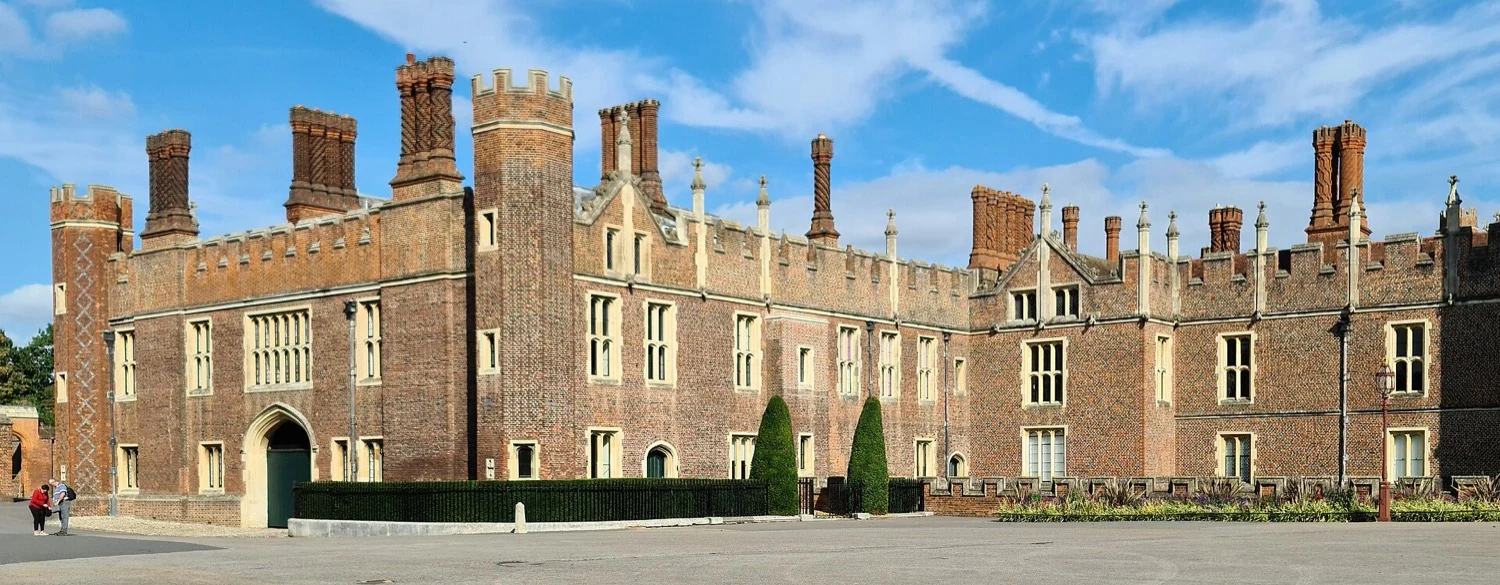
Some twenty kilometres upstream of London, on the quiet banks of the Thames, spreads Hampton Court, the most sumptuous surviving Tudor palace in England. A vast house of rose-red brick bristling with twisted chimneys, it was first the dream of a cardinal, before becoming the showcase of Henry VIII's power.
From a cardinal's dream to the king's palace
Around 1515, Cardinal Thomas Wolsey, the all-powerful minister and archbishop, set out to build himself on the Thames a residence worthy of a prince of the Church: courts of brick, galleries, richly hung apartments, an ornate chapel. Hampton Court became the finest palace in the kingdom — too fine, perhaps, for a subject. When Wolsey fell from favour, having failed to obtain from the pope the annulment of the royal marriage, he gave his palace to Henry VIII, in 1529, in a last effort to regain his grace. In vain: the cardinal died the following year, on his way to trial.
Henry VIII seized the palace and enlarged it without measure. He added the Great Hall with its hanging oak roof, the colossal kitchens able to feed a court of a thousand, a real-tennis court, an astronomical clock. Hampton Court became the setting of his turbulent married life: five of his six wives stayed here, and it was here that he was told of the long-hoped-for birth of his son Edward, whose mother, Jane Seymour, died here soon after. The palace is thus the great book in stone of the most tumultuous reign in English history.
A setting of brick and gardens
What strikes the visitor at Hampton Court is the art of brick carried to its height: turrets, gables, ornate chimneys, and Italian terracottas by Giovanni da Maiano (the roundels of Roman emperors) that bring the vocabulary of the Renaissance into England as early as the 1520s. Around the palace the Tudor gardens — among them the Pond Garden and the site of the Privy Garden — extend the architectural splendour into the art of the enclosed garden, its parterres and arbours, where the court walked and plotted. A famous maze, planted later, carries on this tradition of garden pleasure.
What to see
- Henry VIII's Great Hall, with its hanging hammer-beam oak roof.
- The vast Tudor kitchens, still fitted with their hearths.
- The Chapel Royal, with its blue-and-gold starred ceiling.
- The terracottas of Giovanni da Maiano (emperor roundels) on the brick walls.
- The gardens (Pond Garden, enclosed gardens) and the maze.
Did you know?
It is said that the ghost of Catherine Howard, Henry VIII's fifth wife, still haunts the 'Haunted Gallery' of Hampton Court: arrested for adultery in 1541, she is said to have broken from her room to run and beg the king in the chapel, before being seized by the guards. Her screams, they say, still echo at times. The legend says enough of how far this palace was the intimate theatre of the reign's dramas.
Practical information
Hampton Court Palace lies at Richmond upon Thames, upstream of London, on the north bank of the river. It is today a palace in the care of Historic Royal Palaces, with its gardens open to the public. Opening hours, prices and closing days, as well as access to the gardens and the maze, are liable to change; it is best to check them against the official sources before visiting.
Quiz
- Which cardinal first built Hampton Court before giving it to the king?
- Thomas Wolsey
- Thomas Cranmer
- Reginald Pole
- To which king did the palace owe its greatest enlargements?
- Henry VIII
- Henry VII
- James I
- What can be admired in Henry VIII's Great Hall?
- Its hanging hammer-beam oak roof
- A glass dome
- A fan vault