
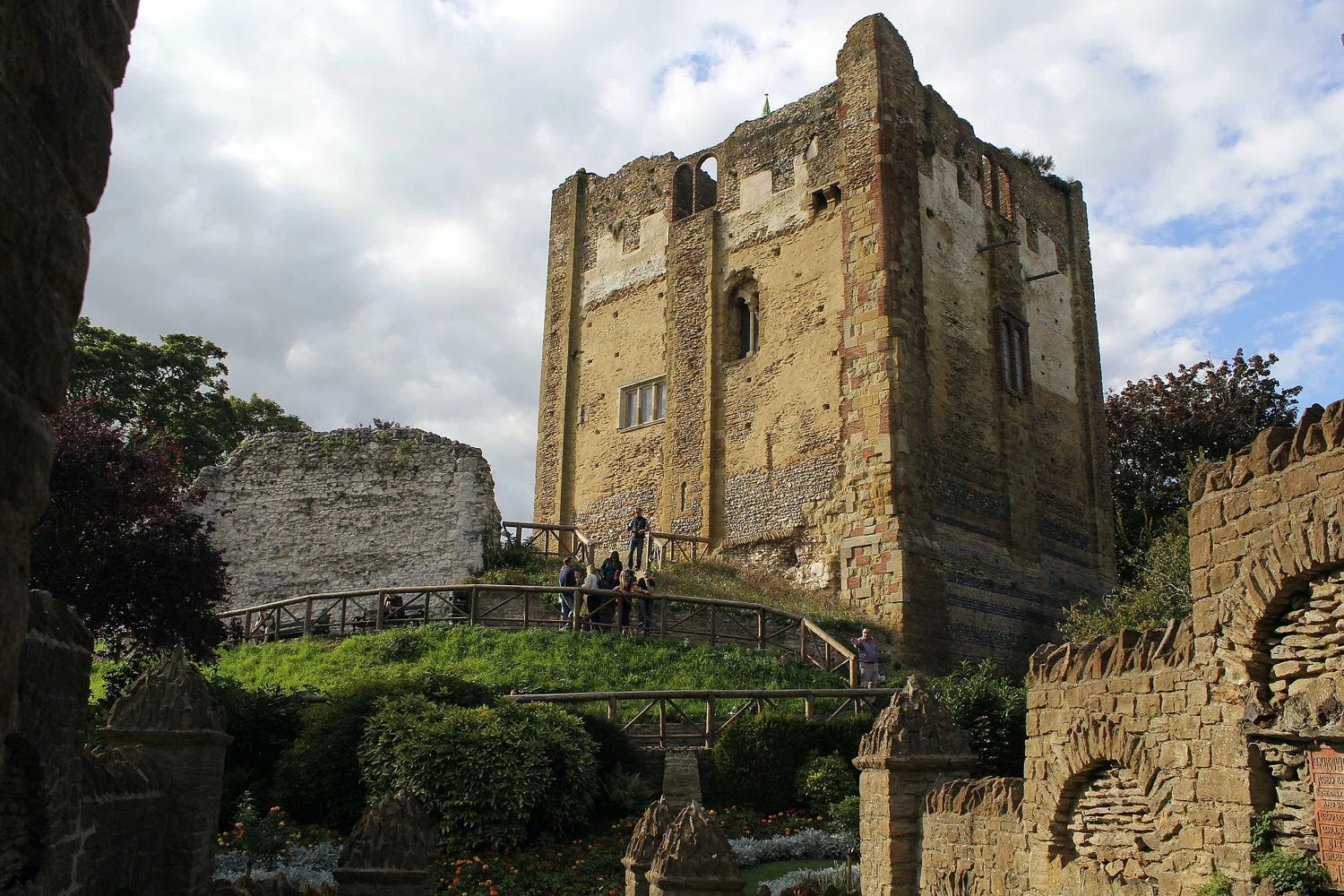
At the heart of Guildford, in Surrey, the old stone keep still dominates the town. A former royal castle, Guildford knew in the Renaissance not military glory, but a slow and significant reconversion: from fortress and gaol, it gradually became a mere dwelling, then a private property.
The decline of a royal castle
Guildford had long served as a royal castle and as the common gaol of Surrey and Sussex. But as early as 1487 — at the dawn of the Tudor age — it ceased to fulfil this penitentiary function, a sign that its usefulness was declining. Like so many medieval fortresses, it had no enemy left to fight nor prisoners to guard. Its twelfth-century Norman keep, once a symbol of royal power, now found itself disused at the heart of a prosperous town that no longer had a warlike use for it.
A domestic reconversion
Guildford's Tudor history is one of reconversion. As early as 1544, the Daborne family obtained the keeping of the site (John Daborne was appointed keeper of the castle garden) and modernised the old medieval keep, piercing it with brick windows and chimneys to make it habitable: the fortress was becoming a house. Then, in 1611, James I granted the estate to Francis Carter, definitively confirming its conversion into a private property and the end of its royal role. Guildford thus illustrates, in a single place, the fate of so many castles: from the military apparatus to civil and domestic use. To see: the twelfth-century stone keep (~14 × 14 m), the shell keep ruins, the Tudor brick windows and chimneys, the visitor centre and the castle garden.
Did you know?
One can read the end of the military Middle Ages on the very walls of Guildford: in the old Norman keep, designed for war, the Dabornes had large windows pierced and brick chimneys installed in the sixteenth century — still visible today. Where the enemy was watched through arrow-slits, light and hearth-fire were now sought.
Notes
Guildford Castle lies at Guildford, Surrey; keep, gardens and visitor centre open to the public (run by the town). Seasonal hours to check.
Quiz
- Which function did Guildford cease to fulfil in 1487?
- That of common gaol of Surrey and Sussex
- That of cathedral
- That of port
- What did the Dabornes do with the keep in the sixteenth century?
- They fitted it as a dwelling (brick windows, chimneys)
- They razed it
- They turned it into a church
- What did James I do with the estate in 1611?
- He granted it to a private man (Francis Carter)
- He returned it to the Church
- He fortified it