
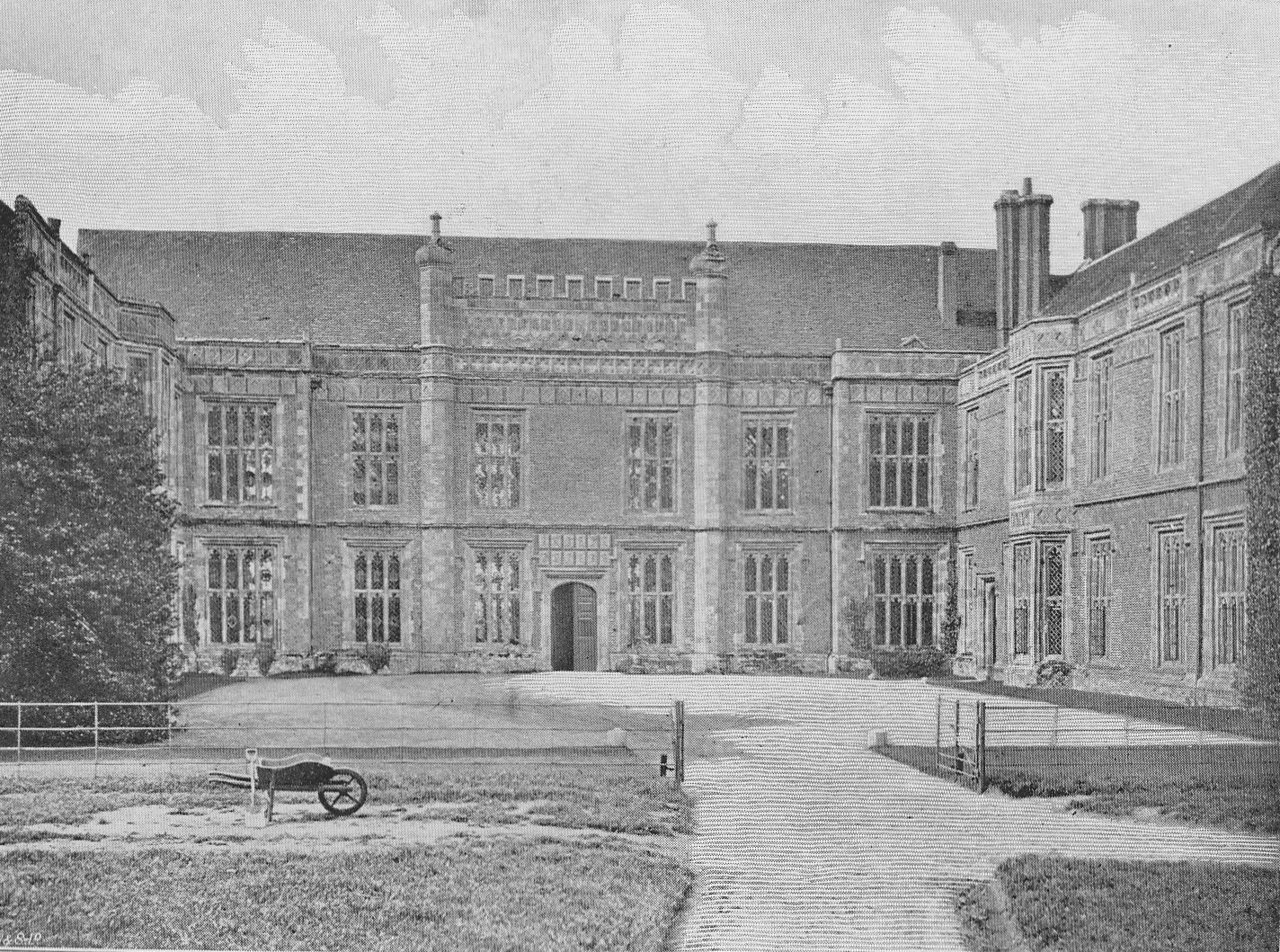
Near Guildford, in Surrey, Sutton Place holds a place apart in the history of English architecture: built around 1525, it is one of the very first houses of the realm conceived with no concern for defence — and one of the first to bring, onto its walls, the décor of the Italian Renaissance.
A house for peace, not for war
For centuries, the house of a great English lord remained, more or less, a defensible stronghold: thick walls, towers, battlements. Sutton Place breaks with this tradition. Built around 1525 by Sir Richard Weston, a courtier and intimate of Henry VIII, it was conceived from the outset as a residence of pleasure and display, without fortification. This confidence in the internal peace of the realm — the 'Pax Tudorica' — is in itself a novelty: under Henry VIII, a gentleman could at last build for comfort and beauty, not for protection.
The Italian terracotta décor
Sutton Place is famous above all for its moulded terracotta ornamentation: classical cupids, foliage, the builder's monograms, made from 40 to 50 different moulds. This décor, inspired by the continent, is one of the first manifestations in England of the ornamental vocabulary of the Italian Renaissance, then introduced at court by artists come from Italy. The house, with its painted armorial glass and its court, embodies that moment when England begins to look towards Italy. Elizabeth I stayed here on 26 September 1591. To see: the moulded terracotta façades, the painted armorial glass, the U-shaped court (once a full quadrangle) and the Weston chapel at Holy Trinity, Guildford. (A private house, restricted access.)
Did you know?
Sutton Place was one of the first great English houses built without the slightest concern for defence: no moat, no towers, no battlements. It is the sign of a silent revolution — under Henry VIII, internal peace had become secure enough for a lord to dare to build an open house, turned towards beauty rather than war.
Notes
Sutton Place lies at Woking, Surrey (about 5 km north-east of Guildford); a private house, restricted access. To be treated as an exceptional monument (architecture), not freely visitable.
Quiz
- What is innovative about Sutton Place (c. 1525)?
- It is one of the first undefended English houses
- It is entirely fortified
- It is of timber
- Which décor makes it famous?
- The moulded terracotta ornamentation (Italian Renaissance)
- Roman mosaics
- Gothic stained glass
- Who built it?
- Sir Richard Weston, courtier of Henry VIII
- Cardinal Wolsey
- Inigo Jones