
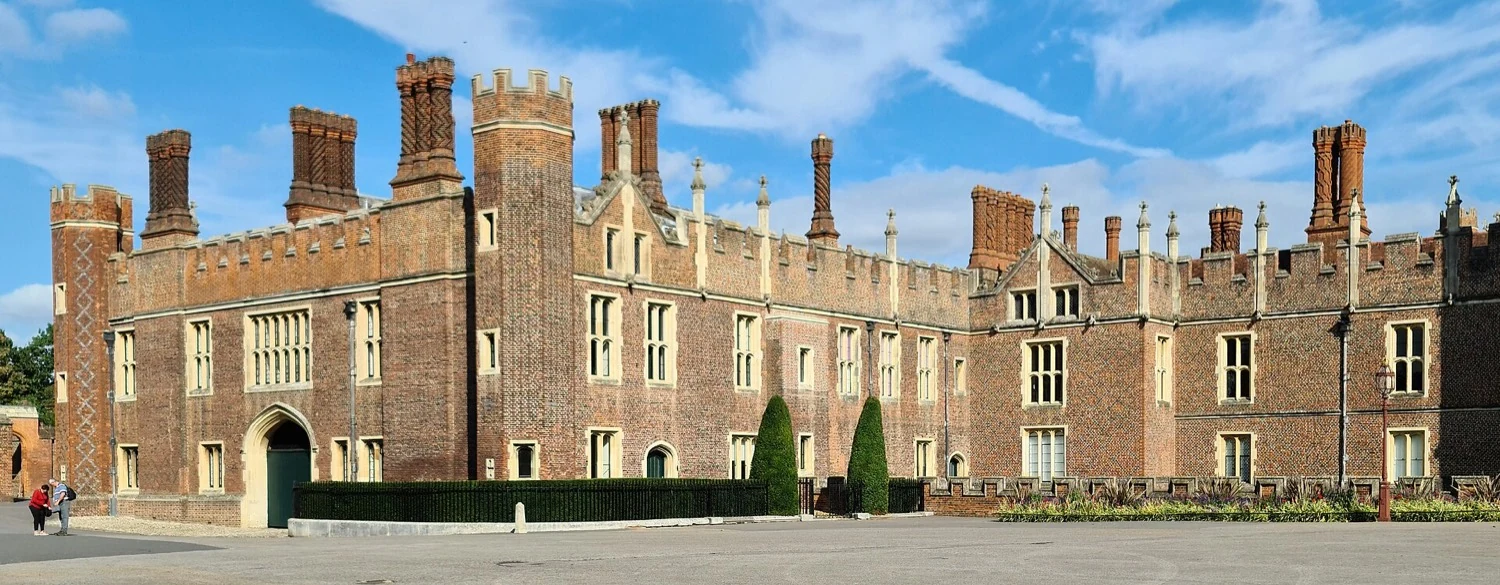
Around Henry VIII's brick palace, on the banks of the Thames, spread the gardens of Hampton Court: sixty hectares where, beneath the fittings of the centuries, the very idea of the English Renaissance garden survives — an enclosed, laid-out place, where power grants itself the luxury of nature mastered.
The garden as an extension of the palace
For the Tudors the garden was not a secondary setting but the natural extension of the palace, a space for walking, conversation and display. Henry VIII had walled gardens laid out at Hampton Court, adorned with geometric parterres, trellises painted in the royal colours (the green and white of the Tudors), heraldic beasts set on poles, and arbours. The Pond Garden, a sunken garden set around basins, keeps the truest memory of them. Here were grown flowers and herbs as well as pleasure for the eye: the Tudor garden mingled the useful, the symbolic and the sumptuous.
From the privy garden to the maze
The Privy Garden, the king's private garden, was reserved for the walks of the sovereign and his close circle, away from prying eyes. Over the reigns the gardens of Hampton Court were endlessly redesigned — French-style parterres, great avenues, the famous hornbeam maze (planted at the end of the seventeenth century), the great vine, the long vista towards the river. This layering of ages is the whole interest of the place: beneath the later strata the art of the Renaissance garden still shows through, the one where the Tudor court came to breathe, to plot and to be seen.
What to see
- The Pond Garden, a sunken enclosed garden, heir to the Tudor parterres.
- The site of the Privy Garden, the sovereigns' private garden.
- The famous hornbeam maze.
- The Great Vine and the long vistas towards the Thames.
Did you know?
The maze at Hampton Court, planted around 1690, is the oldest surviving hedge maze in the United Kingdom: half a hectare of hornbeam in which one still loses oneself with delight. It carries on a Tudor tradition of the garden as game and riddle — for the people of the Renaissance, to lose one's way among the hedges was an elegant way of tasting, in miniature, the giddiness of the world.
Practical information
The gardens of Hampton Court surround the palace of the same name, at Richmond upon Thames, upstream of London. They are in the care of Historic Royal Palaces and open to the public, with the maze and the enclosed gardens. Hours, prices and access to the maze are liable to change with the seasons; it is best to check them against the official sources before visiting.
Quiz
- In which colours were the trellises of the Tudor gardens painted?
- Green and white (the Tudor colours)
- Red and gold
- Blue and silver
- Which sunken garden keeps the memory of the Tudor parterres?
- The Pond Garden
- The Tuileries garden
- The Boboli garden
- What is special about the Hampton Court maze?
- It is the oldest hedge maze in the United Kingdom
- It is the largest in the world
- It is made of stone