
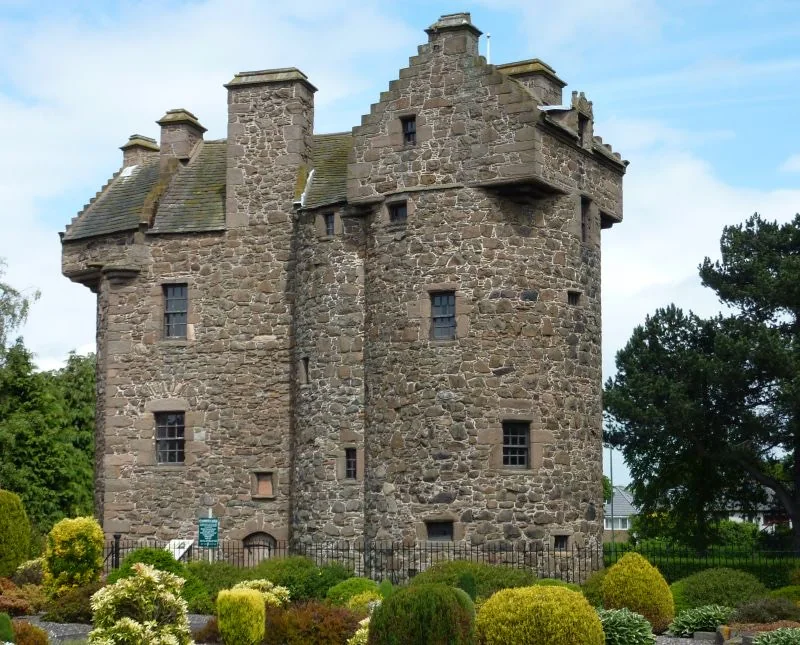
At West Ferry, at the gates of Dundee, Claypotts is one of the best-preserved Z-plan tower houses in Scotland — built entirely in the full Renaissance, between 1569 and 1588, by a man the Reformation had just raised.
From tenant to builder
Before the Reformation of 1560, the Strachans worked the lands of Claypotts as tenants of Lindores Abbey. The collapse of the Catholic Church gave them a new status: become owners, they asserted it by building their own castle. John Strachan raised it between 1569 (a date carved on one tower) and 1588 (on the other): a three-storey rectangular block flanked by two large round towers capped with corbelled square gabled chambers. Claypotts thus illustrates, in stone, the social redistribution wrought by the Reformation. To see: the two round towers with square chambers, the stones dated 1569 and 1588, the almost intact Z-plan.
Did you know?
Claypotts bears, carved on its two towers, the dates 1569 and 1588: nineteen years of building legible to the naked eye. Yet the Strachan family left the castle soon after John's death in 1593; it later passed to the camp of 'Bonnie Dundee', John Graham of Claverhouse.
Notes
Claypotts Castle lies at West Ferry, Dundee; a site in the care of Historic Environment Scotland (limited access). Hours to check.
Quiz
- Which plan does Claypotts have?
- The Z-plan
- The circular plan
- The cross plan
- How did the Reformation benefit the Strachans?
- Abbey tenants, they became owners and built
- They became bishops
- They were exiled
- Which dates are carved on the towers?
- 1569 and 1588
- 1066 and 1215
- 1707 and 1745