
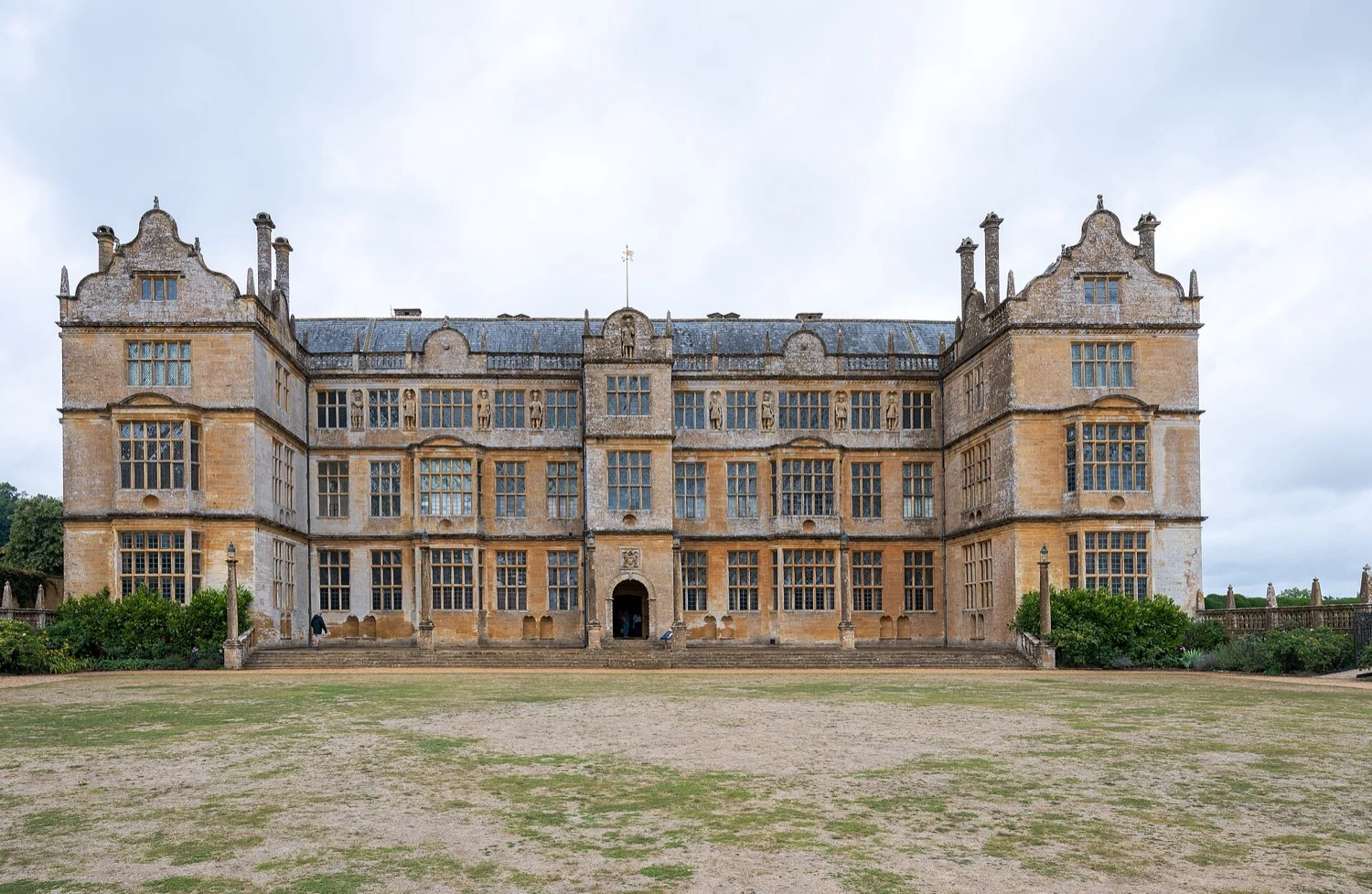
In a Somerset village, Montacute House raises its golden, perfectly symmetrical façade, in the fine Ham stone that takes on, at sunset, tints of honey. Built at the end of Elizabeth I's reign by the Phelips family, it is one of the most accomplished and harmonious houses of the English Renaissance.
The house of an ambitious lawyer
Montacute was raised around 1598 by Sir Edward Phelips, a brilliant lawyer who would become Master of the Rolls and preside, in 1606, over the trial of the Gunpowder plotters. A new man enriched by his career, Phelips wanted a house that would proclaim his success. He had it built in Ham stone (Ham Hill stone), the local golden limestone whose warm hue makes all the charm of the house. Montacute belongs to the last generation of the great Elizabethan houses: perfect symmetry, an H-plan, long galleries, generous windows. Nothing ostentatious to excess like Wollaton, but a serene balance — elegance rather than excess.
A gallery for walking and portraits
The jewel of Montacute is its Long Gallery, the largest surviving in England: a vast panelled corridor running the whole length of the top floor, where guests came to walk, converse and admire the portraits hung on the walls in all weathers. Today this gallery holds a collection of Tudor and Elizabethan portraits lent by the National Portrait Gallery — so that the house, designed for display, now displays the very faces of the age that saw it born. Around it, the walled gardens and the corner pavilions complete this masterpiece of harmony.
What to see
- The golden façade in Ham stone, perfectly symmetrical.
- The Long Gallery, the largest in England, and its Tudor portraits.
- The walled gardens and the corner pavilions.
- The great hall and the interiors of the Phelips family.
Did you know?
The long gallery of Montacute, designed for the walks of the elegant of the sixteenth century, is today the hall of the faces of their time: it holds a selection of Tudor and Elizabethan portraits from the National Portrait Gallery — kings, queens, courtiers, explorers. So, in the house built to assert one man's rank, there now throng, ranged along the walls, all those who made the English Renaissance: the house has become the portrait of its own century.
Practical information
Montacute House lies at Montacute, near Yeovil, in Somerset, in the south-west of England. It is today a house in the care of the National Trust, open to the public with its gardens. Opening hours and days are liable to change; it is best to check them against the official sources before visiting.
Quiz
- In which golden stone is Montacute built?
- Ham stone (Ham Hill stone)
- Carrara marble
- Cornish granite
- What does the long gallery of Montacute hold today?
- Tudor portraits from the National Portrait Gallery
- A collection of armour
- A library of manuscripts
- Which lawyer had Montacute built around 1598?
- Sir Edward Phelips
- Sir John Thynne
- Sir Christopher Hatton