
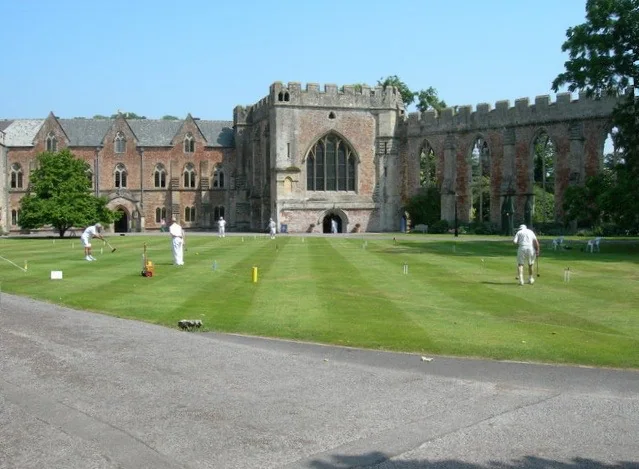
Beside the cathedral of Wells, in Somerset, the Bishop's Palace raises its crenellated walls amid moats peopled with swans. The residence of the Bishops of Bath and Wells since the Middle Ages, it bears the scars of the Reformation: its ruined great hall bears witness to the brutalities the Church's property suffered in the sixteenth century.
A palace coveted under the Reformation
The palace of Wells was, before the turmoil, a rich episcopal residence: its Bishop's House (north wing) of the fifteenth century dates from Bishop Beckington, and the whole, surrounded by moats and ramparts, was as much castle as prelate's house. But the Reformation overturned everything. In 1548, Bishop William Barlow sold the palace to Edward Seymour, Duke of Somerset and Lord Protector of the realm — one of those great laymen who, at the summit of power under Edward VI, appropriated the Church's holdings. The palace returned to the bishops only in 1552, after the fall and execution of Somerset.
The ruined great hall
Barlow's tenure left a visible and desolate mark: the bishop had the lead taken off the roofs of the great hall of the palace, no doubt to profit from it. Deprived of its covering, the hall decayed and fell into ruin — the state in which it is still seen. This deliberate devastation of part of his own residence illustrates the climate of the time: under the Reformation, even prelates took part in the dismantling of the ecclesiastical heritage, by calculation or by compulsion. To see: the ruins of the great hall (north wall, arcade bases), the Gothic chapel, the moats with their swans trained to ring a bell for food, the Bishop's Eye (gatehouse, c. 1450), and the 'Glastonbury Chair'.
Did you know?
The swans of the Wells moat know how to ring for dinner: since the nineteenth century they have been trained to pull a bell hung on the gatehouse wall to ask for their food — a tradition still kept up. The palace that lost the lead of its great hall under the Reformation has thus become famous, centuries later, for its bell-ringing swans.
Notes
The Bishop's Palace lies at Wells, Somerset, beside the cathedral; palace, gardens and moats open to the public. Hours to check.
Quiz
- To whom did Bishop Barlow sell the palace in 1548?
- To Edward Seymour, Duke of Somerset
- To the pope
- To Walter Raleigh
- What did Barlow do with the great hall?
- He had the lead taken off the roof (it fell into ruin)
- He enlarged it
- He gilded it
- What are the Wells moats famous for?
- Their swans trained to ring a bell
- A sea monster
- A floating island