
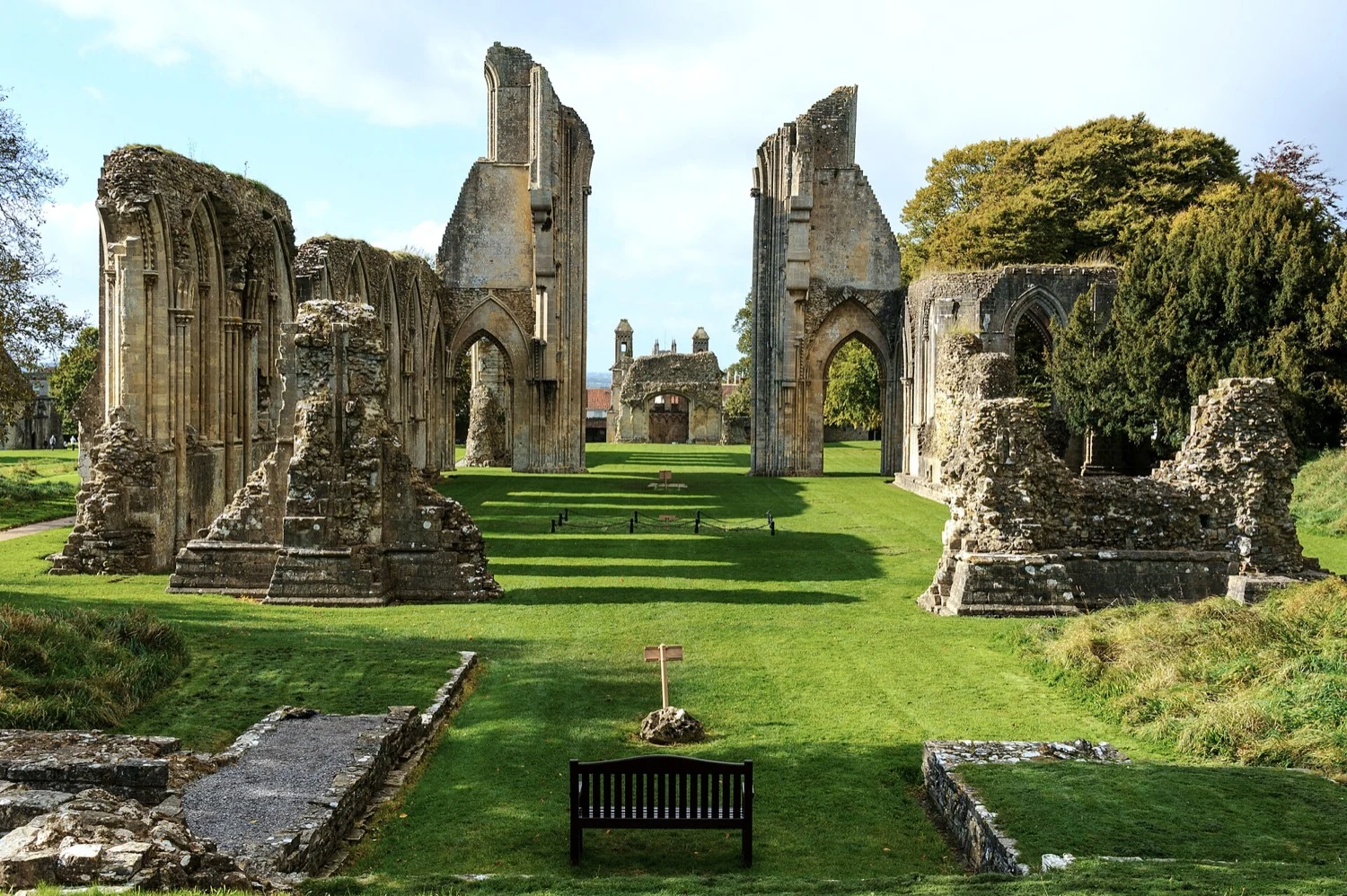
On the Somerset plain, dominated by the conical hill of the Tor, the ruins of Glastonbury Abbey evoke a lost grandeur. Once the richest and most revered of England's abbeys, it was, in 1539, one of the most tragic victims of the dissolution of the monasteries.
The spiritual heart of England
Glastonbury claimed to be the oldest Christian sanctuary in the island: legend had Joseph of Arimathea come here bearing the Grail, and claimed to have discovered here, in the Middle Ages, the grave of King Arthur and Queen Guinevere. Rich in these myths and in immense estates, the Benedictine abbey was, on the eve of the Reformation, the second richest in England, a centre of pilgrimage radiating over the whole kingdom. Its great abbey church was among the largest in the country. Nothing seemed able to shake such spiritual and material power.
1539: the end and the ordeal
Henry VIII's break with Rome sealed its fate. As the great abbeys fell one by one, the last abbot, Richard Whiting, refused to surrender Glastonbury to the Crown. Accused of treason at the end of a mock trial orchestrated by Thomas Cromwell's agents, he was, in November 1539, dragged on a hurdle to the top of the Tor, the hill that dominates the plain, and hanged, nearly eighty years old, then quartered. The abbey was stripped, its treasures seized, its buildings given over to the quarrymen. Of the kingdom's second abbey there soon remained only sections of wall standing in the grass — and, on top of the Tor, the solitary tower of a chapel, the only witness of the drama.
What to see
- The ruins of the abbey church, sections of wall and arches in the meadow.
- The Lady Chapel and the best-preserved remains.
- Glastonbury Tor and its solitary tower (St Michael), the place of the 1539 ordeal.
- The memory of the Arthurian legends and the Grail.
Did you know?
On the Tor where Abbot Whiting was hanged still stands the tower of a chapel dedicated to St Michael — all that remains of the church that crowned it. From this wind-swept summit the whole Somerset plain can be taken in. The place, charged with legends (the Grail, Avalon, King Arthur), thus became the very symbol of the Dissolution: a sacred hill turned, on a day in 1539, into a gallows for the last keeper of the old faith.
Practical information
Glastonbury lies in Somerset, in the south-west of England. The abbey ruins may be visited (a site in the care of a trust); the Tor, in free access, is climbed on foot and offers a view over the region. The abbey's hours are liable to change; it is best to check them against the official sources before visiting.
Quiz
- What rank did Glastonbury hold among England's abbeys?
- The second richest in the kingdom
- The smallest in the country
- A mere hermitage
- Where was the last abbot Richard Whiting hanged in 1539?
- On top of Glastonbury Tor
- At the Tower of London
- In the square of Bath
- Which legend is attached to Glastonbury?
- The grave of King Arthur and the Grail
- The birth of Elizabeth I
- The crowning of kings