
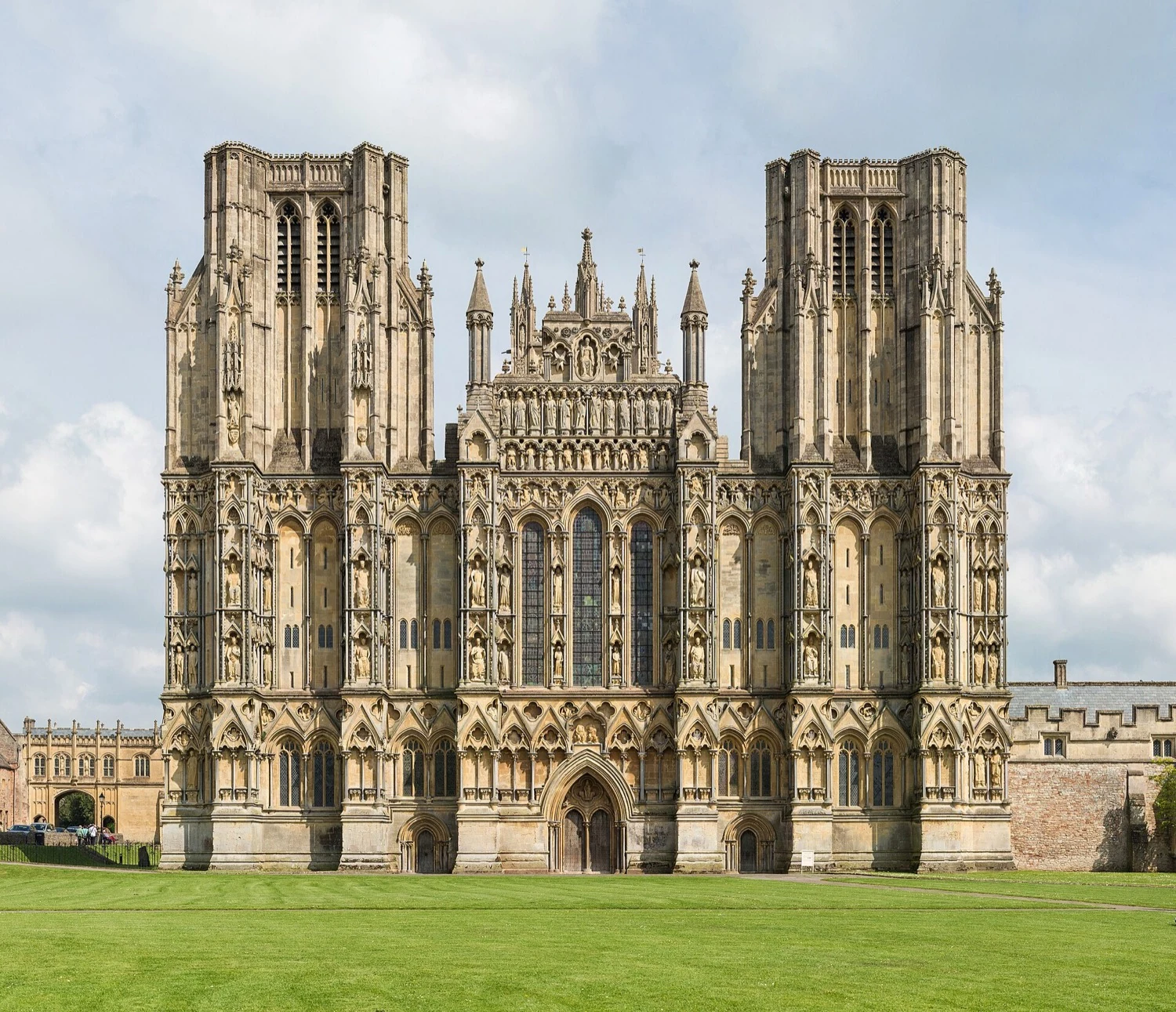
In the small city of Wells, at the foot of the Mendip Hills, rises one of the finest Gothic cathedrals in England, famous for its statue-peopled front and for its medieval astronomical clock. Beside it, the Vicars' Close lines up the houses of the oldest intact residential street in Europe.
A cathedral with a peopled front
Built mainly in the twelfth and thirteenth centuries, Wells Cathedral is famous for its west front, an immense reredos of stone that held hundreds of statues of saints, kings and angels — one of the greatest ensembles of medieval sculpture in the country. Inside, the extraordinary 'scissor arches', added in the fourteenth century to support the tower, offer one of the most striking images in English architecture. In the Renaissance the cathedral passed through the storms of the Reformation: many statues and images were mutilated by the iconoclasts, but the building, remaining an episcopal see, kept most of its splendour.
The clock and the vicars' street
Wells has one of the oldest working astronomical clocks in England (its mechanism dates from the late fourteenth century): every hour, mechanical knights charge in a tournament and one of them is unhorsed, a spectacle that has delighted visitors for six centuries. Close by, the Vicars' Close is a street unique in the world: built in the fourteenth century to house the vicars (the clerks who sang the services), lined with identical chimneyed houses, it is held to be the oldest intact planned residential street in Europe. This ensemble — cathedral, clock, close — makes Wells a rare witness of the ecclesiastical life that carried on, almost unchanged, from the Middle Ages to the Renaissance.
What to see
- The west front and its hundreds of medieval statues.
- The scissor arches supporting the central tower.
- The astronomical clock and its mechanical tournament.
- The Vicars' Close, the oldest intact residential street in Europe.
Did you know?
The astronomical clock of Wells has worked since the late fourteenth century: every hour, four little wooden knights charge in a circular tournament, and the same one is unhorsed each time, for more than six hundred years. The original mechanism, one of the oldest in the world still in working order, is today kept at the Science Museum in London, while a copy keeps the knights turning at Wells. Few human machines have played the same scene for so long.
Practical information
Wells Cathedral and the Vicars' Close lie at Wells, in Somerset, in the south-west of England. The cathedral is a working place of worship, open to visitors outside services; the Vicars' Close, inhabited, can be walked freely from outside. Hours are liable to change; it is best to check them against the official sources before visiting.
Quiz
- What is the west front of Wells famous for?
- Its hundreds of medieval statues
- Its gilded dome
- Its modern stained glass
- What is the Vicars' Close?
- The oldest intact residential street in Europe
- An underground cloister
- A market square
- What do the knights of the Wells astronomical clock do?
- They fight a tournament every hour
- They ring the bells
- They guard the treasure