
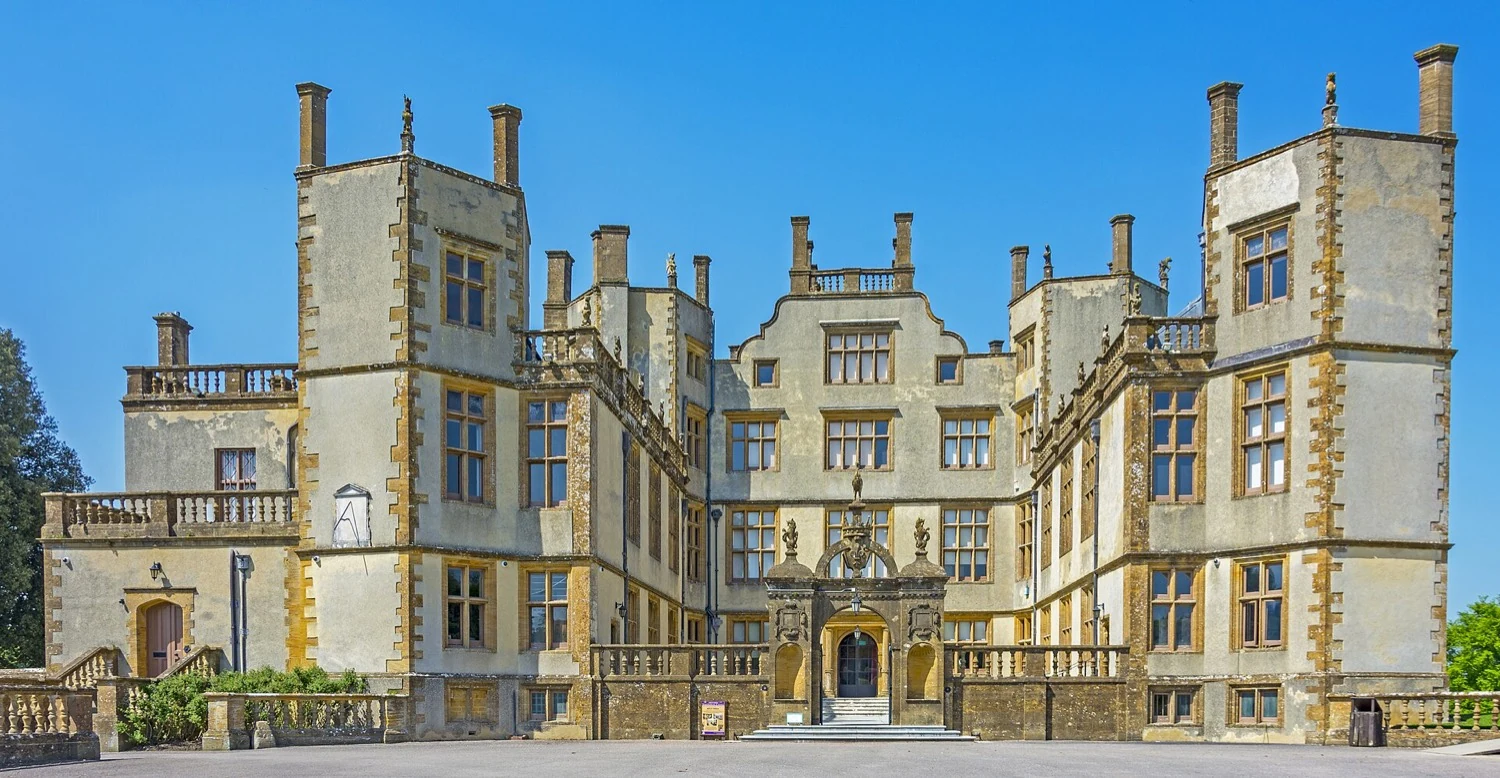
South-east of Sherborne, in Dorset, Sherborne Castle is not a fortress but an elegant brick house, born of the taste of one man: Sir Walter Raleigh, courtier, poet, navigator and favourite of Elizabeth I. It embodies a telling choice of the late reign: to prefer modern comfort to the restoration of the old.
Raleigh's choice: to build new
In 1592, Elizabeth I leased to Walter Raleigh the estate of Sherborne, with its old medieval castle. Raleigh first tried to modernise this ancient episcopal fortress — but the discomfort of the old stone put him off. He then chose, in 1593-1594, to have an entirely new house built right beside it: the 'Sherborne Lodge', a four-storey brick pavilion, flanked by polygonal corner turrets. This course — to abandon the feudal castle for a pleasure residence of human scale — is characteristic of the late Tudor age, when people ceased to protect themselves in order to lodge with elegance.
From disgrace to the Digbys
Sherborne's history followed that of its master. After Raleigh's disgrace under James I (imprisoned, then executed in 1618), the estate reverted to the Crown, which sold it in 1617 to Sir John Digby, future Earl of Bristol. The Digbys enlarged Raleigh's pavilion with four wings in the 1620s, giving it its present silhouette. The antiquary John Aubrey nicely described the original block as 'a delicate lodge in the park, of brick, not big, but very convenient for the bigness'. To see: the original rectangular block with its polygonal turrets, the entrance hidden in a corner tower (to preserve the symmetry of the façade), the Digby wings of the 1620s, the park (Capability Brown's lake) and the ruins of the neighbouring old castle.
Did you know?
So as not to spoil the fine symmetry of his façade, Raleigh had the entrance to his pavilion hidden in a corner tower, instead of placing it in the centre as custom required. Concern for visual harmony now prevailed over convenience: this is the whole spirit of the waning Renaissance, when a house had above all to be beautiful to look at.
Notes
Sherborne Castle lies south-east of Sherborne, Dorset; house and park open to the public. Seasonal hours to check.
Quiz
- Who had the Sherborne Lodge built in 1593-1594?
- Sir Walter Raleigh
- Henry VIII
- Cardinal Wolsey
- Why did Raleigh build new rather than restore?
- The discomfort of the old medieval castle
- A fire
- An order of the queen
- To whom was the estate sold in 1617?
- To Sir John Digby, future Earl of Bristol
- To Francis Drake
- To the pope