
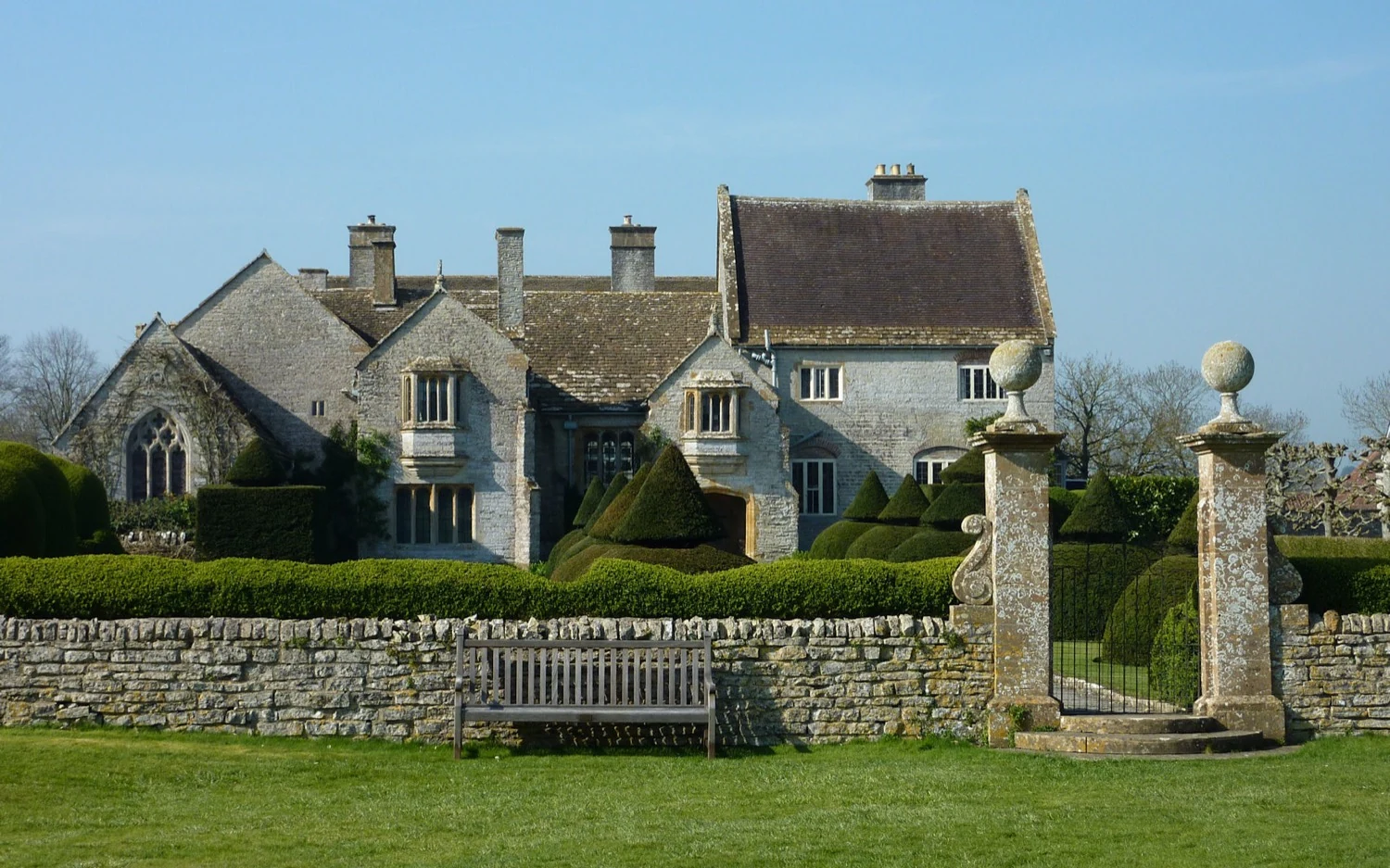
In the Somerset countryside, near Somerton, Lytes Cary is an intimate manor that grew gently through the Renaissance, in the hands of one and the same family: the Lytes. To its medieval great hall they added, generation after generation, the comfortable rooms of the new taste — and one of them wrote here a book that made its fame.
A house that grew with the Lytes
The great hall of Lytes Cary goes back to the fifteenth century, with its roof adorned with carved angels bearing the family's arms. But it was in Tudor times that the house took its face: in the early sixteenth century the entrance porch, the Oriel Room and new parlours were added. In 1533, John Lyte — an agent of Henry VIII's government in Somerset — remodelled the Great Parlour and proudly displayed his arms there; his Great Chamber bears the royal arms and Tudor roses, an ostensible mark of loyalty to the king. Among the gentry, to display the royal emblem on one's walls was at once a homage and an insurance.
Henry Lyte and the queen's herbal
The fame of Lytes Cary owes most to Henry Lyte (c. 1529-1607), botanist and son of the house. In 1578, he published the Niewe Herball, an English adaptation of a great Flemish herbal, which he dedicated to Elizabeth I: it is one of the major works of English Renaissance botany, at a time when the study of plants — medicinal, edible, ornamental — fascinated scholars and gardeners. The family's taste for plants can still be read in the inventory drawn up in 1618 by Thomas Lyte, which listed more than sixty varieties of apple in the orchard alone. To see: the great hall and its angel roof, the Great Chamber with its plaster ceiling and the Lyte arms, the Oriel Room, and a copy of the Lytes Herbal on display.
Did you know?
The master of Lytes Cary catalogued his orchard as a scholar catalogues a collection: in 1618, Thomas Lyte inventoried more than sixty varieties of apple, not counting pears, plums, cherries and vines. In this family where herbals were written for the queen, even the orchard was a matter of erudition.
Notes
Lytes Cary Manor lies near Charlton Mackrell, Somerset; a National Trust property, house and gardens open to the public. Seasonal hours to check.
Quiz
- Which emblem did John Lyte have set on his Great Chamber?
- The royal arms and Tudor roses
- An imperial eagle
- A fleur-de-lys
- What did Henry Lyte write in 1578?
- A herbal (Niewe Herball), dedicated to Elizabeth I
- A play
- A map of Somerset
- What does the 1618 inventory reveal?
- More than 60 apple varieties in the orchard
- A hoard of jewels
- A private army