
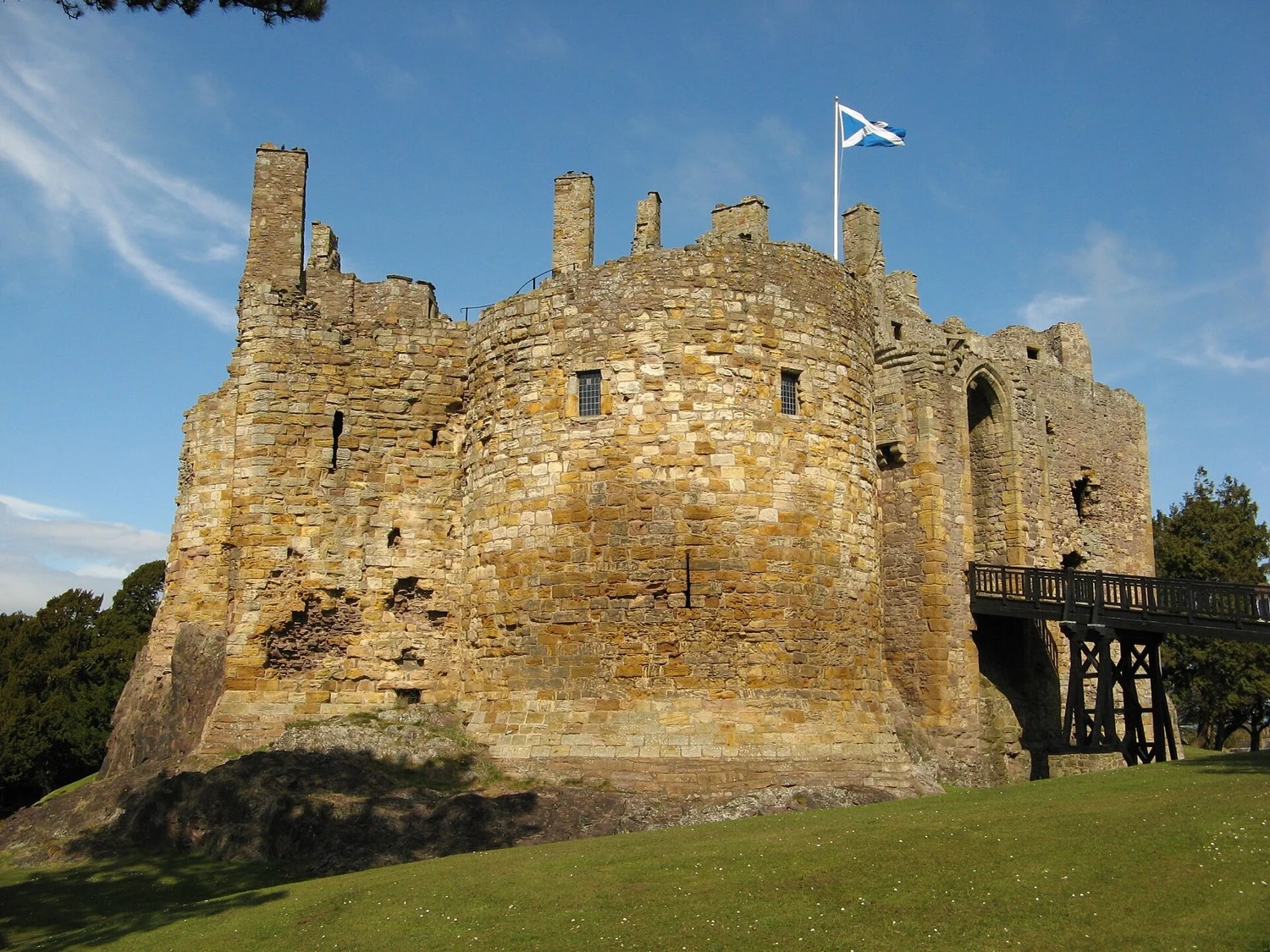
At the heart of the village of Dirleton, in East Lothian, the fortress raises its rose-pink towers above a dry ditch and flowering terraces. A castle of war in the Middle Ages, Dirleton becomes, in the Renaissance, something else: the residence of the Ruthvens, a great family with a shattered destiny, and the setting of the pleasure gardens that make its fame today.
From fortress to pleasure domain
Built in the thirteenth century by the De Vaux, remodelled by the Halyburtons, the fortress passed in the sixteenth century to the Ruthvens, one of the most powerful — and most dangerous — houses in Scotland. William Ruthven, 1st Earl of Gowrie, held it when his family was defying the Crown: it was he who, in 1582, seized the young king James VI in the 'Raid of Ruthven' to wrest power from the royal favourites. Such daring is paid for: Gowrie was executed in 1584, and the Ruthvens would sink for good after the mysterious 'Gowrie conspiracy' of 1600. The castle, confiscated, then passed to Thomas Erskine, the man who had saved the king that day. From then on Dirleton ceased to be a contested stronghold to become a domain of prestige.
The gardens and the great dovecote
It is to its gardens that Dirleton owes its renown. From the sixteenth century, terraces, a bowling green and parterres were laid out around the castle, among the oldest pleasure gardens in Scotland; the horticultural tradition was carried on there right up to the vast Victorian herbaceous border, long the longest in the world. The domain also keeps a splendid sixteenth-century dovecote (doocot), with some thousand nesting-boxes — a mark of status as much as a living larder. To pass from the lord's vaulted hall to the flowering terraces is to read, in one place, the whole movement of the Scottish Renaissance: from military survival to the taste for living well. To see: the medieval towers and the ditch, the great hall and the vaulted kitchens, the terraced gardens and the sixteenth-century dovecote.
Did you know?
The master of Dirleton, the Earl of Gowrie, once held the king of Scotland himself prisoner of his own will: during the Raid of Ruthven (1582) the young James VI, detained by the Ruthvens, is said to have burst into tears; he was told that 'it was better that bairns should weep than bearded men'. The castle that saw this insolence passed, two years later, into the hands of the man who had saved that same king.
Notes
Dirleton Castle lies in the village of Dirleton, East Lothian (about 3 km west of North Berwick); a site in the care of Historic Environment Scotland. Hours to check.
Quiz
- Which family held Dirleton in the Renaissance?
- The Ruthvens
- The Stuarts
- The Campbells
- What was the Raid of Ruthven (1582)?
- The seizure of the young king James VI by the Ruthvens
- A battle against England
- A tournament
- What is Dirleton famous for today?
- Its pleasure gardens and its dovecote
- Its cathedral
- Its theatre