
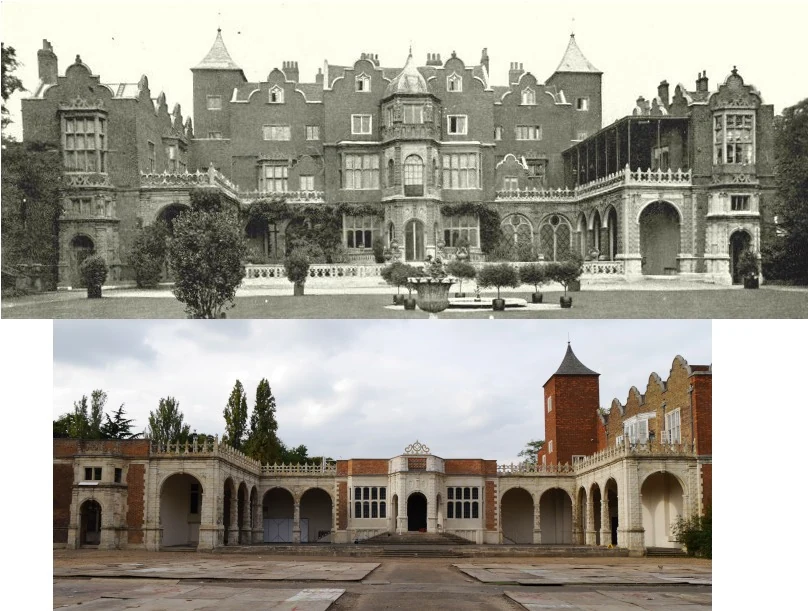
At the heart of Holland Park, an isolated wing and rose-brick arcades stand among the lawns: it is all that remains of Holland House, one of the great Jacobean mansions of London, built in 1605 and cut down by German bombs in 1940.
A Jacobean prodigy house of 1605
The house was raised in 1605 for Sir Walter Cope, a diplomat close to James I, who first called it "Cope Castle". Look at what survives of the south front: the rose brick, the gables, the stair turrets and the columned loggias added around 1638 by the sculptor Nicholas Stone betray the exuberance of the Elizabethan and Jacobean house of display — the "prodigy house", built to dazzle the court and to receive it. Passing by marriage to the Rich family, Earls of Holland, it gave its name to the district.
From Whig salon to ruin
In the eighteenth and nineteenth centuries, Holland House became the most famous political and literary salon in London, the heart of the Whig party: Byron, Sheridan and Macaulay all passed through. Then, on the night of 27 September 1940, the incendiary bombs of the Blitz gutted the house; only the east wing and parts of the front survived. The remnant, Grade I listed, now serves as the backdrop to an open-air theatre and a youth hostel, in the middle of the park. Don't miss: the Jacobean east wing, Nicholas Stone's arcades, the brick south front, the park and its gardens.
Did you know?
The most famous photograph of Holland House shows not the house intact but its library blown open by a bomb in 1940 — and, amid the rubble under a bare sky, three men in hats calmly browsing the shelves still standing. The image travelled the world as a symbol of British composure under the Blitz. The Renaissance house was already half destroyed when it became a legend.
Info
Holland House is in Holland Park (Kensington, London); the ruins are freely accessible within the public park, and the east wing houses a youth hostel. Park open daily.