
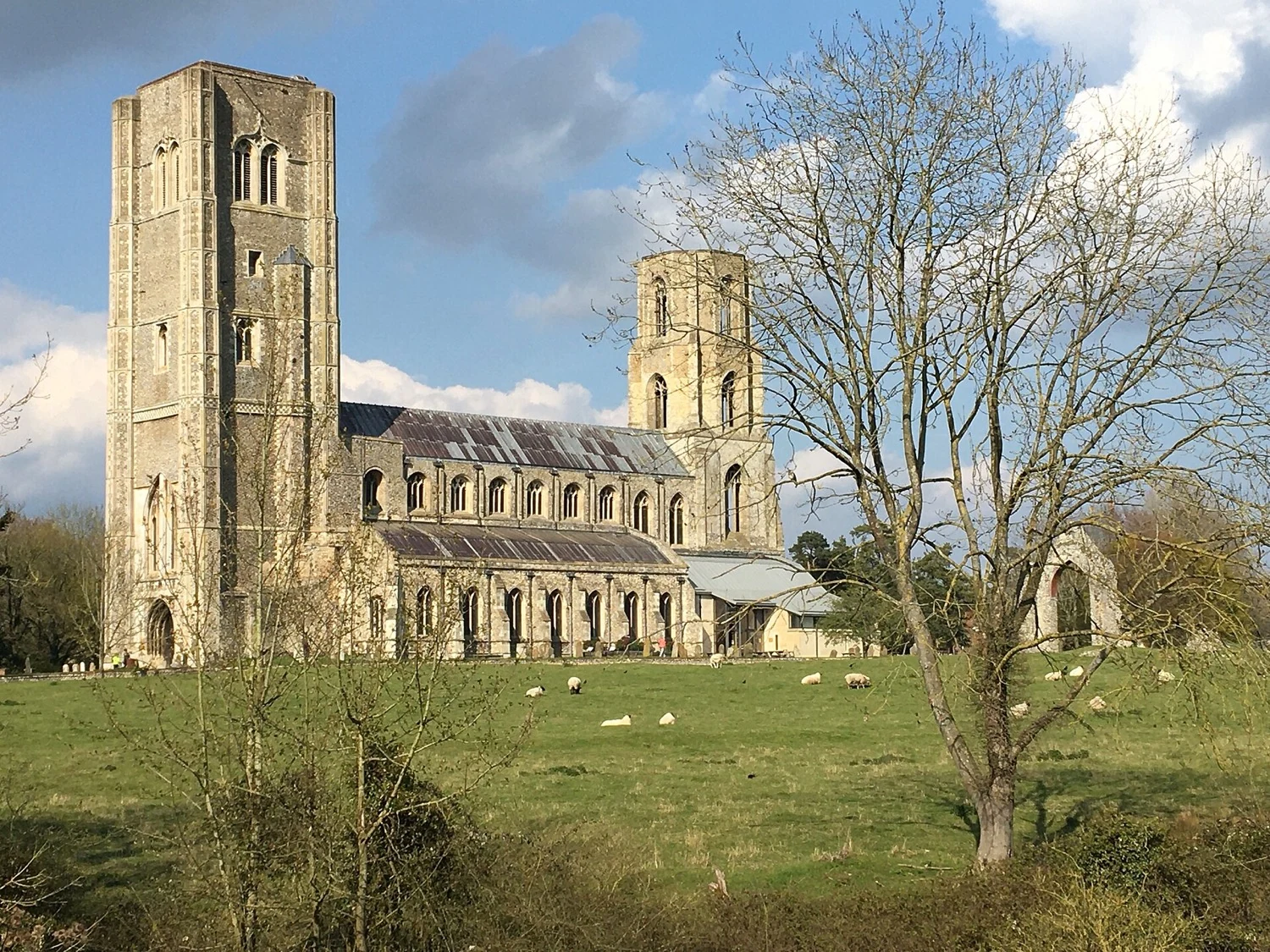
In Norfolk, Wymondham Abbey raises its two towers above a village that was, in 1549, the cradle of the greatest popular revolt of Edward VI's reign. A former Benedictine abbey whose nave survived the Dissolution, it bears the memory of an uprising born of a quarrel over its own lands.
An abbey that survives the Dissolution
A Benedictine abbey, Wymondham was dissolved in 1538, its surrender received by the royal commissioner John Flowerdew. As in other towns, the nave survived by becoming a parish church, while the monastic buildings fell into ruin — hence the present two-tower silhouette (the square west tower begun in 1447, the octagonal east tower now ruined). The church keeps a fine Renaissance witness: a terracotta sedilia of Renaissance style, around 1520, a rare décor imported from continental tastes on the eve of the Reformation.
The cradle of Kett's Rebellion
But Wymondham entered history above all as the starting point of Kett's Rebellion (1549). The spark flew from a quarrel over the lands of the dissolved abbey: the commissioner John Flowerdew, who had appropriated monastic holdings and practised enclosures (the appropriation of common lands), came into conflict with a local notable, Robert Kett. Spectacularly, Kett changed sides: he put himself at the head of the peasants revolting against the enclosures, turning a local dispute into an immense uprising that set Norfolk ablaze and almost took Norwich. Repressed in blood, the revolt ended with Kett's execution at Norwich Castle. To see: the two towers (square west, ruined octagonal east), the Norman nave with its angel roof (c. 1450), the Renaissance terracotta sedilia (c. 1520).
Did you know?
The greatest revolt of Edward VI's reign was born of a reversal: Robert Kett, at first a target of the angry peasants (he too practised enclosures), suddenly joined them, pulled down his own fences and took the head of the uprising. From this improbable conversion — a man who sides with those he should have fought — came a movement of thousands of peasants, a fortified camp on Mousehold Heath, and one of the great cries of social justice of the English Renaissance.
Notes
Wymondham Abbey lies at Wymondham, Norfolk; a working parish (abbey) church, open to visits. Hours to check.
Quiz
- What did the nave of Wymondham become after 1538?
- A parish church (the abbey was dissolved)
- A castle
- A port
- Which revolt began at Wymondham in 1549?
- Kett's Rebellion
- The Rising of the North
- The Gunpowder Plot
- Which Renaissance décor does the church keep?
- A terracotta sedilia (c. 1520)
- A Roman mosaic
- A Flemish stained-glass window