
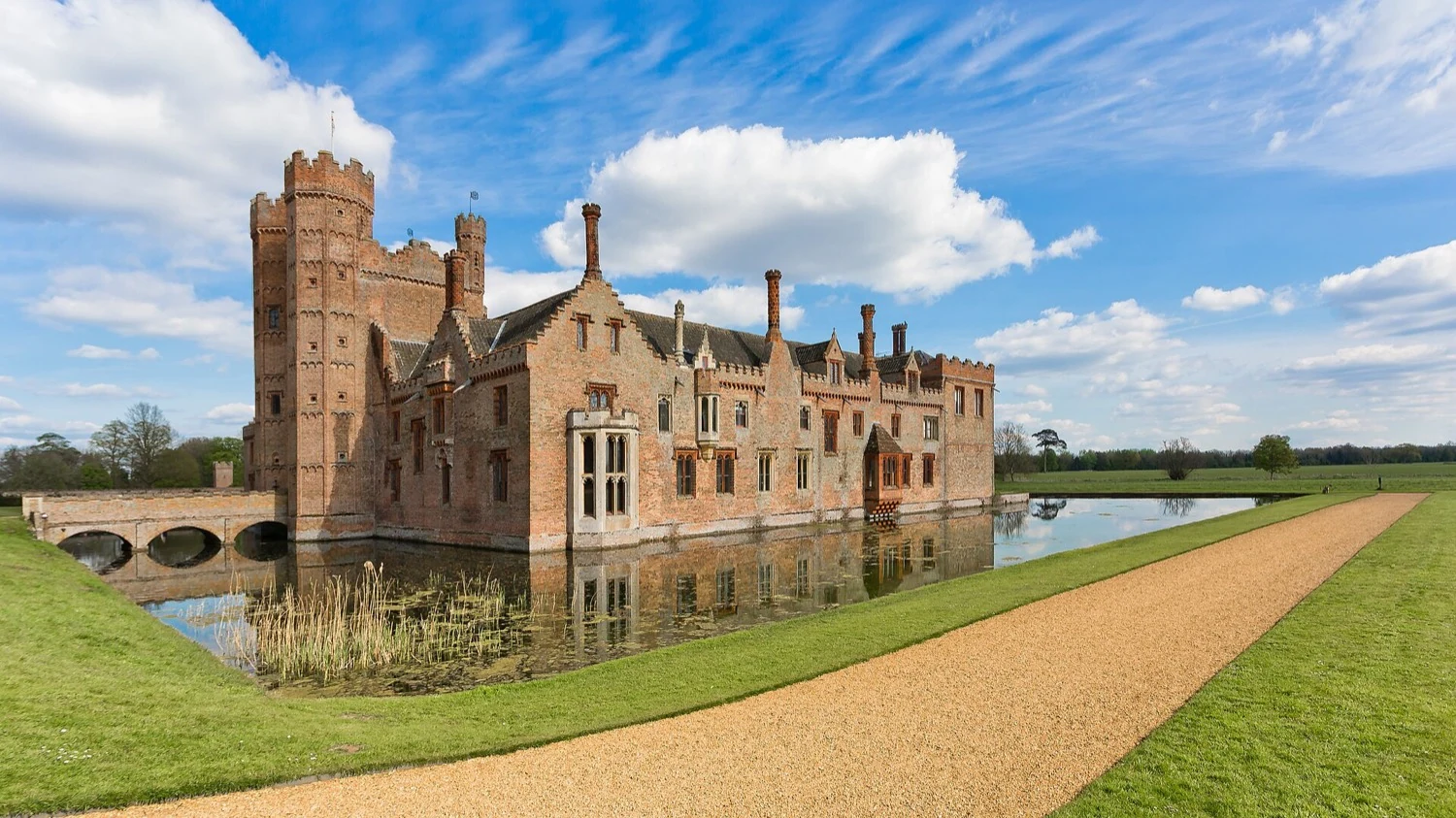
In Norfolk, Oxburgh Hall mirrors itself in its moat behind a superb brick gatehouse. Built in the fifteenth century by the Bedingfeld family, who stayed faithful to Catholicism through the whole Reformation, this manor keeps a rare treasure: embroideries worked, it is said, by Mary Queen of Scots herself.
The manor of a faithful family
Oxburgh was built from 1482 by Sir Edmund Bedingfeld, who obtained the right to 'crenellate' his house: hence its tall turreted brick gatehouse, one of the finest in England, more decorative than defensive. But what sets Oxburgh apart is the constancy of its owners: the Bedingfelds remained Catholic after Henry VIII's break with Rome, and stayed so for centuries, at the cost of fines, suspicion and exclusion. Like other 'recusant' families, they fitted into the house a priest hole, a secret recess in which to conceal a Catholic priest during searches. Oxburgh is thus a witness of the England that refused the Reformation and paid dearly for its loyalty.
The embroideries of Mary Stuart
The manor's treasure is a set of embroidered panels attributed to Mary Queen of Scots and to Bess of Hardwick, her gaoler. During her long captivity in England, the deposed Scottish queen spent her days embroidering, an activity of patience and of memory; into it she slipped mottoes and emblems charged with hidden meaning. These works, later gathered at Oxburgh, are among the most moving relics of her tragic fate. A Catholic manor of Norfolk thus keeps, embroidered in thread and silk, the mute testimony of a captive queen.
What to see
- The turreted brick gatehouse (1482), and the moated manor.
- The priest hole, witness of the Catholic resistance.
- The embroideries attributed to Mary Queen of Scots and Bess of Hardwick.
- The gardens and the setting reflected in the moat.
Did you know?
Catholic families like the Bedingfelds had 'priest holes' fitted into the thickness of the walls — tiny hiding places in which to conceal a priest during the raids of the Crown's agents. Many were devised by the Jesuit Nicholas Owen, an expert in trapdoors and false floors, later tortured to death. At Oxburgh one can still slip into one of these hides: a hole in the wall that says, better than a long speech, what it cost to keep the old faith.
Practical information
Oxburgh Hall lies near Swaffham, in Norfolk, north-east of London. It is today a manor in the care of the National Trust, open to the public with its gardens. Opening hours and days are liable to change; the embroideries, being fragile, may be shown in a limited way. It is best to check against the official sources before visiting.
Quiz
- To which faith did the Bedingfeld family remain loyal despite the Reformation?
- Catholicism
- Calvinism
- Anglicanism
- Which embroidered treasure does Oxburgh keep?
- Embroideries attributed to Mary Queen of Scots
- The Bayeux Tapestry
- Holbein's cartoons
- What is a 'priest hole'?
- A secret hiding place to conceal a priest
- An underground chapel
- A royal confessional