
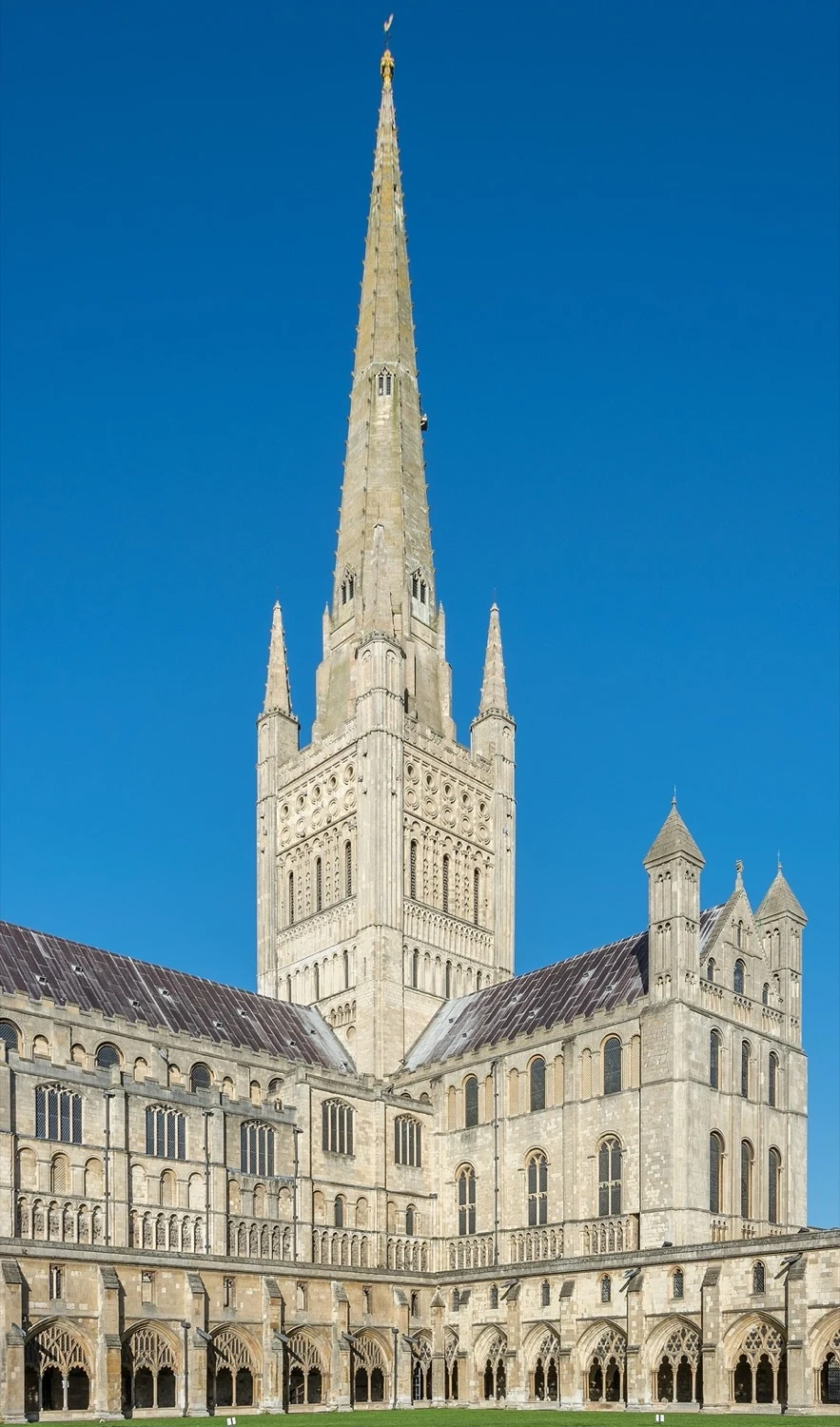
Its stone spire — the second tallest in England — has soared above Norwich since the late fifteenth century. Two landmarks frame almost exactly our period in the history of this cathedral: the completion of its spire around 1485, and its refounding in 1538 at the Reformation. And beneath its vaults shone the English music of the Renaissance.
From the spire to the Reformation
The present stone spire of Norwich was completed around 1480-1485, after lightning had destroyed the previous one in 1463 — a technical feat that raises it to second rank among English spires, just behind Salisbury. Half a century later, the Reformation struck: at the Dissolution, in 1538, the rich Benedictine priory that served the cathedral was dissolved, and the establishment refounded as a secular cathedral, endowed with a dean and canons. It is the classic pattern of the Henrician Reformation applied to a great monastery: the monastic community disappears, the building and the worship remain, under a new organisation.
A home of English music
Norwich was also a high place of Renaissance music. The composer Osbert Parsley was a singer here for some fifty years (until his death in 1585), coming through all the religious upheavals of the century while composing for the choir. The great madrigalist and organist Thomas Morley, one of the major names of Elizabethan music, was also linked with it. The cathedral thus recalls that the English Renaissance, if it was first literary, was also musical — and that its cathedrals were its conservatories. To see: the stone spire (c. 1485), the 64 misericords of the stalls (many of the fifteenth-sixteenth centuries), the cloister and its carved bosses.
Did you know?
A mere singer of Norwich, Osbert Parsley, served the cathedral for half a century — from the end of Henry VIII's reign to Elizabeth I —, coming through unbroken all the religious reversals that saw the Latin Mass abolished, restored, then abolished again. His music, for its part, has survived. An epitaph in the cathedral salutes in him a man 'whose name shall live as long as the art of sound endures'.
Notes
Norwich Cathedral lies at Norwich, Norfolk; a working cathedral, open to visits. Hours to check.
Quiz
- What happened at Norwich Cathedral in 1538?
- Dissolution of the priory, refounding as a secular cathedral
- A coronation
- A fire
- What is exceptional about its spire?
- It is the 2nd tallest in England (c. 1485)
- It is of gold
- It leans
- Which composer was a singer here for 50 years?
- Osbert Parsley
- William Byrd
- Thomas Tallis