
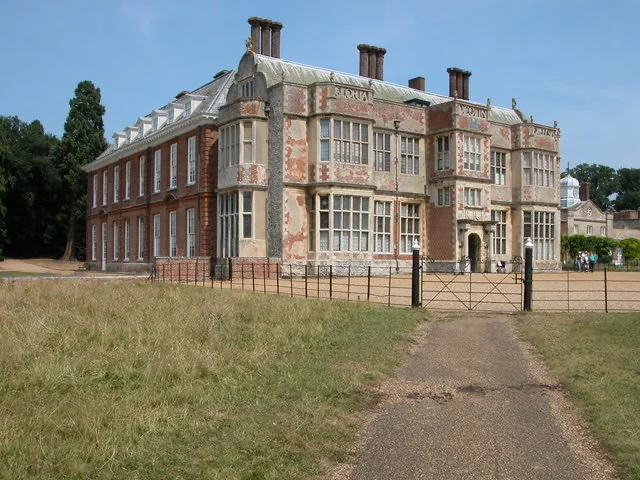
In Norfolk, near Cromer, Felbrigg Hall is the seat of the Wyndhams, one of the county's great families since the late fifteenth century. Its Jacobean façade, raised at the very end of our period, bears a profession of faith carved in stone — a sign of the spirit of an age when architecture spoke.
The domain of the Wyndhams
The estate passes to the Wyndhams as early as the 1460s, at the dawn of the Tudor age. Thomas Wyndham, one of its masters, was a councillor of Henry VIII (died 1522) — the family thus belonged to that gentry of service that kept local government running and gravitated around the court. Remaining in the same line until the twentieth century, the house has come through the centuries without rupture, accumulating the layers of its history. The Renaissance core of Felbrigg rests first on this family continuity, anchored in Tudor Norfolk.
The Jacobean façade of 1624
The Renaissance jewel of Felbrigg is its Jacobean east wing, built around 1624 (probably by John Wyndham, 1558-1645) — at the very hinge of the end of our window. Its façade with projecting bays is crowned with an inscription in openwork stone, cut through: GLORIA DEO IN EXCELSIS ('Glory to God in the highest'), surmounted by the family's heraldic beasts. This way of making one's house a declaration — religious and dynastic — is very characteristic of the Jacobean spirit: the house does not merely shelter, it proclaims. To see: the Jacobean façade with projecting bays, the openwork inscription GLORIA DEO IN EXCELSIS, the Wyndham heraldic beasts.
Did you know?
The façade of Felbrigg literally cries out its faith: atop its great bays, the words GLORIA DEO IN EXCELSIS are cut through the stone, standing out against the sky like a mineral banner. In Jacobean times, a gentleman's house was also a manifesto: one carved on it one's arms and one's devotion, so that the stone might tell the passer-by who one was and what one believed.
Notes
Felbrigg Hall lies at Felbrigg, near Cromer, Norfolk; a National Trust property (Grade I), house, gardens and park open to the public. Seasonal hours to check.
Quiz
- Which family has held Felbrigg since the fifteenth century?
- The Wyndhams
- The Howards
- The Boleyns
- What does the inscription of the Jacobean façade proclaim?
- GLORIA DEO IN EXCELSIS
- A battle date
- A line of Shakespeare
- From when does the east wing date?
- From around 1624 (end of the period)
- From 1066
- From the Victorian era