
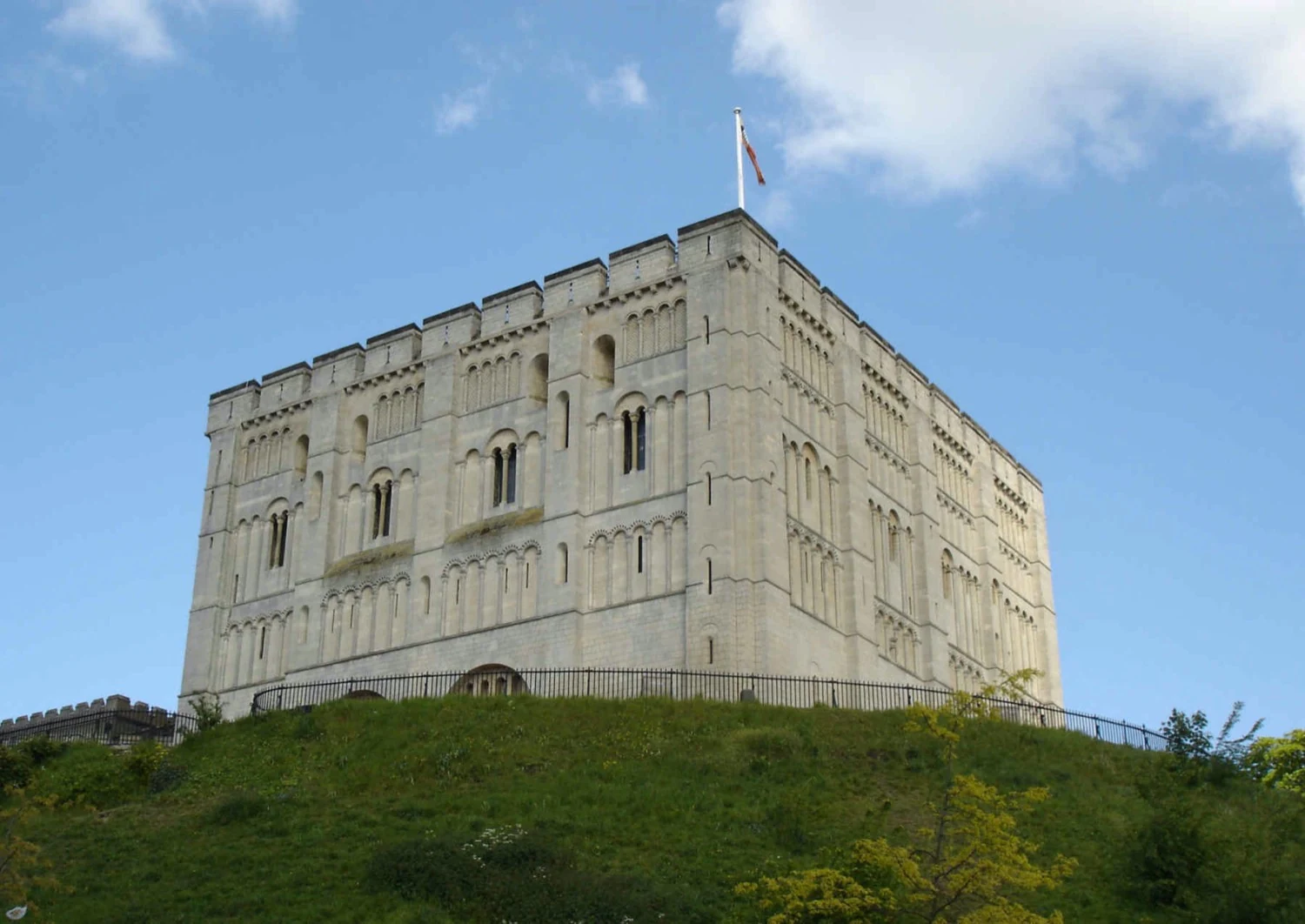
Dominating Norwich, one of the largest Norman keeps in England sits on its motte at the heart of the city. Under the Tudors, it no longer served as a royal residence but as the county gaol and a judicial theatre — and it was there that, in 1549, one of the greatest popular uprisings of the English Renaissance ended.
The gaol of the county of Norfolk
Built from 1094 to 1121, the keep of Norwich served from the thirteenth century and throughout the Tudor period as the prison of the county of Norfolk — a function it kept until 1887. Its massive walls held common-law prisoners and political accused; its approaches were the place of public executions. In a great merchant city like Norwich — the second in England at the time — the castle thus embodied the king's justice and the repressive power of the state, more than war.
The end of Robert Kett (1549)
In 1549, under the reign of Edward VI, Kett's Rebellion set Norfolk ablaze: thousands of peasants, led by Robert Kett, protested against enclosures — the appropriation of common lands by the great owners. It was one of the greatest uprisings of the century. After its bloody repression, Kett was tried, dragged from the Guildhall to the castle, and hanged in chains from a gibbet raised on the west ramparts, on 7 December 1549, 'in the name of Edward VI'. His body was left to rot as an example. Norwich Castle thus remains the memorial of a crushed popular revolt. To see: the Norman keep (original volumes, façade refaced in the nineteenth century), the west ramparts (place of Kett's hanging), the medieval galleries of the museum.
Did you know?
The body of Robert Kett was hanged in chains from the ramparts of Norwich Castle and left there to decompose, as a warning to anyone who might think of revolting. More than four centuries later, the man once executed as a traitor is celebrated at Norwich as a popular hero, a defender of the poor against enclosures: a plaque on the castle now honours 'a notable and courageous man'.
Notes
Norwich Castle lies at Norwich, Norfolk; keep and museum open to the public. Hours to check.
Quiz
- What did Norwich Castle serve as under the Tudors?
- The gaol of the county of Norfolk
- A royal palace
- A cathedral
- Who was hanged here in 1549?
- Robert Kett, leader of the revolt
- Anne Boleyn
- Thomas More
- What did Kett's Rebellion protest against?
- Enclosures (appropriation of common lands)
- Taxes on wine
- The war against Scotland