
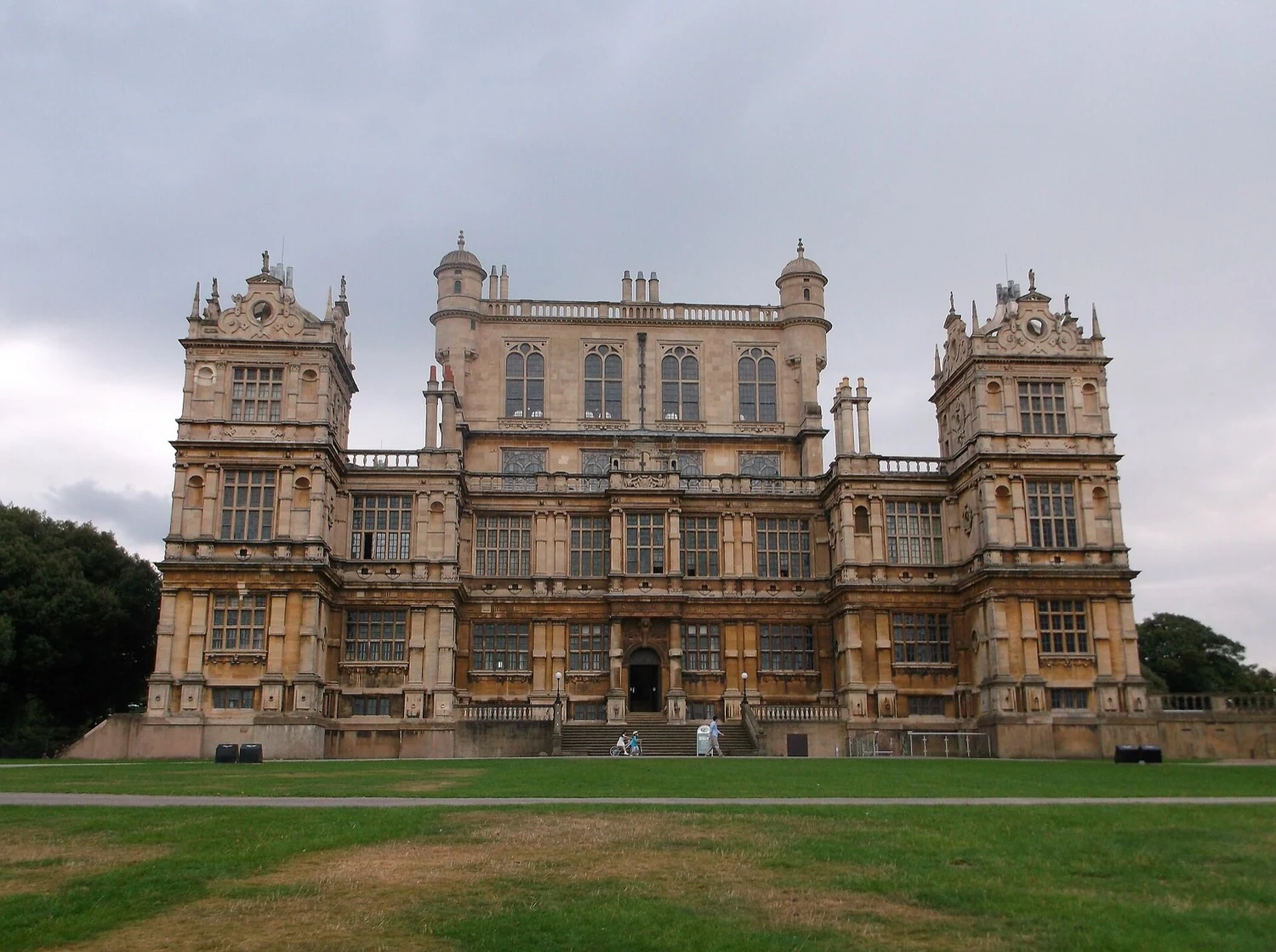
On a height overlooking Nottingham, Wollaton Hall stands like a stage set: a compact, fantastic mass, bristling with pinnacles and turrets, crowned with a glazed high hall that seems to float above the rest. It is the most daring work of the architect Robert Smythson, built for the rich and proud Sir Francis Willoughby.
The pride of a coal man
Sir Francis Willoughby, whose fortune rested on the coal mines of Nottinghamshire, wanted, at the end of the sixteenth century, a house that would crush all others. He entrusted the project to Robert Smythson, already the designer of Longleat and Hardwick. Between 1580 and 1588 Smythson designed a house without equal: a compact, symmetrical plan, with no inner court, dominated by an immense 'High Hall' rising above the whole building like a glazed keep. Willoughby spent without counting, blending into his house motifs borrowed from the Italian and Flemish architectural treatises of the day.
A manifesto of architecture
Wollaton is less a house than a demonstration: Smythson piles up classical pilasters, pediments, statues, obelisks and giant windows, in an exuberance verging on excess. The house asserts that the English architect can now compose as learnedly as those of the Continent. Inside, the High Hall, lit by tall clerestory windows, was the theatrical heart of the house. But pride had its price: ruinous spending and family quarrels darkened Willoughby's end. Wollaton remains the most spectacular — and most extravagant — of the masterpieces of the English Renaissance.
What to see
- The theatrical silhouette, bristling with pinnacles, overlooking Nottingham.
- The central High Hall, raised and glazed, the heart of the composition.
- Smythson's exuberant Renaissance decoration (pilasters, pediments, statues).
- The deer park surrounding the house.
Did you know?
The building of Wollaton nearly ruined its builder: Sir Francis Willoughby sank into it a huge part of his mining fortune, and the quarrels with his wife and daughters poisoned his last years. He died deep in debt, leaving a sublime house and a torn family — proof that, in Elizabethan England, the race for the finest prodigy house could cost as dear as a reign.
Practical information
Wollaton Hall lies at Nottingham, in the centre of England. The house today holds a municipal natural history museum and is surrounded by a vast deer park open to the public. Opening hours and days are liable to change; it is best to check them against the official sources before visiting.
Quiz
- Which architect designed Wollaton Hall?
- Robert Smythson
- Inigo Jones
- Christopher Wren
- On what wealth did Sir Francis Willoughby's fortune rest?
- The coal mines
- The wool trade
- Banking
- What crowns the silhouette of Wollaton?
- A glazed high hall (High Hall)
- A Gothic bell tower
- A gilded dome