
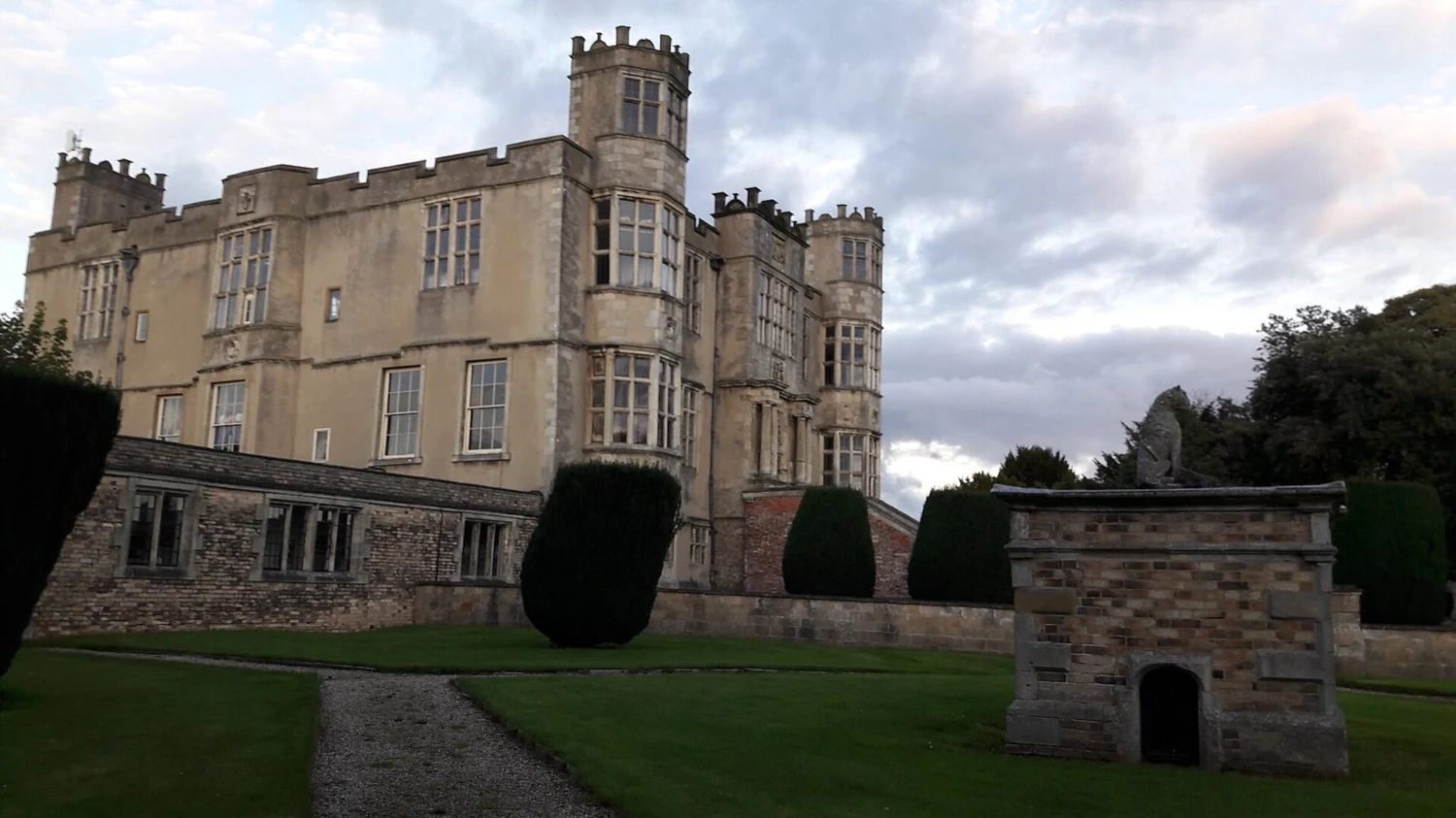
In Derbyshire, Barlborough Hall raises a strikingly vertical silhouette: a compact, tall house, almost an inhabited tower, bristling with turrets and pierced by great windows. It is a work of the greatest architect of Elizabethan England, Robert Smythson, the man of Hardwick Hall and Wollaton.
A manifesto house by Robert Smythson
Barlborough was built in 1583-84 for Francis Rodes, a prosperous judge. Look at the scheme: instead of spreading the house out in length, Smythson gathers it on an almost square plan, around a small central court, and raises it over three tall storeys. The corners are marked by projecting polygonal turrets; the front is rhythmic, symmetrical, heavily glazed. It is a laboratory: here Smythson tries the vertical house, "tall rather than broad", which he would carry to its summit at Hardwick ("more glass than wall") a few years later.
The invention of the "prodigy house"
Barlborough belongs to that generation of houses called prodigy houses: built not to defend but to dazzle, where glass, height and symmetry replace ramparts. The house, now a school, keeps its air of a pleasure fortress. Don't miss: the corner turrets, the symmetrical glazed front, the vertical silhouette, the park.
Did you know?
Robert Smythson is perhaps the first man in England who can be called an "architect" in the modern sense: not a mason, but a designer of plans who signs a style. To him we owe Longleat, Wollaton, Hardwick — and, more intimate, Barlborough. On his tomb he was named "architecter" — a word then so new it almost had to be invented.
Info
Barlborough Hall is at Barlborough (Derbyshire); the house is a private school; exteriors visible from the approaches, interior visits exceptional. Access to be checked.