
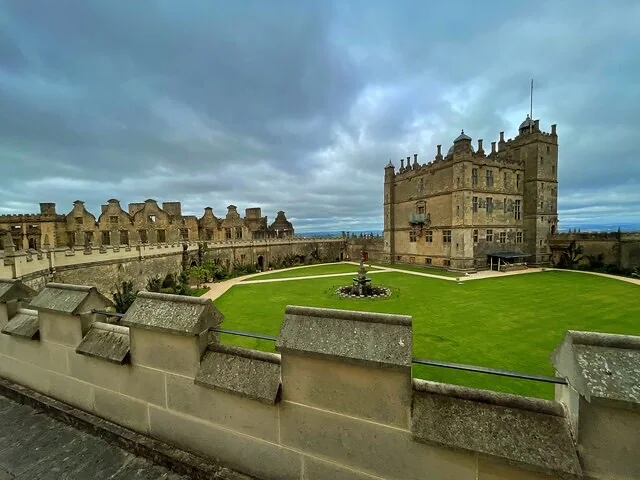
On its ridge above the valley, Bolsover Castle is not a fortress but a dream: a small pleasure "castle" built in the early seventeenth century by the immensely rich Cavendish family, with the Smythson architects, to play at the chivalry of another age while offering the most modern comfort.
The "Little Castle" of 1612-1621
In 1612, Charles Cavendish (son of Bess of Hardwick) demolished an old medieval fortification and undertook, with Robert Smythson then his son John, a new building: the Little Castle, completed around 1621. Look at its silhouette — a compact, battlemented keep, deliberately archaic — then its interiors: painted vaults, chimneypieces of polychrome marble, panelling, a dazzling Mannerist refinement. It is a "mock castle": the shell of a stronghold, the soul of a pleasure palace.
Feasts, riding house and excess
Charles's son, William Cavendish, poet, horseman and future Duke of Newcastle, completed and magnified the place: he added a long feasting gallery (Terrace Range) and a splendid riding house — for the equestrian art, the high school, was his passion. In 1634 he received Charles I here with a sumptuous masque by Ben Jonson. Don't miss: the Little Castle and its painted interiors, the Venus fountain, the seventeenth-century riding house, the terrace gallery, the view over the valley.
Did you know?
The riding house at Bolsover, with its timber roof and its arena, is one of the oldest in England: William Cavendish practised the "manège" here — the learned horsemanship, an aristocratic art from Italy and France, in which the rider has the horse perform codified figures. He even published an illustrated treatise on it. At Bolsover, to ride was not to travel: it was a courtly art, staged like a ballet.
Info
Bolsover Castle is at Bolsover, near Chesterfield (Derbyshire); a site managed by English Heritage, open to the public. Seasonal hours to be checked.