
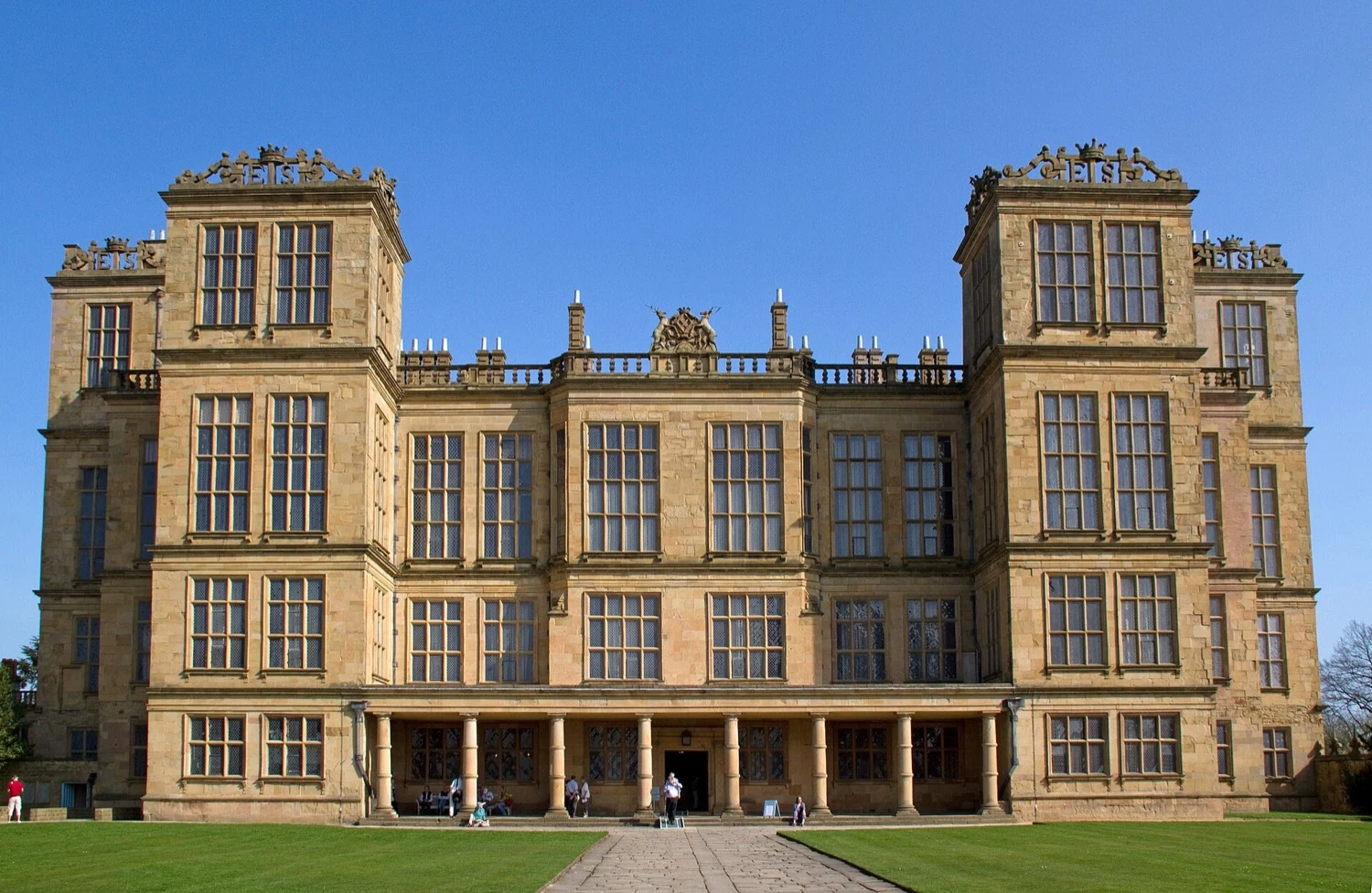
On a Derbyshire hill, Hardwick Hall raises its towers crowned with immense windows, so vast that contemporaries summed up the house in a phrase that has stayed famous: 'Hardwick Hall, more glass than wall.' It is the masterpiece of the architect Robert Smythson — and the monument of an extraordinary woman, Bess of Hardwick.
Bess of Hardwick, the builder
Born into a modest Derbyshire family, Elizabeth Talbot, known as Bess of Hardwick (1527-1608), rose through four successive marriages to become, after Elizabeth I, the richest woman in England. Widowed for the fourth time and estranged from her last husband, she returned to her native lands and, at over sixty, set out to build the house that would carry her name and her glory. Between 1590 and 1597 she had Hardwick raised by the finest architect of the age, Robert Smythson. The house is the assertion of a female power without equal: on top of every tower, her initials 'ES' (Elizabeth Shrewsbury), carved and crowned, proclaim to all the winds whose palace this is.
The triumph of glass
Hardwick carries Elizabethan architecture to its height. Its perfectly symmetrical façade rises in a cliff of windows growing ever taller the higher one climbs: on the top floor, the long gallery and the state rooms bathe in a light then unheard of, for glass, still costly, was an ostentatious luxury. Inside, the long gallery, the 'High Great Chamber' adorned with a plaster frieze, the tapestries and the great staircase make up one of the best-preserved ensembles of the English Renaissance — an interior kept almost intact since Bess herself.
What to see
- The symmetrical glass façade, 'more glass than wall'.
- The crowned initials 'ES' on top of the six towers.
- The long gallery and the 'High Great Chamber' with its plaster frieze.
- The tapestries and original furniture, exceptionally preserved.
Did you know?
Glass, in the sixteenth century, was expensive: to crown one's towers with immense windows was, for Bess of Hardwick, a way of displaying her fortune as surely as covering her walls with gold. The phrase 'Hardwick Hall, more glass than wall' was not only a description: it was the observation, admiring or envious, that a woman who had started with nothing was affording herself the most insolent of luxuries — light.
Practical information
Hardwick Hall lies near Chesterfield, in Derbyshire, in the centre of England. It is today a house in the care of the National Trust, open to the public with its gardens; the neighbouring 'Old Hall' (a ruin) is in the care of English Heritage. Opening hours and days are liable to change; it is best to check them against the official sources before visiting.
Quiz
- Which famous phrase sums up the architecture of Hardwick Hall?
- 'More glass than wall'
- 'The brick palace'
- 'The house without windows'
- Which woman had Hardwick Hall built?
- Bess of Hardwick
- Elizabeth I
- Mary Queen of Scots
- What is seen, carved, on top of the towers?
- The builder's initials 'ES'
- The king's arms
- A clock