
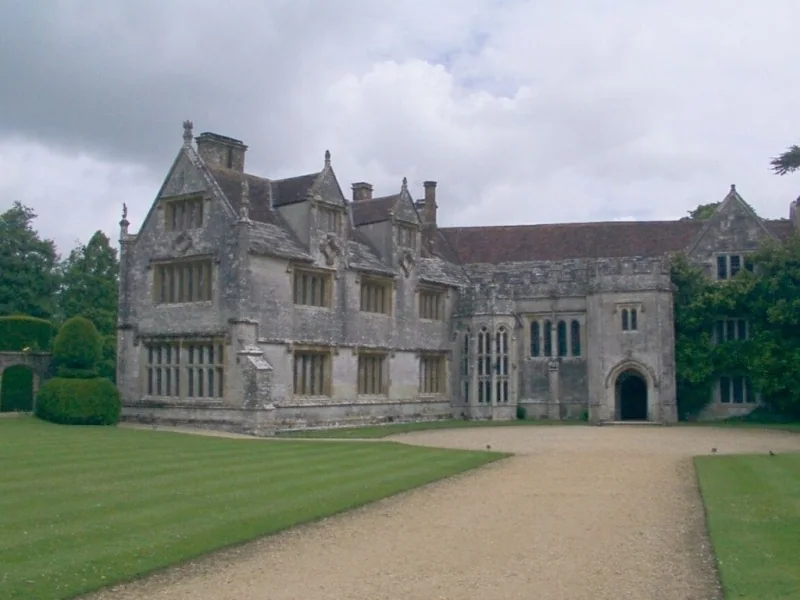
East of Dorchester, in Dorset, Athelhampton is one of the finest Tudor houses in south-west England. Built at the very dawn of the dynasty, it tells of the rise of a gentry family, the Martyns, and — through its walls — one of the great economic springs of the period: the redistribution of the Church's wealth.
The house of the Martyns
The great hall of Athelhampton was commissioned around 1485 — the year of Bosworth — by Sir William Martyn, a rich notable of Dorset. Its hammerbeam roof and its eight-panel oriel window, adorned with the arms of the Martyns and their alliances, embody the splendour of the Tudor gentry. These families, neither high nobility nor common folk, formed the backbone of local government — justices of the peace, sheriffs — and displayed their rank through stone and glass. Sir Nicholas Martyn was thus Sheriff of Dorset in 1581.
The fortune of the Dissolution
The enlargement of Athelhampton, with its west wing of the first half of the sixteenth century, was financed by a fortune characteristic of the age: that drawn from the Dissolution of the Monasteries, via Sir John Tregonwell — one of the commissioners who presided over the closure of the convents and enriched themselves in the process. Athelhampton thus illustrates, very concretely, how the Reformation transferred the Church's wealth to a rising class of servants of the Crown. The family also touched the dramas of the time: Chidiock Tichborne, a conspirator of the Babington Plot against Elizabeth I, executed in 1586, had married a Martyn. To see: the great hall with its hammerbeam roof, the Tudor west wing and its original glass, the eight-panel oriel window, the restored Elizabethan kitchen.
Did you know?
The father of the writer Thomas Hardy, a stonemason, worked at Athelhampton; the novelist himself, a child of Dorset, later painted a watercolour of the south front. The great Tudor house thus entered the world of one of the greatest English writers of the nineteenth century, who made this landscape the setting of his novels.
Notes
Athelhampton House lies at Athelhampton, about 8 km east of Dorchester, Dorset; house and gardens open to the public. Hours to check.
Quiz
- From when does the great hall of Athelhampton date?
- From c. 1485 (Sir William Martyn)
- From the twelfth century
- From the Victorian era
- How was the west wing financed?
- By the fortune drawn from the Dissolution of the Monasteries
- By a pirates' hoard
- By a Spanish dowry
- Which writer painted the south front?
- Thomas Hardy
- Charles Dickens
- William Shakespeare