
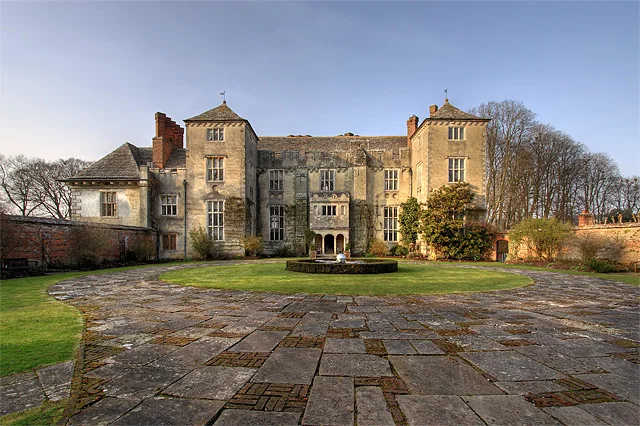
At the heart of Dorset, Cranborne Manor is a Jacobean house of quiet charm, born from the transformation of a medieval royal hunting lodge. It is the work of Robert Cecil, James I's most powerful minister — the man who, a few miles away, was at the same time building the colossal Hatfield House.
A hunting lodge turned minister's house
The core of Cranborne goes back to a hunting lodge built for King John in the early thirteenth century, on the edge of Cranborne Chase. In the early seventeenth century, Robert Cecil, 1st Earl of Salisbury, made it his country residence: he wrapped the old structure in elegant Jacobean additions — look at the two entrance loggias, the mullioned windows, the tall chimneys. Where Hatfield dazzles by its mass, Cranborne charms by its measure: it is the private house of a statesman, not his palace of state.
A Renaissance garden
Cecil entrusted the gardens to John Tradescant the Elder, one of the greatest gardener-botanists of the age, who brought back plants from his travels. Cranborne's walled gardens, several times remade, keep the spirit of that Renaissance taste for the ordered, learned garden. Don't miss: the Jacobean entrance loggias, the mullioned front, the walled gardens, the neighbouring church.
Did you know?
Cranborne's gardener, John Tradescant the Elder, was also an insatiable collector: his London cabinet of curiosities, "The Ark", was one of the first museums in England open to the public, and formed the core of today's Ashmolean Museum in Oxford. The garden of a Dorset manor is thus tied to the birth of English museums.
Info
Cranborne Manor is at Cranborne (Dorset); the private house of the Cecils (Marquesses of Salisbury), gardens open on certain days; house generally not open. Hours to be checked.