
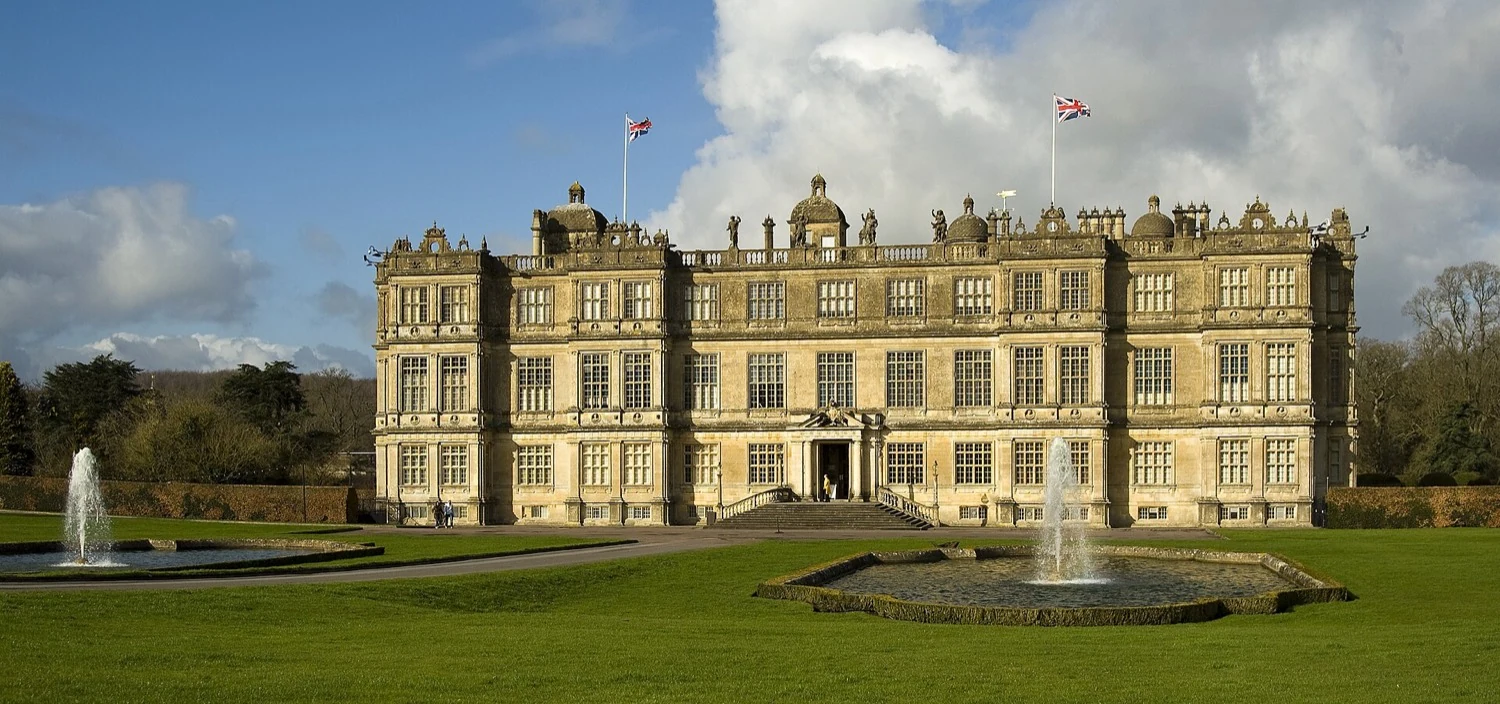
At the bottom of a wooded Wiltshire valley, Longleat unfurls its long regular façade, patterned with windows and crowned with statues. Built by Sir John Thynne in the mid-sixteenth century, it is reckoned the first truly Renaissance great house in England — a model that inspired all the prodigy houses of the reign.
From an abbey to a house
Like so many great estates of the age, Longleat was born of the Reformation: the site was that of a former priory, bought after the dissolution of the monasteries by Sir John Thynne, a shrewd and ambitious steward, enriched in the Crown's service. From the 1550s Thynne set out to build there a house of a new kind, turned no longer inward (around an enclosed court, in the medieval way) but outward, offering the eye a symmetrical, learned façade, ordered according to the classical principles come from Italy. It was a revolution: the English house ceased to be a fortress and became a work of architecture.
Born of fire, mother of the prodigy houses
The building was long and troubled. In 1567, when the house was all but finished, a fire ravaged it. Far from giving up, Thynne, obsessed with perfection, had it rebuilt finer still, more regular, surrounding himself with the finest craftsmen — among them the young Robert Smythson, who learned his trade here before becoming the greatest architect of the age and building Wollaton and Hardwick. Completed around 1580, Longleat ushered in the line of prodigy houses: those monumental, symmetrical residences that the great of the kingdom raised to assert their rank. The house is thus doubly foundational — by its style, and by the school of architects it formed.
What to see
- The symmetrical Renaissance façade, patterned with windows and statues.
- The Great Hall and the interiors of the Thynne family.
- The place's role in the formation of Robert Smythson.
- The landscaped park (later redesigned by Capability Brown).
Did you know?
Sir John Thynne was so obsessed with his house that after the fire of 1567 he rebuilt it not once but several times, endlessly reworking its façades until his death. It is said he made and unmade his plans according to his reading and his travels. From this maniacal exactingness was born the first masterpiece of the English Renaissance: Longleat owes its perfection to the stubbornness of a man who was never satisfied.
Practical information
Longleat House lies near Warminster, in Wiltshire, in the south-west of England. It is a private house, still linked to the Thynne family (Marquesses of Bath), open to the public with its park (today also famous for its safari park). Opening hours, prices and days are liable to change; it is best to check them against the official sources before visiting.
Quiz
- What is Longleat reckoned to be in the history of English architecture?
- The first great Renaissance house
- The oldest cathedral
- The largest castle
- What event struck Longleat in 1567?
- A fire, before its rebuilding
- A flood
- A siege
- Which great architect learned his trade at Longleat?
- Robert Smythson
- Inigo Jones
- Christopher Wren