
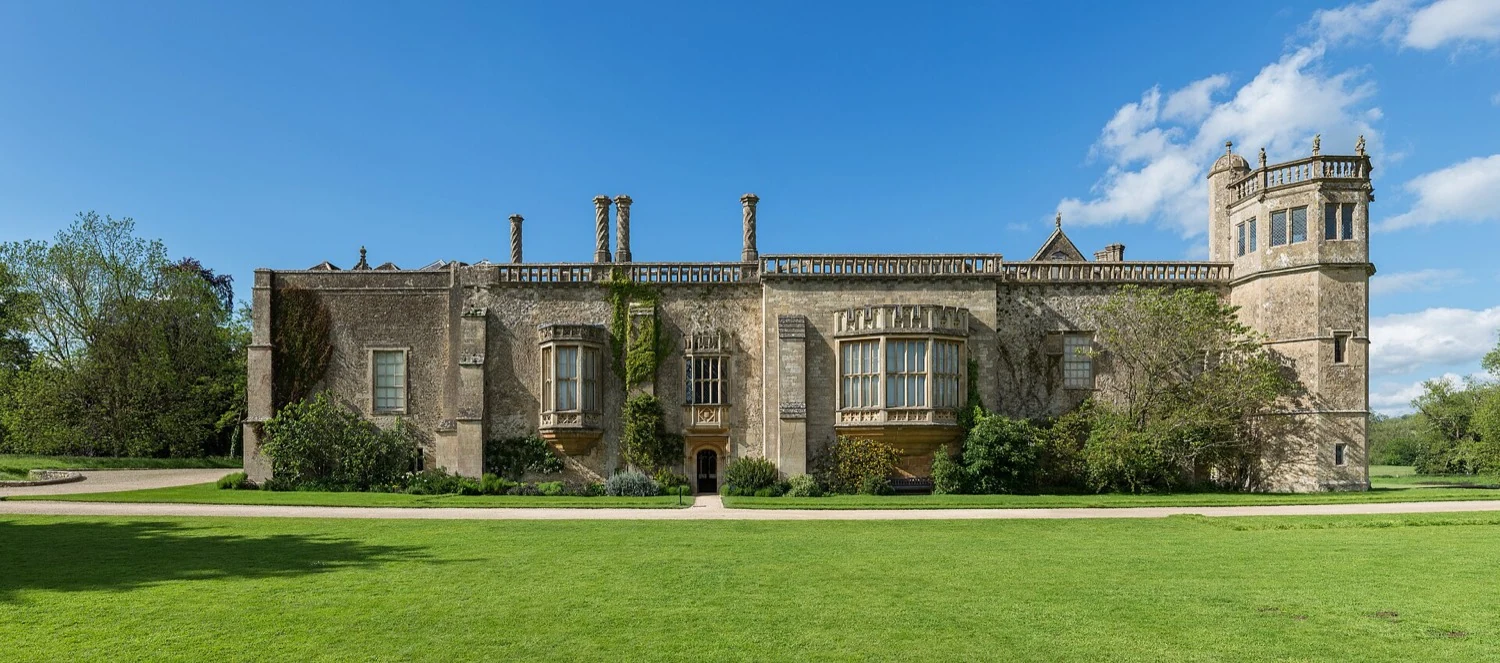
In the heart of the preserved village of Lacock, in Wiltshire, the abbey of the same name offers one of the most perfect examples of a convent transformed into a house after the Reformation. Its medieval cloisters, kept intact on the ground floor, support a Tudor house built on their vaults: the passage from one world to another can be read at a single glance.
From an abbey of nuns to a house
Founded in the thirteenth century, Lacock was an abbey of Augustinian canonesses, prosperous and peaceful. The dissolution of the monasteries ended it in 1539: the convent was sold to William Sharington, a courtier and official of the royal Mint (later compromised in an affair of counterfeiting). Rather than raze the buildings, Sharington did a then-new thing: he kept the cloister and the Gothic ground-floor rooms, and built above them a comfortable Tudor house, adding an elegant octagonal tower in the Renaissance style. Lacock thus becomes a manifesto of architectural recycling: the new house grows literally on the roots of the old faith.
An open-air book of architecture
To walk through Lacock is to read, one upon another, several ages: the medieval cloisters with their intact vaults, the chapter house, the sacristy, and then, upstairs, the Tudor rooms and their Renaissance chimneypieces adorned with antique motifs. Sharington's tower, with its carved octagonal stone table, is one of the first examples of Renaissance ornament in an English house. Much later, Lacock knew a second fame: it was here that, in the nineteenth century, William Henry Fox Talbot made one of the very first photographic negatives in history. But its heart remains this striking marriage of the Gothic cloister and the Tudor house.
What to see
- The intact medieval cloisters, on the ground floor of the house.
- Sharington's octagonal tower and its Renaissance decoration.
- The Tudor rooms built on the abbey's vaults.
- The preserved village of Lacock, around the abbey.
Did you know?
William Sharington, the man who transformed Lacock, nearly lost everything: treasurer of the Bristol Mint, he was convicted of having struck false coin to finance a plot, and condemned. He narrowly escaped execution, obtained his pardon and recovered Lacock — which he went on embellishing. The fine Renaissance house born of the cloister was thus, in part, paid for with fraudulent money: beneath the elegance of the stones, a counterfeiter's story.
Practical information
Lacock Abbey lies in the village of Lacock, in Wiltshire, in the south-west of England. It is today a site in the care of the National Trust (abbey, cloisters and the Fox Talbot Museum of Photography). Opening hours and days are liable to change; it is best to check them against the official sources before visiting.
Quiz
- What did William Sharington keep in transforming Lacock?
- The medieval cloisters, beneath the Tudor house
- The ramparts of a castle
- A Roman theatre
- What did the abbey become after the Dissolution?
- A Tudor house built on the cloister
- A cathedral
- A barracks
- Which later invention is linked to Lacock?
- The beginnings of photography (Fox Talbot)
- Printing
- The telegraph