
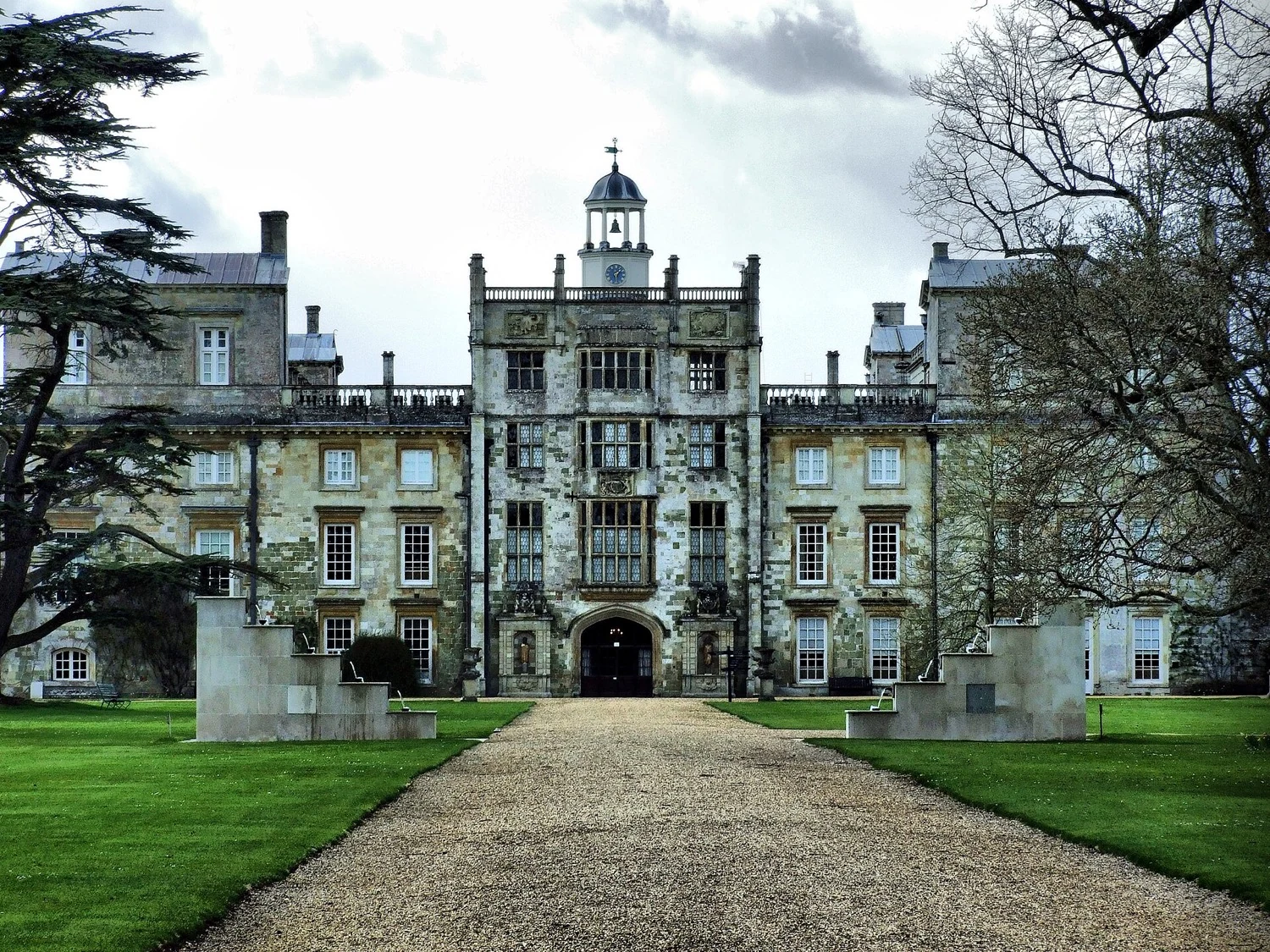
Not far from Salisbury, in Wiltshire, Wilton House was, in the Elizabethan age, far more than a fine house: it was one of the most brilliant literary homes in England, led by an exceptional woman, Mary Sidney, Countess of Pembroke. Born of a dissolved abbey, the house became a temple of letters.
From an abbey to a courtier's house
Wilton was originally an abbey of nuns, dissolved by Henry VIII and given to William Herbert, first Earl of Pembroke, one of the great beneficiaries of the Reformation. On the lands of the old convent the Herberts built a Tudor house, the seat of one of the most powerful families in the kingdom. But it was under the following generation that Wilton entered the history of the mind: Henry Herbert, second Earl of Pembroke, married Mary Sidney, sister of the poet Philip Sidney — and made his house a radiant centre of culture.
The Wilton Circle
Mary Sidney, Countess of Pembroke (1561-1621), was one of the most cultivated women of Elizabethan England: a poet, a translator, a patron of letters. She gathered at Wilton a circle of writers and scholars — the 'Wilton Circle' — among the most brilliant of the age. It was here that her brother Philip Sidney wrote part of his romance, the Arcadia, which he dedicated to his sister (the work is known as The Countess of Pembroke's Arcadia). After Philip's death, Mary edited and completed his work, and herself translated the Psalms and continental texts, helping to shape the English poetic language. Tradition — unverifiable but stubborn — even has it that Shakespeare's company played at Wilton before James I in 1603. Wilton was thus, more than a house, a veritable academy of English letters.
What to see
- The house of the Earls of Pembroke, born of the dissolved abbey.
- The memory of the Wilton Circle and Philip Sidney's Arcadia.
- The role of Mary Sidney, poet and patron of letters.
- The gardens and park (the famous façade and Palladian Bridge are later).
Did you know?
Philip Sidney titled his great romance The Countess of Pembroke's Arcadia in homage to his sister Mary, to whom he had dedicated it and for whom he had partly written it at Wilton. On Philip's untimely death, it was Mary who gathered, corrected and published the unfinished work. A rare example, for the age, of a woman keeper and editor of her brother's masterpiece: at Wilton, English literature was, too, a matter for a sister.
Practical information
Wilton House lies at Wilton, near Salisbury, in Wiltshire, in the south-west of England. It is a private house, still linked to the Herbert family (Earls of Pembroke), open to the public with its gardens at certain times. Opening hours and days are liable to change; it is best to check them against the official sources before visiting.
Quiz
- Which woman led the literary circle of Wilton?
- Mary Sidney, Countess of Pembroke
- Bess of Hardwick
- Elizabeth I
- Which romance did Philip Sidney partly write at Wilton?
- The Arcadia
- Utopia
- The Faerie Queene
- Where did the estate of Wilton come from?
- A dissolved abbey given to the Herberts
- A Norman castle
- A gift from the Queen of France