
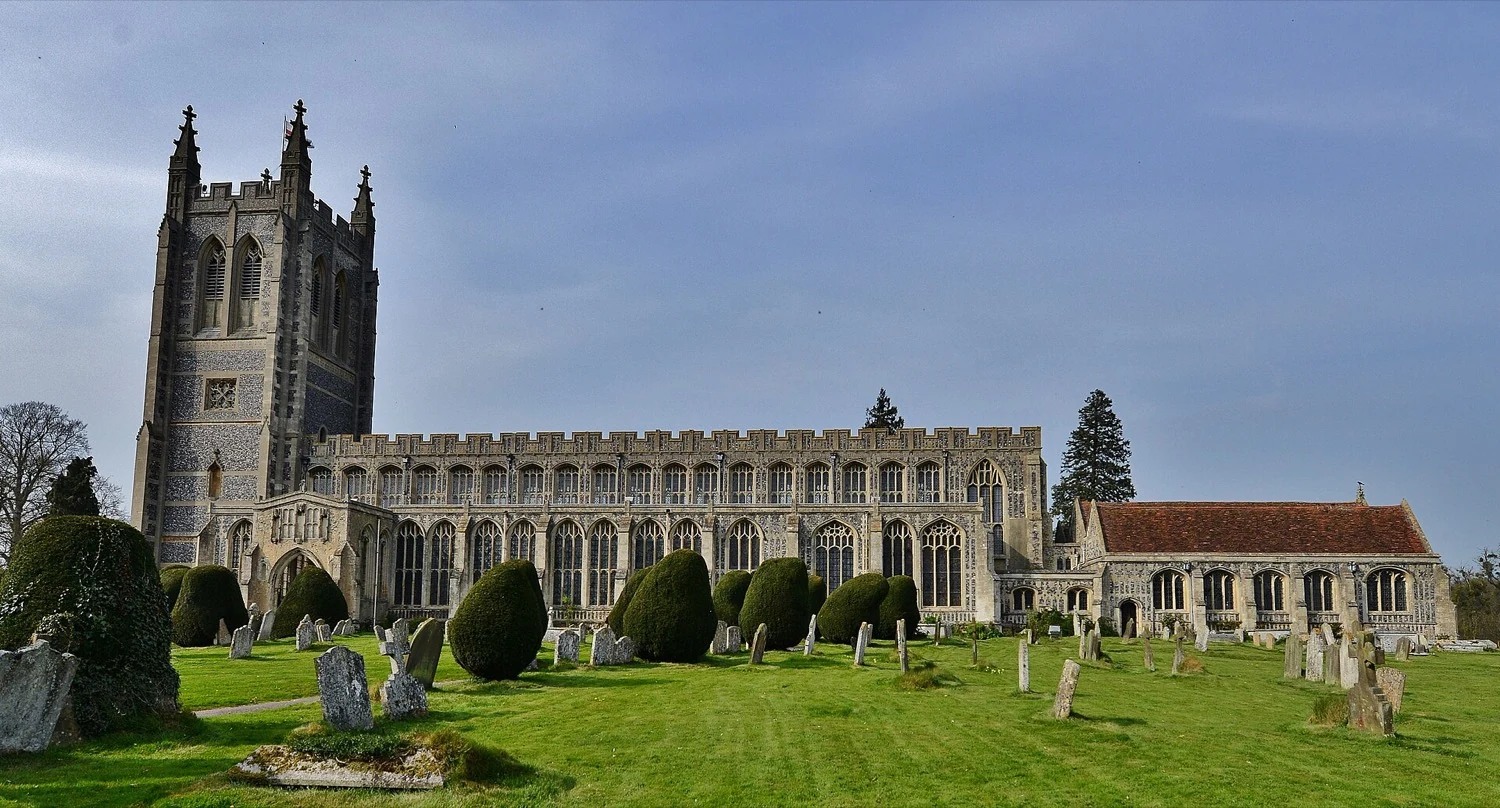
In Suffolk, around one of the longest village streets in England, Long Melford displays the splendours of clothier wealth: a monumental wool church and, beside it, two great Tudor brick manors. It is the portrait, in a single place, of the prosperity that made East Anglia one of the richest regions in the kingdom.
The wool church
The money of the cloth trade covered Suffolk with immense churches, out of all proportion to the size of the villages — the famous 'wool churches'. That of Long Melford, Holy Trinity, is one of the largest and finest: rebuilt at the end of the fifteenth century thanks to the gifts of the clothier merchants, notably the Clopton family, it astonishes by its length, its immense windows and its wrought ceiling. At the dawn of the Renaissance, these churches bear witness to a proud merchant piety: in funding God, the clothiers secured at once their salvation and their memory, having their names carved into stone and glass.
Two brick manors
The village boasts, besides, two fine Tudor houses. Melford Hall, a rose-brick manor built in the mid-sixteenth century on former lands of Bury St Edmunds Abbey, received Queen Elizabeth I in 1578 on one of her great journeys. Nearby, Kentwell Hall, another moated brick manor of the same age, extends this landscape of the prosperous gentry. Together, the church and the two halls make Long Melford a distillation of Renaissance East Anglia: the fortune of wool, the piety of the merchants and the rise of a rural nobility born, in part, of the dissolution of the monasteries.
What to see
- The church of Holy Trinity, one of the largest 'wool churches' in Suffolk.
- The medieval stained glass and the wrought ceiling of the church.
- Melford Hall, a rose-brick manor that received Elizabeth I (1578).
- Kentwell Hall, a moated brick manor of the same age.
Did you know?
The 'wool churches' of Suffolk are so vast that they seem out of scale for small villages: for the clothier merchants vied in generosity to build the finest, carving their marks and their prayers everywhere. At Long Melford, the windows keep the kneeling portraits of the donors — the Cloptons and their peers — praying for eternity in the church they had paid for. Earthly wealth becomes there, quite literally, a monument of faith.
Practical information
Long Melford lies in Suffolk, north-east of London. The church of Holy Trinity is a place of worship open to visitors; Melford Hall (National Trust) and Kentwell Hall (private) may be visited on varying hours and days, sometimes seasonal. It is best to check this against the official sources before visiting.
Quiz
- To what wealth does Long Melford owe its monuments?
- The trade in wool and cloth
- Gold mines
- The spice trade
- What are the great churches built by the clothier merchants called?
- 'Wool churches'
- Royal cathedrals
- Palatine chapels
- Which queen was received at Melford Hall in 1578?
- Elizabeth I
- Mary Queen of Scots
- Anne Boleyn