
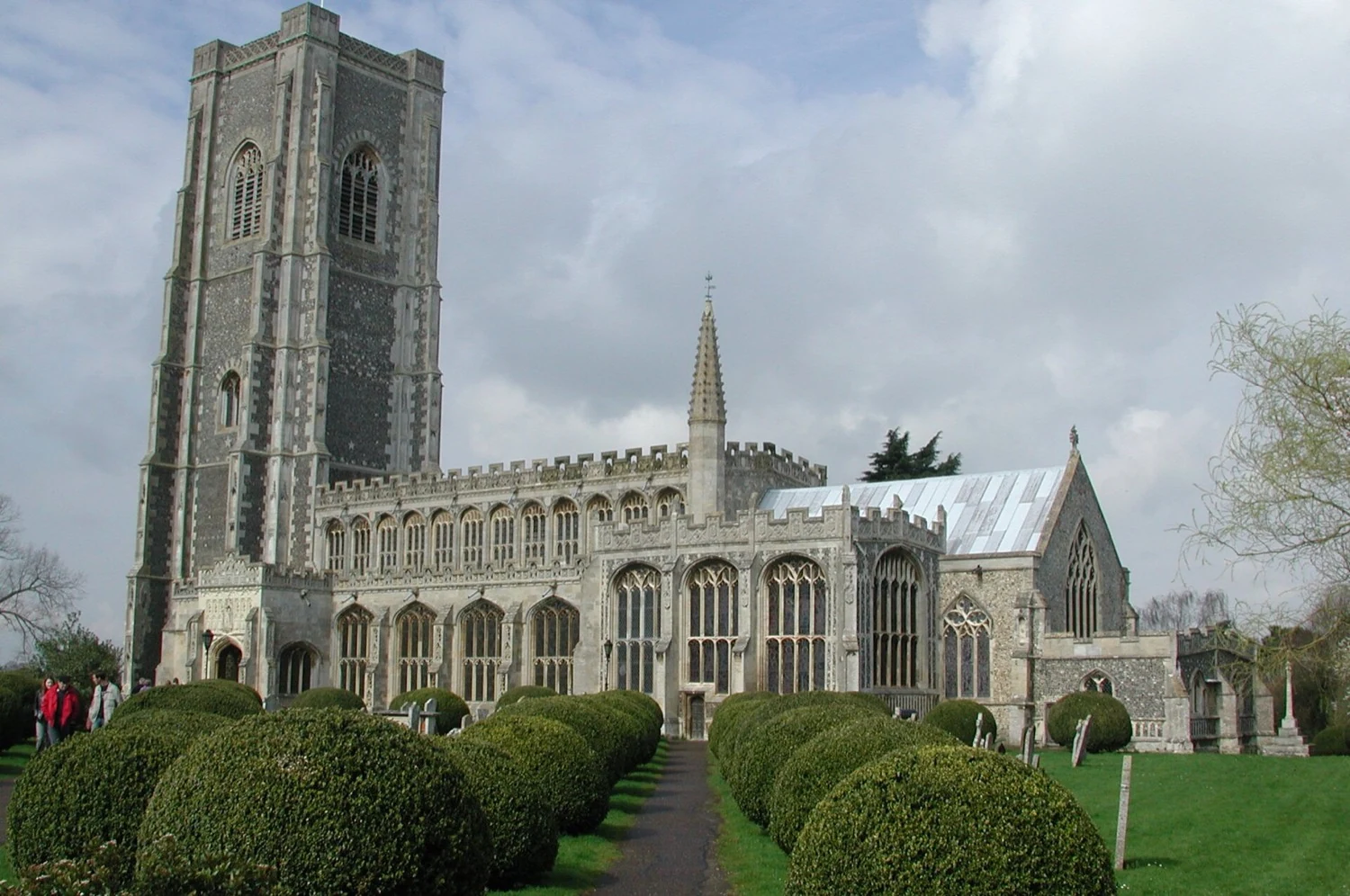
In the village of Lavenham, in Suffolk, stands one of the most sumptuous 'wool churches' in England. Rebuilt in the years immediately following Henry Tudor's victory at Bosworth, it celebrates, in its very stone, the alliance between the triumphant nobility and the fabulously rich merchants of the early Tudor age.
A church born of Bosworth and of wool
The church of Lavenham was rebuilt from about 1485 to 1525 — that is, from the very year of Bosworth. Its financing tells the new Tudor world: it was paid for by John de Vere, 13th Earl of Oxford, who had commanded the vanguard of Henry VII's army at Bosworth (1485), and by the immensely rich drapers Thomas Spring II and III. For Lavenham was then one of the richest towns in Britain, prospering on the cloth trade (the famous 'Lavenham Blue'). Its 42-metre tower, the tallest village church tower in the country, proclaims this prosperity — financed by wool, blessed by the victorious nobility.
A stone loaded with blazons
The church is a heraldic manifesto of the noble-merchant alliance. At the top of the tower shines the star of the de Veres, emblem of the victor of Bosworth. On the exterior, the arms and the merchant mark of Thomas Spring are repeated more than thirty times, carved in the stone like an obsessive signature of the drapery fortune. Inside, the chantry chapels of the Springs (around 1525) and the Branches (around 1500), with their finely carved wooden parclose screens, recall the desire of these families to perpetuate their memory. Lavenham is thus the church where the English Renaissance can be read in the stone: dynastic victory and the money of trade. To see: the 42-metre tower (de Vere star), the arms and mark of Thomas Spring (30+ times), the Spring and Branch chantry chapels and their screens.
Did you know?
The rich draper Thomas Spring had his merchant mark carved more than thirty times on the walls of Lavenham church — a way of inscribing his name and his fortune for ever in sacred stone. In the Renaissance, to finance a church was for a merchant the height of prestige: one bought there one's salvation, but also one's earthly glory. At Lavenham, the pride of the draper rivals, carved in the flint, the star of the earl who won Bosworth.
Notes
St Peter and St Paul lies at Lavenham, Suffolk; a working parish church (Grade I), open to visits. Hours to check.
Quiz
- Who partly financed the church of Lavenham?
- John de Vere (victor of Bosworth) and the Spring drapers
- The pope
- The king of France
- What is remarkable about its tower?
- It reaches 42 m (tallest village church tower)
- It is of wood
- It leans
- What does the star atop the tower celebrate?
- The de Veres, victors of Bosworth (1485)
- The birth of Elizabeth
- The defeat of the Armada