
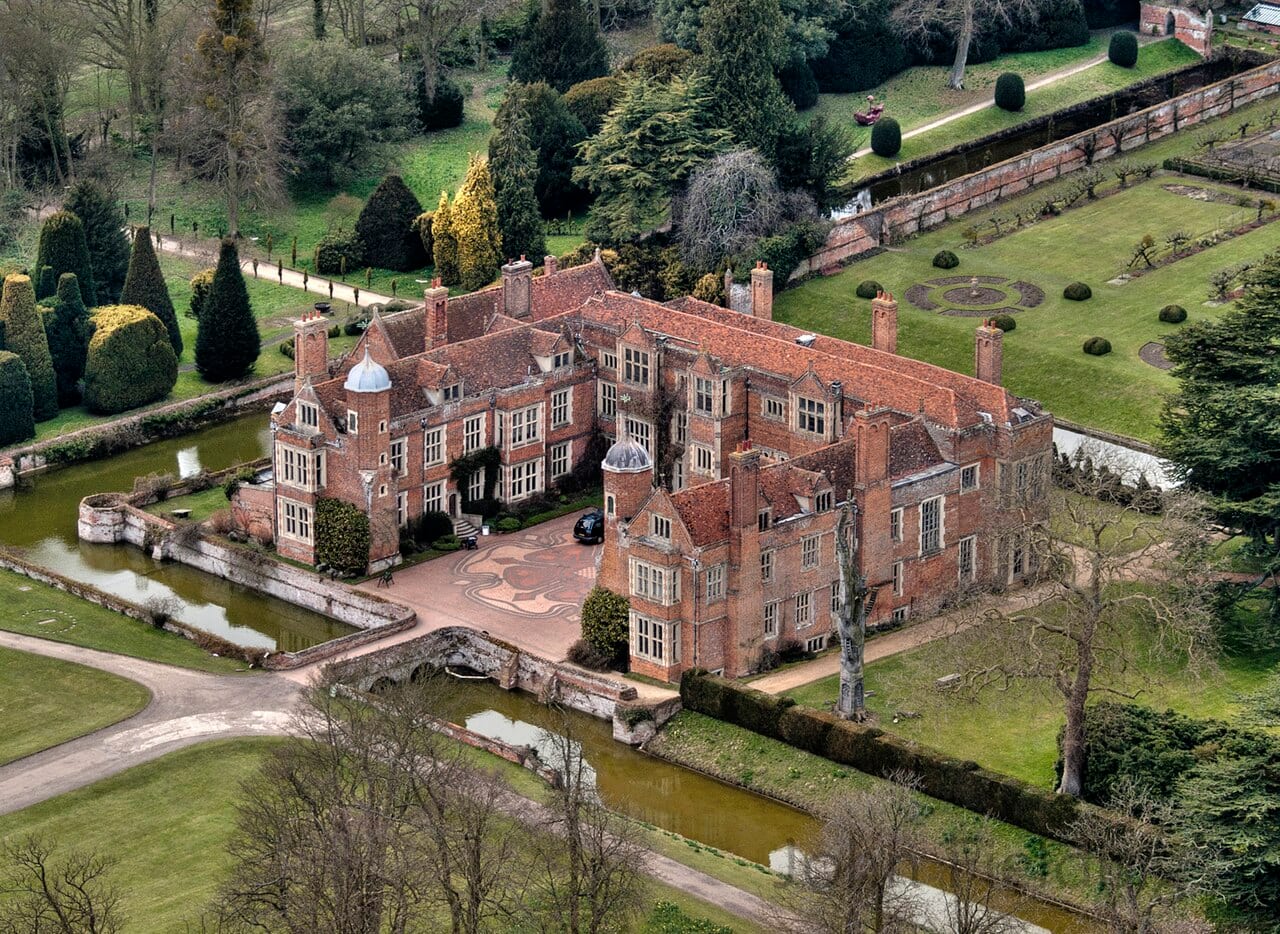
At the end of a long lime avenue planted in the eighteenth century, in the green Suffolk countryside near Long Melford, Kentwell Hall appears all at once: a rose-pink brick front shaped like an E, two wings reaching toward the water, and before them a broad moat crossed by a low bridge. The image is one of perfect Tudor harmony, and Kentwell ranks, with good reason, among the finest moated manor houses in England.
The house is the work of the Cloptons, a family whose fortune tells in itself a chapter of late-medieval and Renaissance English economy: wool. John Clopton grew so rich in that trade that he was able to fund the rebuilding of the neighbouring church at Long Melford, one of the most sumptuous "wool churches" in the realm. Wealthy and well-established, the Cloptons built Kentwell in stages between about 1500 and 1578; the house developed over several generations, reaching under Elizabeth I the outline we know today, so that its fabric reads as the slow accretion of a family's rising fortunes rather than a single act of building. The E-plan, the warm brick, and the most extensive moat in the county form a quiet manifesto of sixteenth-century provincial prosperity — not the splendour of a court, but the calm assurance of a great family of country gentry.
Inside, Kentwell offers a genuine journey through time. The great Tudor kitchen, with its vast hearths, speaks of the domestic life of a sixteenth-century household; the Gothic centre block and the apartments record successive reworkings, down to later schemes such as the state bedroom redesigned in the nineteenth century by the architect Thomas Hopper. In the courtyard a maze in the shape of a Tudor rose has been recreated, a nod to the dynasty's emblem and to the garden pleasures the age so loved. The moat, stocked with carp, still girdles the house as in the Cloptons' day — protection as much as ornament.
Yet Kentwell's distinctiveness also lies in its second life. The estate played a pioneering role in what the English call living history: since the late twentieth century, large-scale "re-creations" have revived there, with celebrated thoroughness, the daily life of a Tudor household — costumes, crafts, gestures, period speech. For the visitor the experience goes beyond the mere contemplation of old stones: it restores the human bustle that once filled these walls, the smells of the kitchen, the work of fields and workshops, the domestic hierarchy of a sixteenth-century manor. Few places convey so physically what everyday life was actually like in the English Renaissance, far from the royal courts and close to the land.
Kentwell cannot be separated from its village. Long Melford, close by, owes its splendour to the same wool wealth: its immense church of the Holy Trinity, among the most sumptuous "wool churches" in England, was largely funded by John Clopton, whose arms and memory still remain there. Manor and church thus form the two faces of a single merchant fortune — the one for seigneurial life, the other for the salvation of the soul: an eloquent witness to the way in which, at the close of the Middle Ages and the dawn of the Renaissance, trade was transforming the English countryside, raising families of merchants to the rank of builders and patrons.
Kentwell thus embodies an essential facet of our atlas: here the Renaissance is not a matter of princes or famous painters, but of enriched merchants turned lords, of brick and wool, still water and heraldic rose. It is the portrait of a rural, prosperous England that built its endurance through measure and elegance rather than display. Whoever walks toward its moat, between the limes, approaches less a monument than a living organism, patiently shaped by three-quarters of a century of family ambition.